

As ferramentas de IA para revisão de documentos jurídicos utilizam inteligência artificial para analisar contratos, assinalar riscos e destacar lacunas de conformidade em grandes volumes de documentos jurídicos. Se precisa de acompanhar volumes crescentes de contratos, identificar cláusulas de risco antes que passem despercebidas ou adaptar regras do manual de procedimentos em tempo real, estas ferramentas foram concebidas para a sua realidade.
Neste guia, verá quais são as opções que ajudam as equipas jurídicas a acelerar a revisão, manter a consistência em grande escala e integrar a análise de documentos nas suas operações mais abrangentes—para que possa tomar decisões inteligentes e confiantes sobre qual o sistema que realmente se adequa à sua prática.
Why Trust Our Software Recommendations
6,700+
Reviews
20
Industry experts
16+
Evaluation factors
14
Years
Our team has been testing and reviewing software since 2012. As legal practice leaders ourselves, we know how difficult—and important—it is to choose the right software.
For this guide, we evaluated tools using hands-on testing and independent research, scoring tools using our selection criteria.
Our reviews reflect our human editorial judgment, not a sales pitch.
Tabela de comparação das ferramentas de IA para revisão de documentos jurídicos
Esta tabela de comparação resume os detalhes de preços das minhas principais escolhas de ferramentas de IA para documentos jurídicos:
| Tool | Best For | Trial Info | Price | ||
|---|---|---|---|---|---|
| 1 | Best for playbook-driven contract risk flagging | Free demo available | Pricing upon request | Website | |
| 2 | Best for contract portfolio risk flagging | Free plan available | Pricing upon request | Website | |
| 3 | Best for in-house contract review playbooks | Free demo available | Pricing upon request | Website | |
| 4 | Best for in-house contract review and analytics | Free demo available | Pricing upon request | Website | |
| 5 | Best for enterprise contract AI within Workday | Free demo available | Pricing upon request | Website | |
| 6 | Best for enterprise contract portfolio review | Free demo available | Pricing upon request | Website | |
| 7 | Best for portfolio-wide playbook deviation checks | Free demo available | Pricing upon request | Website | |
| 8 | Best for enterprise contract portfolio review at scale | Free demo available | Pricing upon request | Website | |
| 9 | Best for bulk review across thousands of documents | Free demo available | Pricing upon request | Website | |
| 10 | Best for M&A due diligence at scale | Free demo available | Pricing upon request | Website |


Avaliações das ferramentas de IA para revisão de documentos jurídicos
Seguem-se os meus resumos detalhados das melhores ferramentas de IA para revisão de documentos jurídicos que entraram na minha lista. As minhas avaliações apresentam uma análise detalhada das funcionalidades, dos melhores casos de utilização e das capacidades de cada plataforma, para o ajudar a encontrar a melhor opção para si.
 1Best for playbook-driven contract risk flagging
Juro
- Free demo available
- Pricing upon request
Visit WebsiteCustomer Rating:4.8/5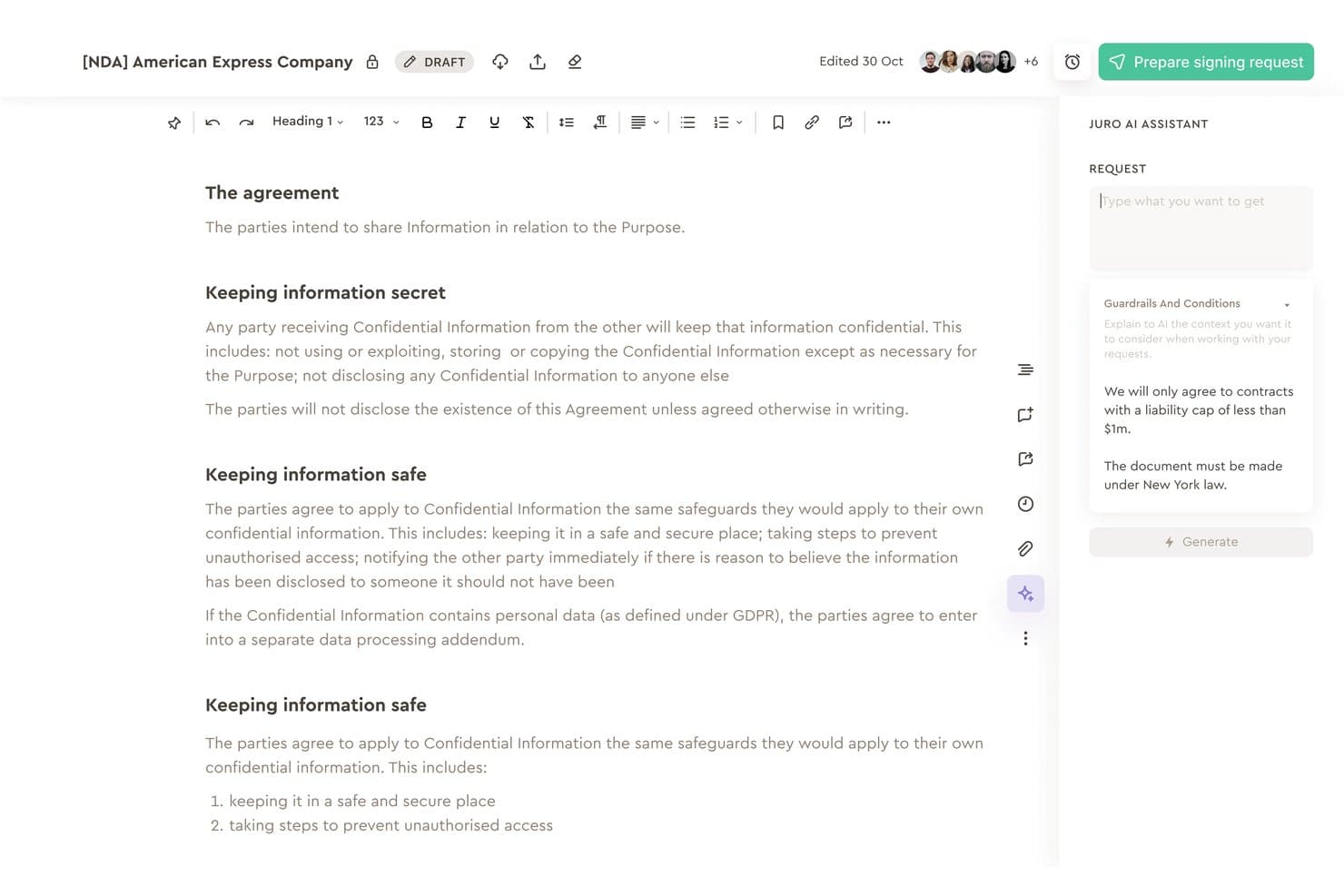
Juro's AI Assistant applies guardrails to flag contract clause issues. Juro is an AI-native contract lifecycle management platform that covers contract drafting, AI-powered clause extraction, playbook-driven review and redlining, negotiation, and a searchable post-signature repository.
Who Is Juro Best For?
Juro is a natural fit for in-house legal and commercial teams that need to review, negotiate, and manage contracts against a defined legal playbook.
Why I Picked Juro
Juro earns its spot on my shortlist because its playbook-driven AI review goes beyond generic risk scoring: every flagged clause includes a cited rationale tied directly to your defined legal positions, which is how a 95% suggestion acceptance rate actually makes sense in practice. I particularly like that AI Review can redline incoming third-party contracts against your playbook from within Microsoft Word, so your team isn't forced into a new tool mid-negotiation. Pair that with Operator's natural-language Q&A across your full contract set, and you get traceable, explainable answers rather than black-box outputs.
Juro Key Features
- AI Extract smartfields: Pull structured data points from contracts—dates, liability clauses, auto-renewal terms, and custom fields—into configurable smartfields with accept/reject controls per field.
- Bulk contract import and extraction: Upload batches of legacy or vendor contracts via Google Drive or SharePoint folder sync and run AI extraction across the entire set at once.
- Operator natural-language Q&A: Query your full contract repository using plain-language questions and get answers with cited source contracts rather than unattributed summaries.
- Clause library: Store and apply standardized clause language across templates so your legal team maintains consistent contract language at scale.
Juro Integrations
Juro offers native integrations with Microsoft Word, Google Drive, SharePoint, Slack, Docusign, Salesforce, HubSpot, and Pipedrive. Enterprise plans include REST API and webhooks, and Juro also supports Zapier.
Pros and Cons
Pros:
- Natural-language Q&A across contract repository
- Customizable extraction fields for contract data
- Playbook-driven AI review with rationale citation
Cons:
- Not suitable for litigation or e-discovery
- AI review supports only English contracts
Learn more about Juro: Best for contract portfolio risk flagging
- Free plan available
- Pricing upon request
Visit WebsiteCustomer Rating:4.7/5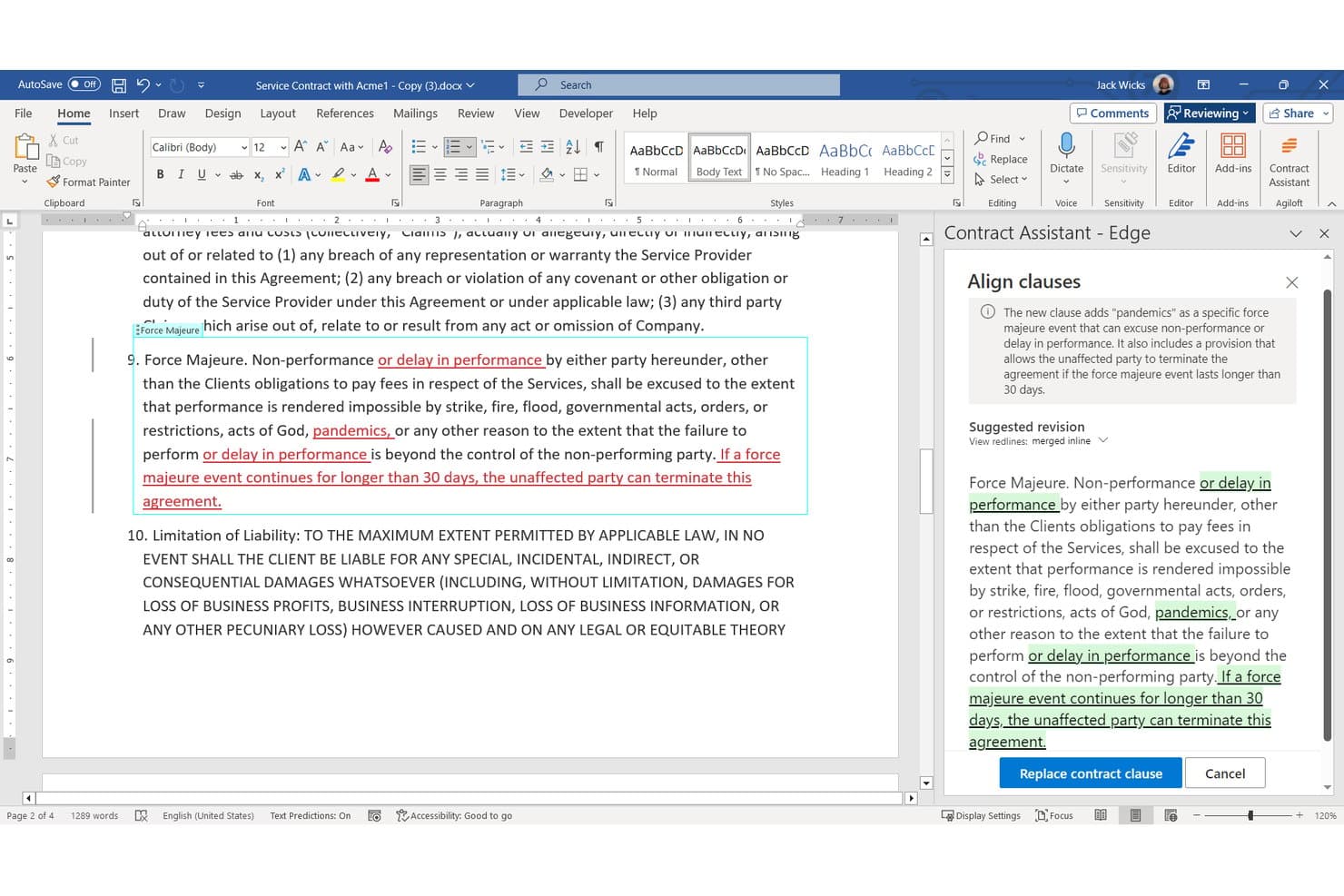
Agiloft Astra applies AI to extract clauses, flag contract risks, and analyze portfolios. Agiloft Astra is a contract intelligence platform that uses AI to extract clauses and structured data, flag risk and non-standard language against custom playbooks, and analyze contracts at the portfolio level.
Who Is Agiloft Best For?
Agiloft is a strong fit for corporate legal counsel and contract managers who need to govern large contract portfolios with configurable risk playbooks and structured data extraction.
Why I Picked Agiloft
I picked Agiloft as one of the best because its playbook-based risk flagging works at the portfolio level, not just contract-by-contract. I love that you can scan an entire contract portfolio against a new regulation, like the EU AI Act, and surface non-compliant clauses across thousands of agreements at once. The Astra Assistant lets you ask plain-language questions across your full portfolio, with every AI-generated answer linked back to the source contract text.
Agiloft Key Features
- Microsoft Word add-in: Review, analyze, and redline contracts directly inside Word using Astra's AI, with no credit consumption for this activity.
- No-code workflow configuration: Build custom approval chains, automated notifications, and lifecycle workflows without writing any code.
- Astra Assistant for portfolio Q&A: Ask plain-language questions across your entire contract portfolio, with every AI-generated answer linked to the source contract text.
- AI-assisted contract intake: Automatically extract structured data from an uploaded contract to generate a new CLM record, reducing manual data entry.
Agiloft Integrations
Agiloft offers 1,000+ pre-built connectors through Integration Hub, including Salesforce, SAP, NetSuite, DocuSign, Adobe Sign, SharePoint, Microsoft Teams, Slack, and Google Workspace. Its API supports custom integrations.
Pros and Cons
Pros:
- No-code workflows and approval chains included
- Citation-linked AI answers support review verification
- Portfolio-wide contract risk flagging with playbooks
Cons:
- No support for e-discovery or litigation review
- Backend setup requires significant technical expertise
Learn more about Agiloft: Best for in-house contract review playbooks
- Free demo available
- Pricing upon request
Visit WebsiteCustomer Rating:4.7/5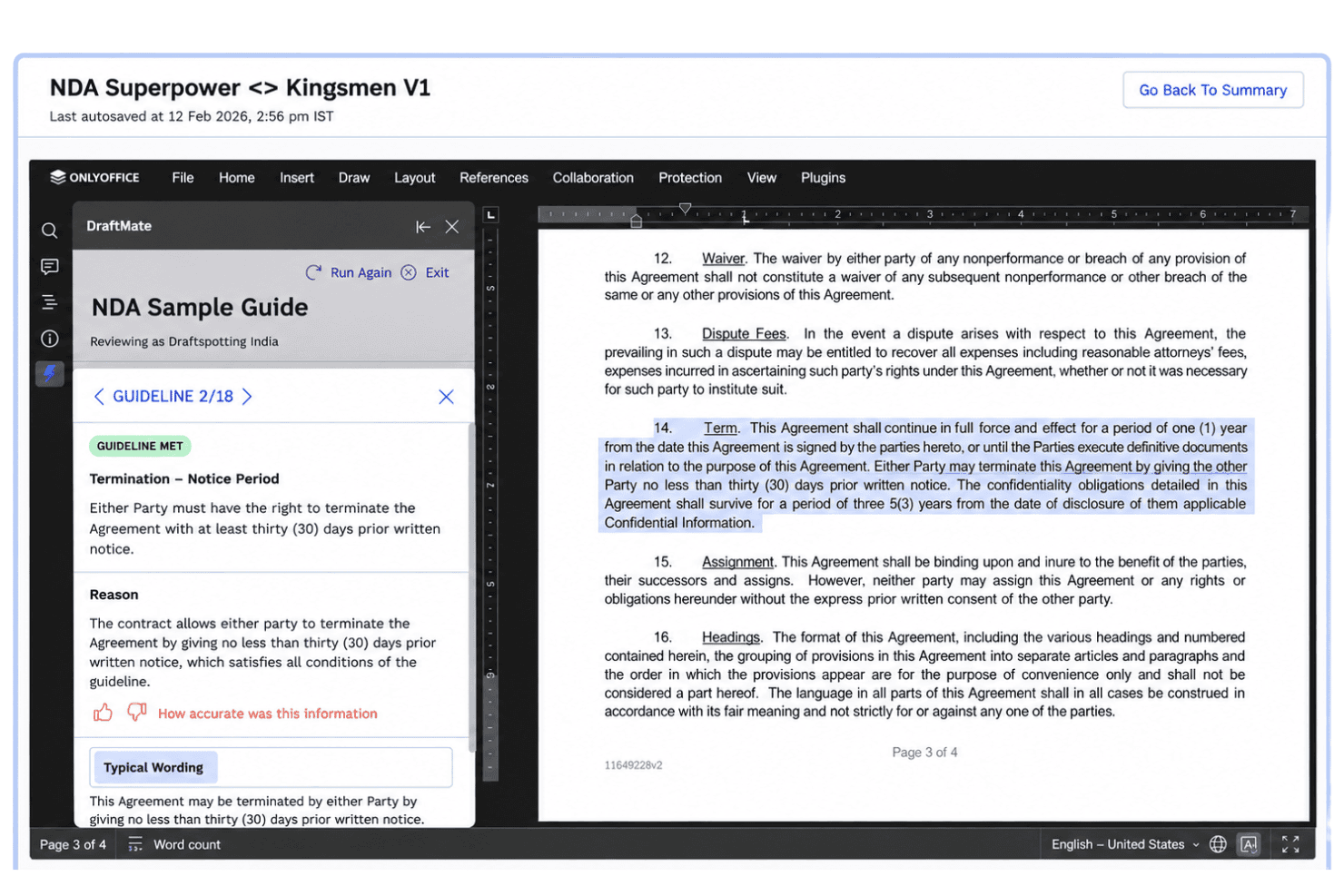
SpotDraft manages contract creation, review, signing, storage, and AI-powered search. SpotDraft is an AI-native contract lifecycle management platform that covers contract creation, editing, review, signing, and repository management, with AI-powered clause extraction, custom review playbooks, and a natural-language query layer across your entire contract portfolio.
Who Is SpotDraft Best For?
SpotDraft is a strong fit for in-house legal teams that need a structured, playbook-driven approach to contract review and lifecycle management.
Why I Picked SpotDraft
SpotDraft earns its spot on my shortlist because of how well VerifAI handles playbook-driven contract review inside Microsoft Word. I love that you can build a custom playbook in plain English or auto-generate one from an existing template, then run a one-click review that flags non-compliance with source references and rationale attached to every result. The pre-vetted playbook library for Buy-Side MSAs, Sell-Side MSAs, and procurement contracts gives in-house teams a solid starting point without building from scratch.
SpotDraft Key Features
- Portfolio-wide natural-language Q&A: Sidebar lets you query your entire contract portfolio in plain English, pulling deal briefings, clause comparisons, and trend data across all stored contracts.
- Contract analytics dashboards: Track 30+ metrics—including approval turnaround, negotiation rounds, and stage-level review time—filterable by contract type, user, date, and workflow.
- Automated metadata extraction: SpotDraft extracts 1,000+ data fields per contract on upload, covering parties, dates, renewal terms, revenue figures, and counterparty details.
- Audit logs and version history: Every user action is logged per contract, with full version history and granular role-based permissions by contract type, entity, or department.
SpotDraft Integrations
SpotDraft offers 30+ native integrations, including Microsoft Word, SharePoint, OneDrive, Google Drive, Box, Dropbox, DocuSign, Adobe Sign, Salesforce, and Microsoft Teams. It also supports Zapier.
Pros and Cons
Pros:
- Portfolio-wide natural-language contract Q&A available
- Clause extraction with source references and explanations
- Review custom playbooks directly inside Word
Cons:
- Self-serve bulk processing not available
- No e-discovery or litigation document workflows
Learn more about SpotDraft: Best for in-house contract review and analytics
- Free demo available
- Pricing upon request
Visit WebsiteCustomer Rating:4.7/5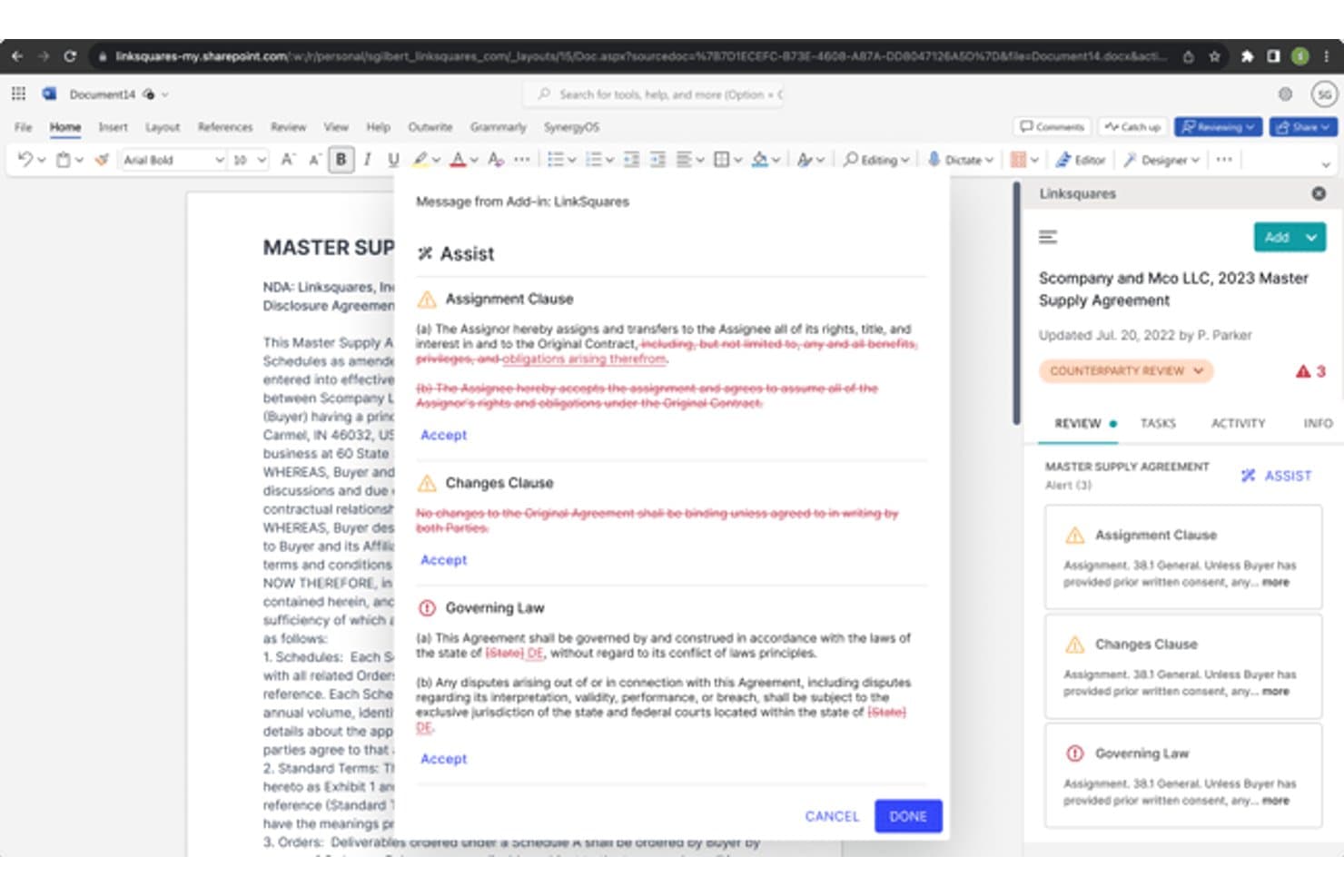
LinkSquares flags assignment and governing law clauses for review. LinkSquares is an AI-native contract lifecycle management platform built for in-house legal teams, combining AI-powered clause extraction, contract redlining, playbook-based risk flagging, and a searchable repository with analytics.
Who Is LinkSquares Best For?
LinkSquares is built for in-house legal teams and corporate counsel who manage high contract volumes and need structured data extraction, playbook-based review, and portfolio-wide analytics in one place.
Why I Picked LinkSquares
LinkSquares earns its spot on my shortlist because its AI engine, LinkAI, is purpose-built for in-house contract intelligence, extracting 120+ data points per contract across bulk uploads of thousands of agreements at once. I especially like the playbook-based flagging, which instantly surfaces deviations from your preferred clause positions so only true exceptions reach legal review. Paired with a contract repository that searches by context and intent, it gives in-house counsel a genuinely structured view of their entire contract portfolio.
LinkSquares Key Features
- AI legal assistant: Draft contracts, generate negotiation summaries, and get citation-backed answers from statutes, regulations, and case law directly within the platform.
- Microsoft Word add-in: Review, redline, and summarize contracts inside Word using LinkSquares' AI without switching between tools.
- Configurable approval routing: Set up approval workflows by contract value or type, with parallel review paths and rejection comments built in.
- Obligation and renewal tracking: Automated alerts notify your team of key dates, renewal windows, and outstanding obligations across your entire contract portfolio.
LinkSquares Integrations
LinkSquares offers native integrations with Microsoft Word, Salesforce, Slack, SharePoint, OneDrive, Google Drive, Box, Dropbox, DocuSign, and Adobe Sign. It also supports NetSuite, Ramp Procurement, Amazon S3, ShareFile, LinkSquares API custom integrations, and other eSignature connections via API.
Pros and Cons
Pros:
- Human-in-the-loop review with audit trails
- Playbook-based AI flags non-standard clauses
- Bulk extract 120+ data points per contract
Cons:
- AI extraction accuracy inconsistencies reported by users
- No support for litigation document review
Learn more about LinkSquares: Best for enterprise contract AI within Workday
- Free demo available
- Pricing upon request
Visit WebsiteCustomer Rating:4.7/5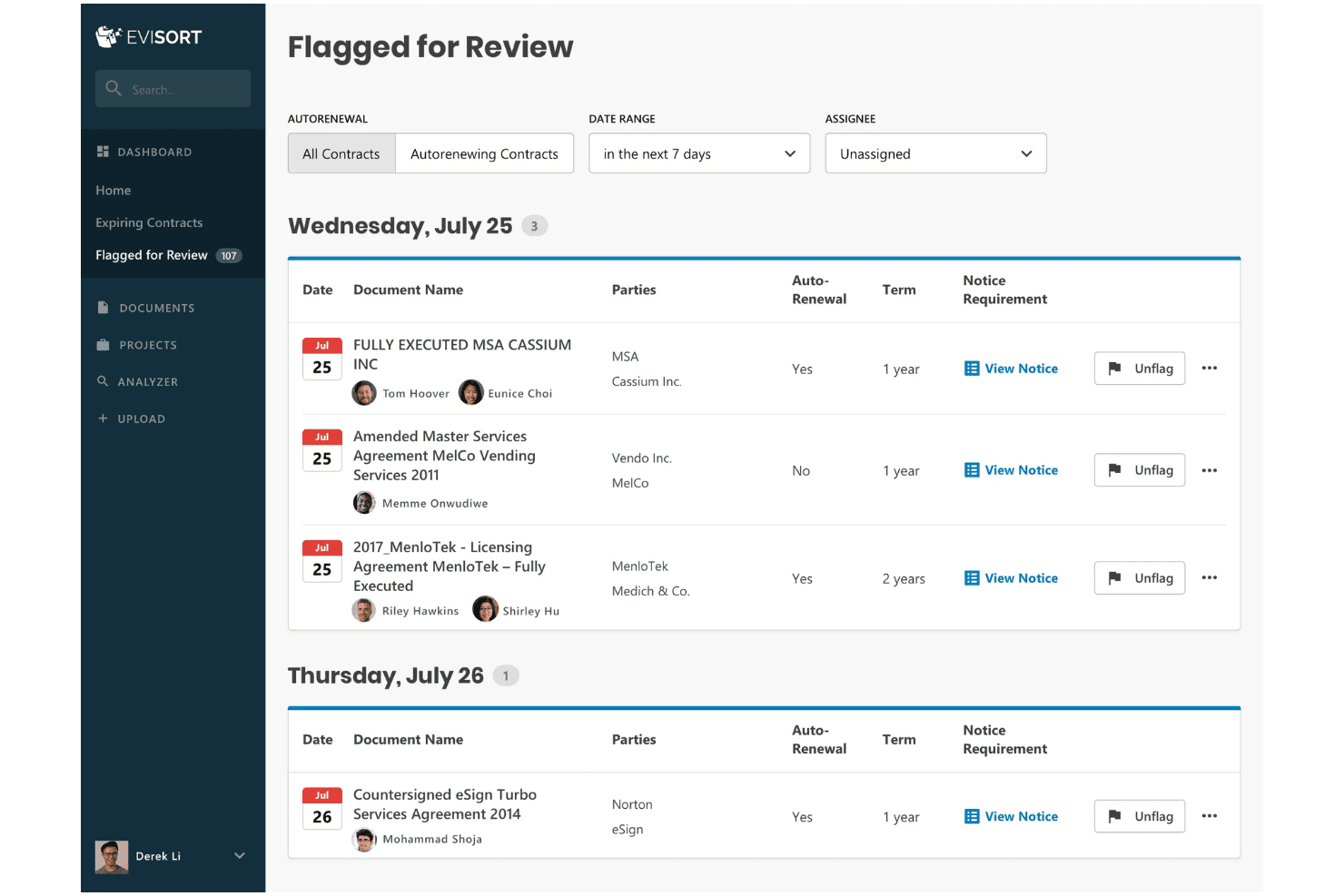
Evisort reviews contracts with AI, supports redlining, Q&A, repository search, and obligation tracking. Workday Contract Intelligence, powered by Evisort AI, is a contract-focused AI document review platform that combines an intelligent contract repository, custom AI model building, natural-language Q&A, agentic clause-level redlining, and obligation tracking across the full contract lifecycle.
Who Is Evisort Best For?
Evisort is built for enterprise in-house legal teams and contract managers who run high-volume contract operations inside the Workday ecosystem.
Why I Picked Evisort
Evisort earns its spot on my shortlist because it's the only contract AI tool built directly into the Workday ecosystem, which matters when your contracts, financials, and procurement data all live in one place. I particularly like the Contract Negotiation Agent, which does clause-level redlining against your own playbook automatically, flagging non-standard language without manual comparison. The custom AI model builder also lets your team train extraction on your specific contract types without involving a data science team.
Evisort Key Features
- Natural-language contract Q&A: Ask AI lets you query contracts in plain language and returns cited answers linked directly to the relevant contract provisions.
- Obligation and deadline tracking: Monitor renewal dates, expirations, and contractual obligations across your entire repository to avoid missed deadlines.
- Bulk document ingestion: Upload and process large contract libraries at scale, with vendor-reported throughput of 450,000 documents in 24 hours.
- Searchable metadata repository: Extracted contract data is auto-organized into a structured, searchable repository with dashboards and analytics built from that metadata.
Evisort Integrations
Evisort offers six native integrations: DocuSign, Adobe Sign, SharePoint, Box, Google Drive, and Salesforce. It supports custom connections through a REST API and offers the Contract Negotiation Agent through the Workday Marketplace.
Pros and Cons
Pros:
- Ask AI cites contract provisions directly
- Clause-level redlining using your playbooks
- Bulk processes over 400,000 contracts per day
Cons:
- Renewal alerts sometimes fail to trigger
- No e-discovery or litigation integrations
Learn more about Evisort: Best for enterprise contract portfolio review
- Free demo available
- Pricing upon request
Visit WebsiteCustomer Rating:4.3/5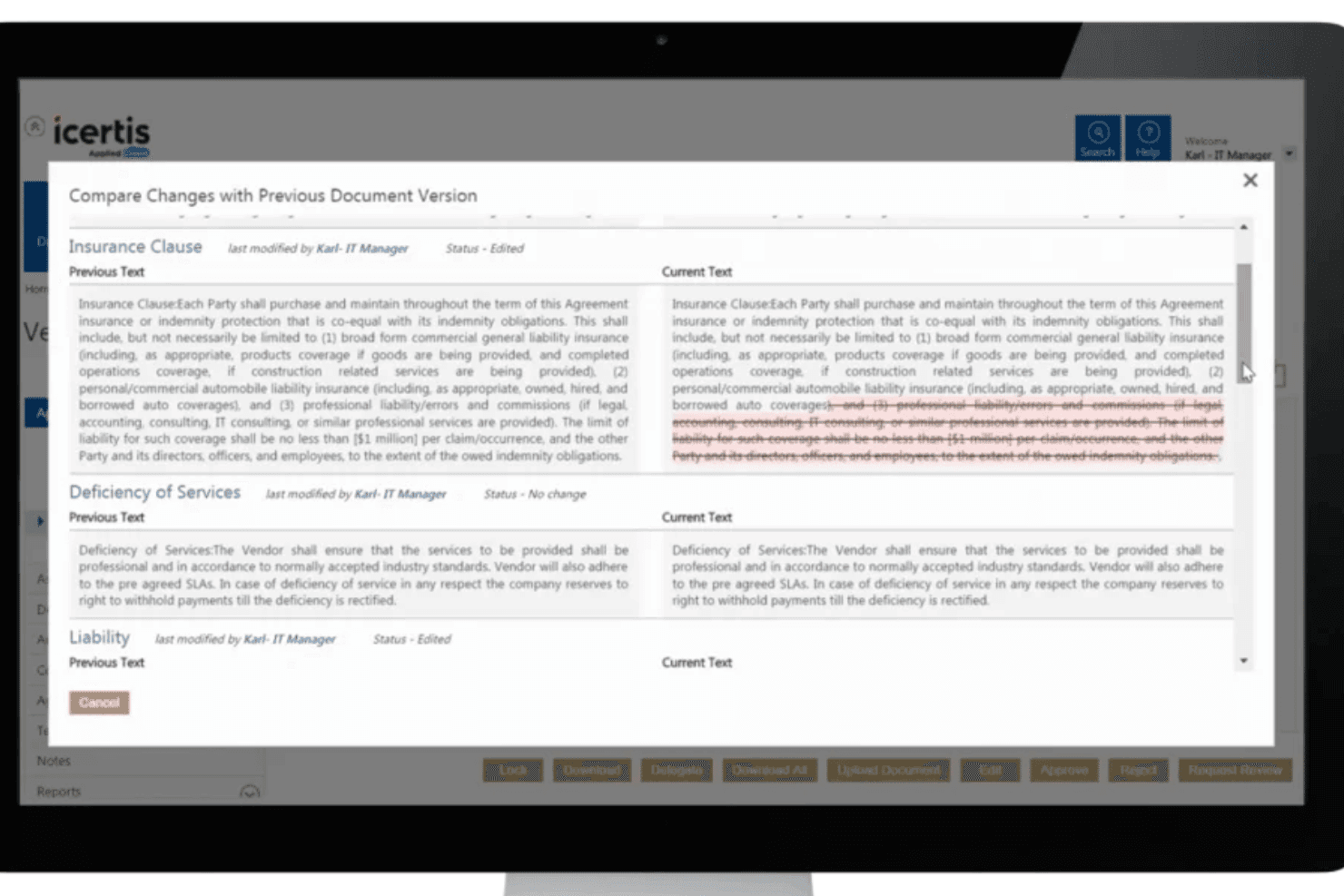
Icertis applies AI to extract clauses, flag risks, support redlining, and search contract portfolios. Icertis is an AI-native contract lifecycle management platform that combines clause extraction, playbook-driven redlining, risk flagging, and natural-language portfolio search across large volumes of enterprise contracts.
Who Is Icertis Best For?
Icertis is built for in-house legal and contract management teams at large enterprises managing high volumes of contracts across multiple business units.
Why I Picked Icertis
I've included Icertis in my top picks because it handles enterprise contract portfolio review at a scale few tools can match. Vera Analytics Advanced ingests thousands of agreements in bulk, with OCR and multilingual support, pre-computing clause-level analysis so you can query across 250,000+ contracts in seconds. Vera Copilot then lets you ask plain-language questions across that entire corpus and get citation-backed answers tied directly to specific contract records.
Icertis Key Features
- Playbook-driven redlining: Vera Redline Agent compares contract language against approved playbooks and generates clause-level redlines with plain-language explanations of each deviation.
- Obligation tracking: Vera Obligations assigns owners to contract obligations, sends reminders, and tracks completion with supporting proof through Vera Fulfilment Agent.
- Legacy contract ingestion: The Operate module pulls unstructured contracts from shared drives, email, and legacy systems and converts them into structured, searchable records.
- Role-based access control: Permissions limit what each stakeholder can view or edit, with all AI-assisted actions logged and tied to originating contract records for audit purposes.
Icertis Integrations
Icertis offers documented integrations across Microsoft 365, Microsoft Teams, Outlook, Salesforce CRM and CPQ, SAP Ariba, DocuSign, and Adobe Sign. Public APIs support custom integrations, while no legal DMS or e-discovery connectors are advertised.
Pros and Cons
Pros:
- Multilingual bulk ingestion and OCR support
- AI-backed natural-language Q&A across portfolios
- Playbook-driven redlining highlights non-standard clauses
Cons:
- No e-discovery or litigation-specific features
- Challenging for teams without technical expertise
Learn more about Icertis: Best for portfolio-wide playbook deviation checks
- Free demo available
- Pricing upon request
Visit WebsiteCustomer Rating:4.5/5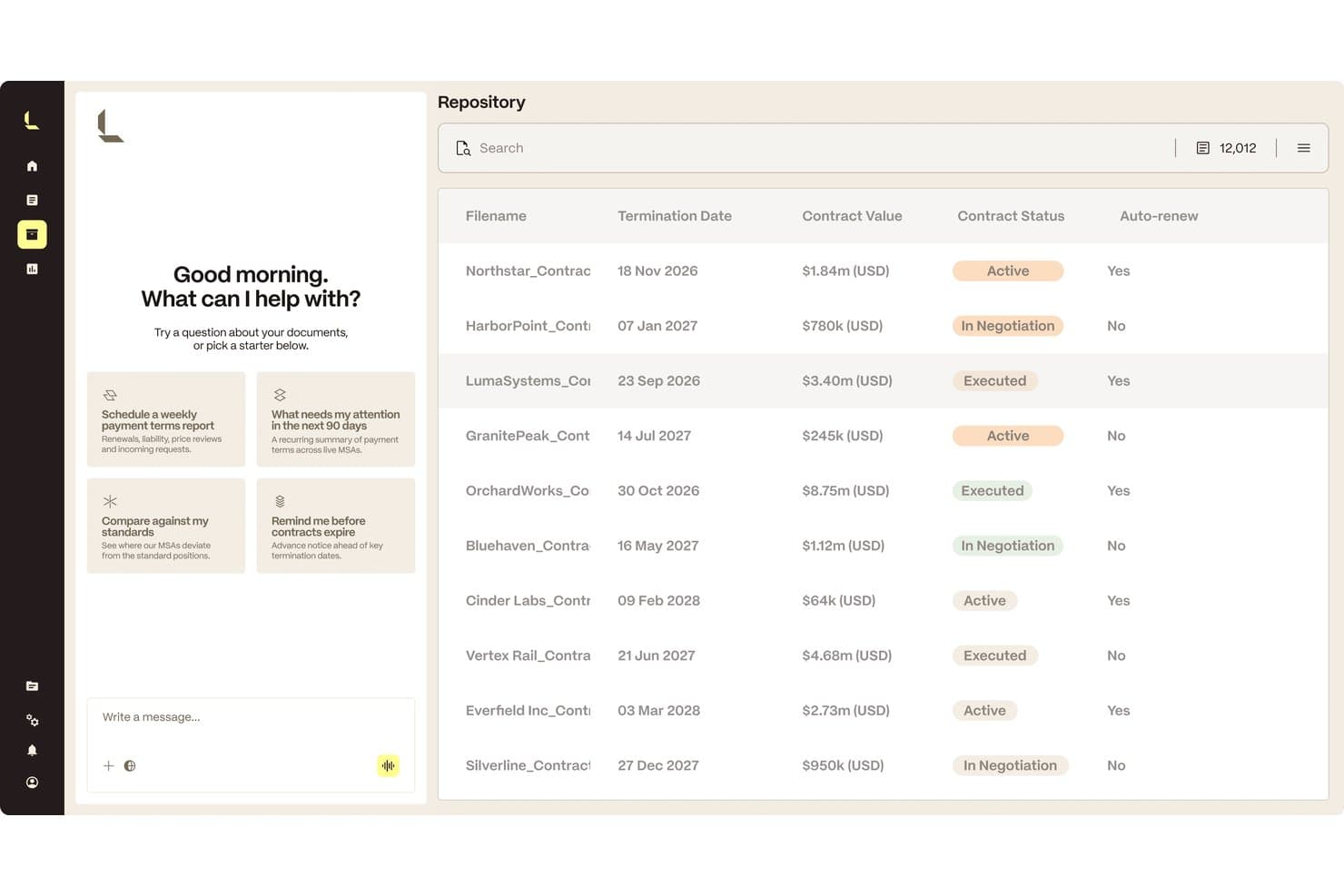
Luminance centralizes contract review with AI-extracted key terms. Luminance is an AI contract intelligence platform built around clause extraction, playbook-based review, portfolio-wide repository analysis, and workflow automation across the full contract lifecycle.
Who Is Luminance Best For?
Luminance is a strong fit for enterprise in-house legal teams and large law firms that manage high volumes of contracts and need portfolio-wide playbook enforcement.
Why I Picked Luminance
Luminance earns its spot on my shortlist because of how it handles playbook enforcement at portfolio scale. I'm particularly impressed by its repository feature, which compares up to 10,000 contracts simultaneously against your playbook to flag deviations, risk exposure, and missed obligations. On top of that, its Context Graphs link contracts, amendments, and related documents so you're never reviewing a clause in isolation.
Luminance Key Features
- Luna Crescent LLM: Luminance's proprietary legal language model extracts, classifies, and analyzes clauses using training from 220M+ verified legal documents.
- Context Graphs: Automatically links contracts, amendments, and related documents so you review each clause with full contractual context.
- Differential Validation: An independent review layer flags AI outputs with uncertainty for human oversight, including source-backed citations on every answer.
- Workflow routing: Routes contracts and approval tasks to the right teams automatically, with role-based permissions, real-time status tracking, and a complete audit trail.
Luminance Integrations
Luminance has documented integrations with Microsoft Word, Outlook, DocuSign, LexisNexis, and HighQ. It also supports MCP for connecting with AI assistants and enterprise applications.
Pros and Cons
Pros:
- Source-backed clause analysis with human validation
- Context graphs link related contracts and amendments
- Portfolio-wide playbook deviation checks at scale
Cons:
- Limited independent review volume for size
- Pricing and contract packaging not transparent
Learn more about Luminance: Best for enterprise contract portfolio review at scale
- Free demo available
- Pricing upon request
Visit WebsiteCustomer Rating:4.5/5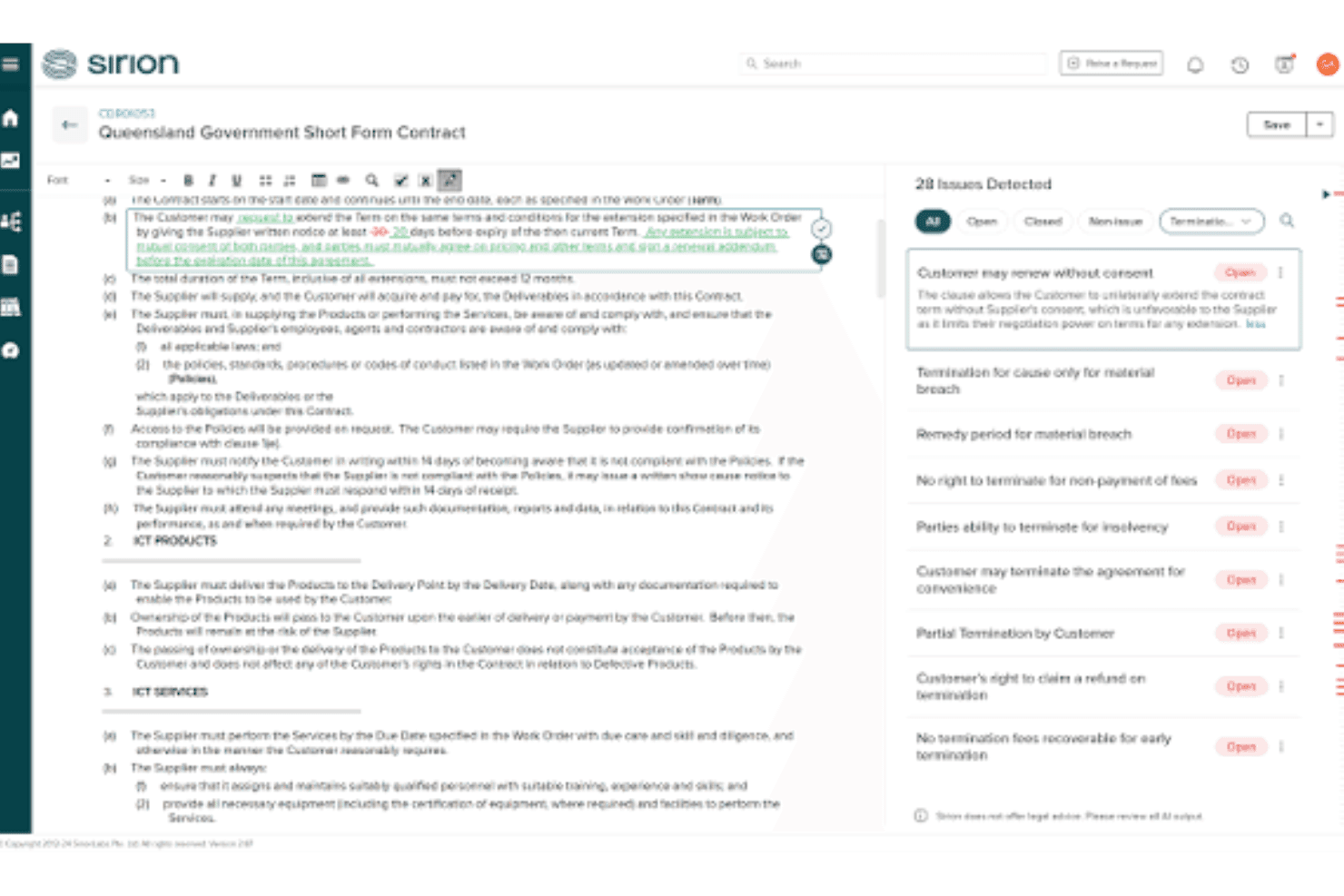
Sirion extracts clauses, flags contract risks, generates redlines, and searches contract portfolios with AI. Sirion is an AI-native contract lifecycle management platform built around agentic AI, offering clause extraction across 1,200+ data fields, automated risk and deviation flagging, redline generation, bulk legacy portfolio ingestion, and a natural-language search repository.
Who Is Sirion Best For?
Sirion is a strong fit for enterprise in-house legal and contract management teams that need to centralize, extract, and govern large volumes of contracts across business units.
Why I Picked Sirion
I picked Sirion as one of the best because no other tool I've seen handles bulk legacy contract ingestion at this scale, pulling structured data across 1,200+ fields, including obligations, tables, and images, without requiring engineering support. The Extraction Agent automatically de-duplicates documents and links agreements to their amendments and SOWs, which matters enormously when you're centralizing thousands of contracts across business units. I also find the self-learning playbooks genuinely useful: they flag deviations and missing clauses in real time and refine their guidance as reviewers interact with them.
Sirion Key Features
- Redline agent: Generates clause-level redlines inside Microsoft Word, with a plain-language explanation for each revision and human approval control for exceptions.
- AskSirion natural-language search: Lets you query the full contract repository in plain language across multiple languages, with answers linked directly to source clauses.
- Obligations tracking: Monitors post-signature commitments, SLAs, and invoice-to-contract discrepancies to flag compliance issues after execution.
- agentOS™ custom agent builder: Lets legal teams build and train bespoke AI agents on their own policies, institutional knowledge, and risk profiles for specialized workflows.
Sirion Integrations
Sirion has native integrations with DocuSign, Adobe Sign, Microsoft Word, SSO, and its REST-based Service Level Integration Framework. It also offers marketplace integrations through Microsoft AppSource and Salesforce AppExchange, plus API connectivity for custom integrations.
Pros and Cons
Pros:
- Custom playbooks and agents for reviews
- Source citations on every AI recommendation
- Extraction covers 1,200+ fields including tables
Cons:
- Interface complexity slows configuration and updates
- No litigation or e-discovery functionality
Learn more about Sirion: Best for bulk review across thousands of documents
- Free demo available
- Pricing upon request
Visit WebsiteCustomer Rating:4.3/5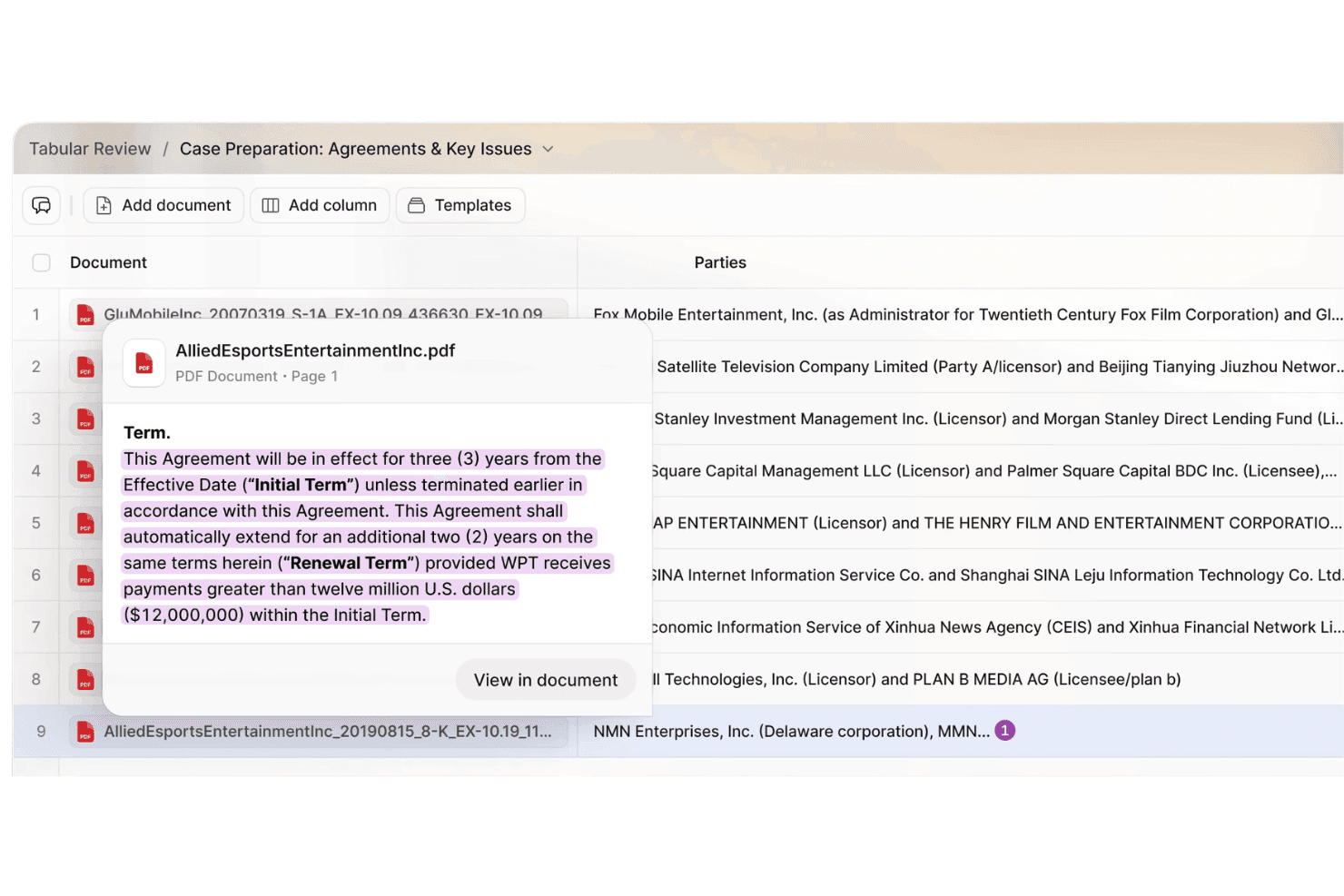
Legora reviews legal documents with AI, extracts clauses, flags risks, and supports redlining. Legora is an AI legal document review platform built around agentic workflows, offering bulk document analysis via Tabular Review, clause extraction, risk flagging, redlining, legal research, and no-code workflow automation.
Who Is Legora Best For?
Legora is a strong fit for mid-size to large law firms and corporate legal departments that regularly process high volumes of documents across matters, jurisdictions, or languages.
Why I Picked Legora
Legora earns its spot on my shortlist because of how Tabular Review handles volume that would otherwise take a team weeks to get through. I love that it converts thousands of documents into a filterable, sortable table where each cell expands to show the AI's reasoning and the exact source passage. For due diligence or litigation matters spanning massive document sets in multiple languages, that citation transparency is what makes the output actually usable.
Legora Key Features
- Playbooks: Build customizable rule sets for specific agreement types—like NDAs or supplier contracts—and run them directly inside Microsoft Word to flag non-standard clauses and risks.
- Legal research: Runs multi-angle research across jurisdictions in parallel, ranks sources by authority, and verifies findings against primary law, with coverage spanning federal, all 50 US states, and international content partners.
- No-code workflow builder: Create, customize, and share document review workflows across your firm without writing code, using pre-built templates for red flag reports, compliance reviews, and employment agreement analysis.
- Monitors: Continuously tracks regulatory changes across global jurisdictions and surfaces alerts with obligation summaries, timelines, and source citations.
Legora Integrations
Legora offers documented integrations with Microsoft Word and Outlook, iManage, NetDocuments, and DeepL. It also connects to VDRs, internal repositories, legal content partners, and MCP connectors for additional data sources and workflows.
Pros and Cons
Pros:
- No-code workflow builder for legal teams
- Per-cell AI reasoning with citation links
- Bulk review across thousands of documents
Cons:
- Most features tailored for large enterprises
- No transparent or self-serve pricing available
Learn more about Legora: 10Best for M&A due diligence at scale
Kira
- Free demo available
- Pricing upon request
Visit WebsiteCustomer Rating:4.3/5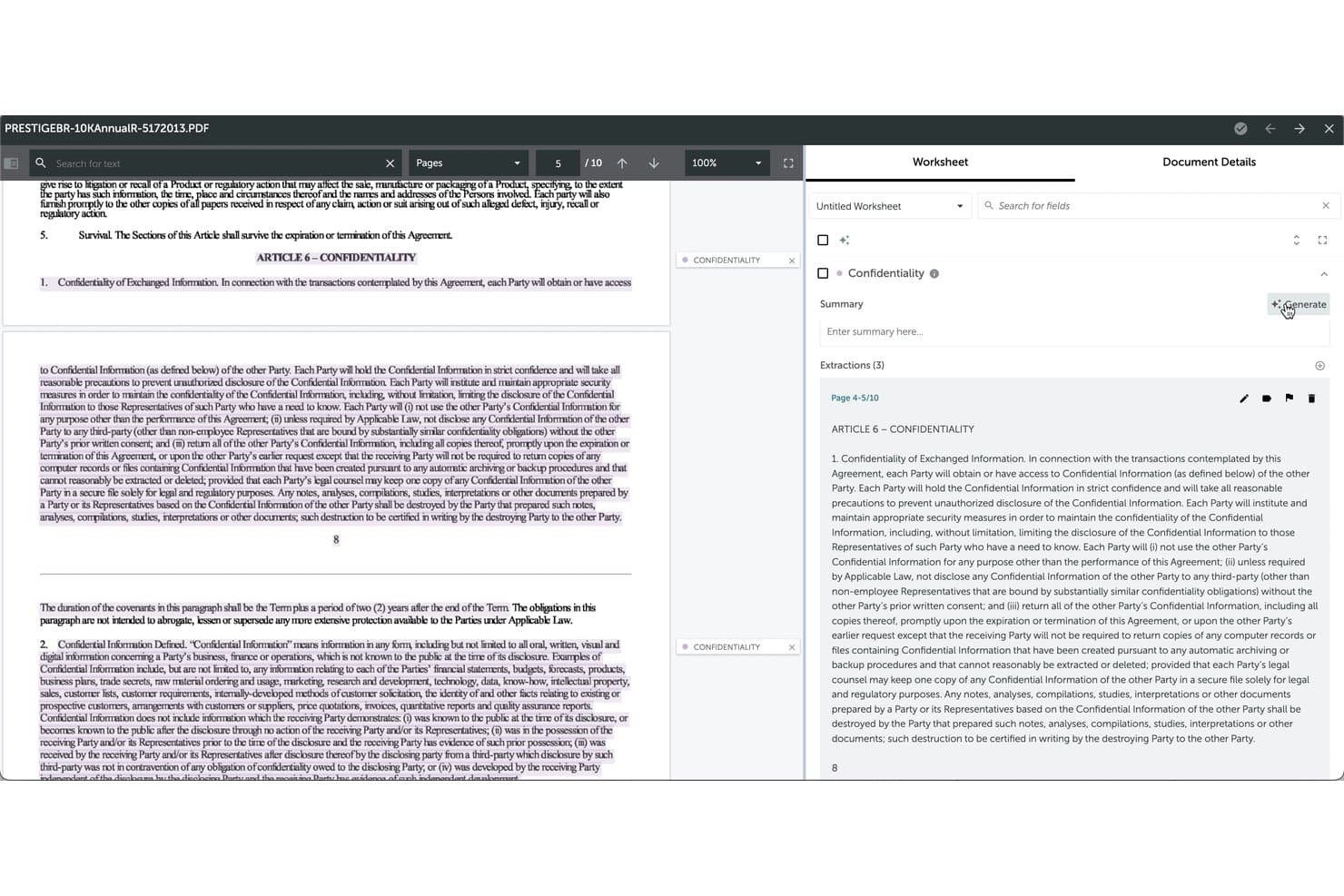
Kira automatically generates confidentiality clause summaries from legal documents. Kira is an AI contract review platform built on lawyer-trained extraction models, offering 1,400+ pre-built smart fields, cross-document Q&A, risk flagging, clause comparison, and bulk document processing across large contract sets.
Who Is Kira Best For?
Kira is a strong fit for corporate legal teams and large law firms running high-volume M&A due diligence, where speed and extraction accuracy across hundreds of contracts matter most.
Why I Picked Kira
I picked Kira as one of the best because no other tool on this list matches its depth for M&A due diligence at scale. Its 1,400+ pre-built smart fields cover the provisions that matter most in deal review, and Grid Chat lets you ask a single plain-language question across every contract in a project, returning citation-backed answers that trace directly to source clauses. When your team is working through hundreds of agreements under deal-timing pressure, that extraction accuracy and cross-document Q&A combination is where Kira earns its place.
Kira Key Features
- Generative smart fields: Build custom extraction fields from a plain-language prompt, with no coding or training cycles required, in any language.
- Project-level GenAI governance: Admins can toggle generative AI features on or off per project to meet outside counsel guidelines or client restrictions.
- Rapid clause analysis: Automatically identifies, organizes, and summarizes clauses into client-ready memos without manual sorting.
- Concept search: Finds a target legal concept across every document in a project using a single example clause, regardless of how the language varies.
Kira Integrations
Kira lists integrations with Microsoft 365, Litera Transact, HighQ, and Intralinks. API capabilities and Word, Excel, and PDF exports support custom workflows and reporting.
Pros and Cons
Pros:
- GenAI custom fields in any language
- Citation-backed answers for cross-document Q&A
- 1,400+ pre-built smart extraction fields
Cons:
- Limited export customization and DMS connectivity
- No e-discovery or privilege review module
Learn more about Kira:
Outras ferramentas de IA para revisão de documentos jurídicos
Eis algumas opções adicionais de ferramentas de IA para revisão de documentos jurídicos que não entraram na minha lista, mas que ainda vale a pena conhecer:
- 11HarveyBest for bulk contract review with custom playbooks
- 12ContractPodBest for playbook-driven contract redlining
- 13DocusignBest for contract review inside Microsoft Word
- 14SummizeBest for contract review embedded in Word and Teams
- 15CoCounselBest for Westlaw-grounded litigation document review
- 16LegalOnBest for attorney-built playbook contract review
- 17LEGALFLYBest for privacy-first corporate contract review
- 18RobinBest for citation-backed cross-document Q&A
- 19IvoBest for contract review with traceable AI reasoning
- 20eBreviaBest for M&A due diligence with source-linked AI
How I Evaluate AI Legal Document Review Tools
To earn a spot on this list, a tool needs to deliver real, measurable AI value—not just surface-level automation. I split my evaluation into core functionality every tool must meet and differentiating factors that separate the best from the rest.
Core Functionality (Table Stakes for This List)
When I'm selecting tools for my list, I rank each one on a scale from 0 (does not offer the functionality) to 5 (excels in this area) for each core functionality listed below. I then calculate the tool's total score into a percentage, and use that to help me assess its overall fit for the list.
- AI clause extraction: I evaluate how accurately each tool identifies and categorizes clause types across varied contract formats, including non-standard language in NDAs, MSAs, and procurement agreements.
- Risk and anomaly flagging: Each tool needs to surface deviations from accepted playbooks or precedent, so I check how well it catches missing clauses, unusual liability caps, or non-standard indemnification terms.
- Document comparison and redlining: I look for clause-level change tracking that goes beyond simple text diffs to contextualize how edits affect obligations, especially across negotiation rounds.
- Bulk document processing: The tool should handle large volumes of contracts at once without choking on mixed file formats, which matters most during M&A due diligence or portfolio-wide compliance audits.
- Searchable repository and data extraction: Structured extraction of key data points like renewal dates, governing law, and termination triggers should feed into a searchable repository that supports filtering and reporting.
- Workflow and collaboration tracking: I check whether the platform supports task assignment, status visibility, and audit trails so review teams can coordinate across multiple reviewers without losing track of progress.
Once I have a list of tools that meet the criteria, I consider what sets each platform apart.
Differentiating Factors (What Sets Vendors Apart)
Here's how I compare and contrast different vendors:
Standout Features
I look for custom playbook training that lets teams encode their own precedents and negotiation positions into the AI, not just generic clause detection. During a portfolio audit, the difference between a tool trained on your firm's risk thresholds and one using off-the-shelf rules is night and day. Multi-language contract support matters just as much when your deals cross jurisdictions. I check whether extraction accuracy holds up across languages or drops off outside English. Clause benchmarking is another separator—tools like Luminance and Kira let you compare terms against market norms, which gives real leverage in negotiations.
Beyond Features
I check whether vendors train their models on customer data, since contract files often contain privileged information. SOC 2 or ISO 27001 certifications help, but data residency options matter just as much for cross-border teams. I also evaluate onboarding support, because configuring custom playbooks without vendor-guided training slows adoption fast, especially for smaller firms without dedicated IT staff.
Como escolher ferramentas de IA para revisão de documentos jurídicos
A escolha de ferramentas de IA para revisão de documentos jurídicos começa por associar os pontos críticos da revisão da sua equipa aos pontos fortes do fluxo de trabalho: eis como passar das promessas das demonstrações a resultados reais.
| Se a sua prioridade for... | Procure... |
|---|---|
| Se a sua prioridade for...Reduzir o tempo do ciclo de revisão | Procure...Suporte para carregamentos em massa e atribuição de tarefas |
| Se a sua prioridade for...Garantir a consistência do manual de procedimentos | Procure...Configuração de regras ou do manual de procedimentos personalizado |
| Se a sua prioridade for...Gerir portefólios multilingues | Procure...Precisão de extração declarada nos idiomas de que necessita |
| Se a sua prioridade for...Proteger dados abrangidos pelo segredo profissional | Procure...Informações do fornecedor sobre o treino dos modelos e opções de residência dos dados |
Como avaliar a sua lista de opções
- Teste o seu próprio contrato durante um período experimental: Carregue um contrato com alterações assinaladas e não normalizado e avalie a precisão da extração no prazo de um dia útil.
- Peça um relatório de exemplo: Solicite um resumo real dos riscos ou desvios para uma revisão de portefólio semelhante ao seu volume habitual.
- Envie uma questão sobre segurança ou conformidade: Apresente um pedido de comprovativo atualizado da certificação SOC 2 ou ISO 27001 e pergunte sobre as práticas de retreino dos modelos.
- Teste a adequação ao fluxo de trabalho: Atribua uma tarefa de revisão a vários membros da equipa e confirme, numa única semana, a visibilidade do estado, os comentários ou os registos de auditoria.
- Compromisso—Personalização vs. Pronto a utilizar: Decida se pretende uma personalização mais profunda, que poderá exigir mais esforço inicial, ou uma implementação mais rápida com manuais de procedimentos e regras de risco normalizados.
O que são as ferramentas de IA para revisão de documentos jurídicos?
As ferramentas de revisão de documentos jurídicos com IA são plataformas de software que utilizam inteligência artificial para analisar documentos jurídicos, identificar cláusulas importantes, assinalar riscos e extrair pontos de dados críticos.
Estas ferramentas ajudam as equipas jurídicas a rever rapidamente grandes volumes de contratos ou acordos, a manter a consistência e a detetar lacunas de conformidade. São importantes porque facilitam a gestão de portefólios de documentos complexos, reduzem o erro humano e aceleram a análise de contratos sem comprometer a precisão.
Funcionalidades
Eis as principais funcionalidades que qualquer excelente ferramenta de revisão de documentos jurídicos com IA deve ter:
Extração de cláusulas com IA: Identifica e categoriza cláusulas em diversos formatos de contrato, facilitando a localização dos termos essenciais sem revisão manual.
Assinalação de riscos e anomalias: Analisa os contratos em busca de desvios face ao manual de negociação, assinalando antecipadamente termos em falta, limites de responsabilidade invulgares e cláusulas não normalizadas.
Comparação de documentos e controlo de alterações: Acompanha as edições ao nível das cláusulas entre versões, mostrando de que forma as alterações afetam as obrigações e introduzem ou eliminam riscos contratuais.
Processamento de documentos em massa: Revê grandes lotes de contratos em vários formatos para análise de portefólios, diligência prévia, auditorias e revisão de acordos com fornecedores.
Repositório pesquisável e extração de dados: Extrai dados essenciais dos contratos para um sistema pesquisável, permitindo criar relatórios, acompanhar obrigações e recuperar documentos mais rapidamente.
Acompanhamento de fluxos de trabalho e colaboração: Atribui tarefas de revisão, acompanha o progresso e mantém registos de auditoria dos documentos para garantir uma responsabilização clara em todos os portefólios de contratos.
Configuração personalizada do manual de negociação: Configura regras de negociação, normas relativas a cláusulas e níveis de tolerância ao risco, para que os problemas contratuais sejam assinalados com base nos requisitos internos.
Suporte multilingue: Analisa contratos multilingues e extrai cláusulas para apoiar uma revisão consistente e a conformidade em diferentes regiões.
Comparação de cláusulas com referências de mercado: Compara a linguagem contratual com as práticas de mercado para avaliar posições de negociação e identificar riscos atípicos.
Controlos de segurança e conformidade: Apresenta informações sobre o treino dos modelos, a localização dos dados e as certificações de segurança para apoiar a confidencialidade e a conformidade organizacional.
Benefícios
A implementação de ferramentas de revisão de documentos jurídicos com IA proporciona vários benefícios à sua equipa e à sua empresa. Eis alguns dos benefícios que pode esperar:
- Ciclos de revisão de contratos mais rápidos: A extração de cláusulas com IA e o processamento de documentos em massa permitem analisar grandes portefólios e acordos não normalizados em menos tempo do que numa revisão manual.
- Aplicação consistente do manual de negociação: A configuração personalizada de regras e do manual de negociação ajuda a assinalar desvios e a aplicar automaticamente as suas normas de negociação em todos os documentos.
- Deteção de riscos melhorada: As funcionalidades de assinalação de riscos e anomalias detetam termos em falta ou invulgares, alertando-o para lacunas de conformidade ou desvios nas negociações antes que estes se agravem.
- Maior colaboração e capacidade de auditoria: As ferramentas de acompanhamento de fluxos de trabalho e de colaboração permitem que vários revisores coordenem tarefas com uma visibilidade clara do estado e registos de auditoria.
- Proteção de dados reforçada: Funcionalidades de segurança como as certificações SOC 2 ou ISO 27001, práticas detalhadas de treino de modelos e controlos de localização dos dados apoiam os seus requisitos de confidencialidade dos dados.
- Suporte multilingue preciso: A extração multilingue de cláusulas assegura uma revisão contratual fiável em diferentes jurisdições e ajuda a manter a conformidade em portefólios internacionais.
- Informações de negociação mais aprofundadas: A comparação de cláusulas com referências de mercado e os relatórios permitem comparar a linguagem contratual com as práticas de mercado, dotando a sua equipa de dados para obter melhores posições de negociação.
Custos e preços
A seleção de ferramentas de revisão de documentos jurídicos com IA exige uma compreensão dos vários modelos de preços e planos disponíveis. Os custos variam consoante as funcionalidades, o tamanho da equipa, os complementos e outros fatores. A tabela abaixo resume os planos comuns, os respetivos preços médios e as funcionalidades normalmente incluídas nas soluções de ferramentas de revisão de documentos jurídicos com IA:
Tabela de comparação de planos para ferramentas de revisão de documentos jurídicos com IA
| Tipo de plano | Preço médio | Funcionalidades comuns |
|---|---|---|
| Tipo de planoPlano gratuito | Preço médio$0-$50/mês | Funcionalidades comunsCarregamento limitado de documentos, extração básica de cláusulas, sinalização de riscos padrão e apoio da comunidade. |
| Tipo de planoPlano pessoal | Preço médio$60-$150/utilizador/mês | Funcionalidades comunsLimites de documentos superiores, extração de cláusulas personalizável, exportação básica de dados e apoio por e-mail. |
| Tipo de planoPlano empresarial | Preço médio$200-$500/utilizador/mês | Funcionalidades comunsProcessamento em massa, pesquisa avançada, ferramentas de fluxo de trabalho, integrações, suporte multilingue e relatórios. |
| Tipo de planoPlano empresarial de grande dimensão | Preço médio$600-$2000+/mês | Funcionalidades comunsGuias de procedimentos personalizados, integração inicial dedicada, acesso à API, controlos de conformidade, colaboração avançada e SLAs. |
Perguntas frequentes
Eis algumas respostas a perguntas comuns sobre ferramentas de revisão de documentos jurídicos com IA:
As ferramentas de revisão de documentos jurídicos com IA conseguem processar contratos não normalizados?
Sim, a maioria das ferramentas de revisão de documentos jurídicos com IA consegue processar contratos não normalizados, mas a precisão depende do nível de formação da IA da ferramenta. Para obter os melhores resultados, carregue os seus próprios documentos durante um período de teste para verificar se existem cláusulas não detetadas ou classificadas incorretamente. As equipas que trabalham com formatos exclusivos ou alterações significativas resultantes de negociações devem dar prioridade a fornecedores que suportem guias de procedimentos personalizados ou que possam voltar a treinar os modelos com base nos seus contratos.
Quão seguros estão os meus dados quando utilizo estas ferramentas?
A segurança dos seus dados depende do fornecedor. Muitos disponibilizam certificações SOC 2 ou ISO 27001 e fornecem informações sobre a residência dos dados, o treino dos modelos e os controlos de privacidade. Solicite sempre a documentação, esclareça se os seus documentos serão utilizados para voltar a treinar os modelos e verifique se o serviço cumpre os requisitos de confidencialidade da sua empresa ou dos seus clientes.
Estas ferramentas suportam contratos em vários idiomas?
Sim, várias ferramentas de revisão de documentos jurídicos com IA oferecem suporte para contratos em vários idiomas. No entanto, a precisão da extração pode variar fora do inglês. Se trabalha com contratos que não estão em inglês, execute um lote de amostra e verifique os resultados para cada idioma necessário antes de escolher uma plataforma.
Como é que as ferramentas de revisão de documentos jurídicos com IA ajudam nas auditorias de conformidade?
Estas ferramentas ajudam ao extrair pontos de dados essenciais, sinalizar obrigações e riscos e criar repositórios pesquisáveis de termos contratuais. Isto permite identificar rapidamente lacunas de conformidade ou tarefas em atraso ao responder a auditorias ou questões regulamentares, sem rever manualmente cada documento.
Estas ferramentas podem integrar-se nos meus sistemas jurídicos ou de gestão de contratos existentes?
Algumas ferramentas de revisão de documentos jurídicos com IA oferecem integrações com ferramentas de gestão documental, gestão do ciclo de vida dos contratos (CLM) ou produtividade, como o Microsoft Word ou o Teams. Confirme as integrações suportadas no site do fornecedor e teste os fluxos de trabalho com o seu conjunto tecnológico atual antes da implementação completa.
Qual é a melhor forma de avaliar uma ferramenta de revisão de documentos jurídicos com IA antes de a comprar?
Comece por um período de teste com uma amostra de contratos semelhante à sua carga de trabalho real. Concentre-se na precisão da extração, na adequação do fluxo de trabalho, na sinalização de riscos e no facto de a plataforma suportar ou não as suas necessidades de conformidade e elaboração de relatórios. Solicite uma demonstração detalhada do produto e verifique as medidas de apoio e segurança tendo em conta os seus próprios requisitos.