

The 10 Best Law Firm Software on the Market of 2026

10 Best Law Firm Software Shortlist


Law firm software streamlines time tracking, billing, document management, and case workflows, which frees up your team to focus on high-value legal strategy and client service. Juggling calendars, compliance, and caseloads can be challenging, but the proper support can reduce administrative overhead and improve accuracy.
In this article, I compare and review the best tools to support your buying decision.
Why Trust Our Software Recommendations
Our team has been testing and reviewing software since 2012. As legal practice leaders ourselves, we know how difficult—and important—it is to choose the right software.
For this guide, we evaluated tools using hands-on testing and independent research, scoring tools using our selection criteria.
Our reviews reflect our human editorial judgment, not a sales pitch.
Best Law Firm Software Summary
This comparison chart summarizes pricing details for my top law firm software selections to help you find the best one for your budget and business needs.
| Tool | Best For | Trial Info | Price | ||
|---|---|---|---|---|---|
| 1 | Best for unified case and billing management | 7-day free trial | From $49/user/month (billed annually) | Website | |
| 2 | Best for centralizing client communications | Free trial available | Pricing upon request | Website | |
| 3 | Best for integrated time tracking and invoicing | Free trial available | From $39/user/month (billed annually) | Website | |
| 4 | Best for remote document notarization | Free demo available | From $49/month | Website | |
| 5 | Best for cloud-based legal practice management with AI-powered assistance | Free trial available | From £79/user/month | Website | |
| 6 | Best for personal injury law firms with built-in settlement tools | Free demo available | Pricing upon request | Website | |
| 7 | Best for billing and accounting for small to mid-sized firms | Free demo available | From $89/user/month | Website | |
| 8 | Best for fully integrated practice management and accounting | 10-day free trial | From $49/user/month (billed annually) | Website | |
| 9 | Best for document management and collaboration for remote teams | Free demo available | Pricing upon request | Website | |
| 10 | Best for mobile time and expense tracking on-the-go | Free trial available | From $59/user/month | Website |
Best Law Firm Software Reviews
Below are my detailed summaries of the best law firm software that made it onto my shortlist. My reviews offer a detailed look at the key features, pros & cons, integrations, and ideal use cases of each tool to help you find the best one for you.

Best for unified case and billing management
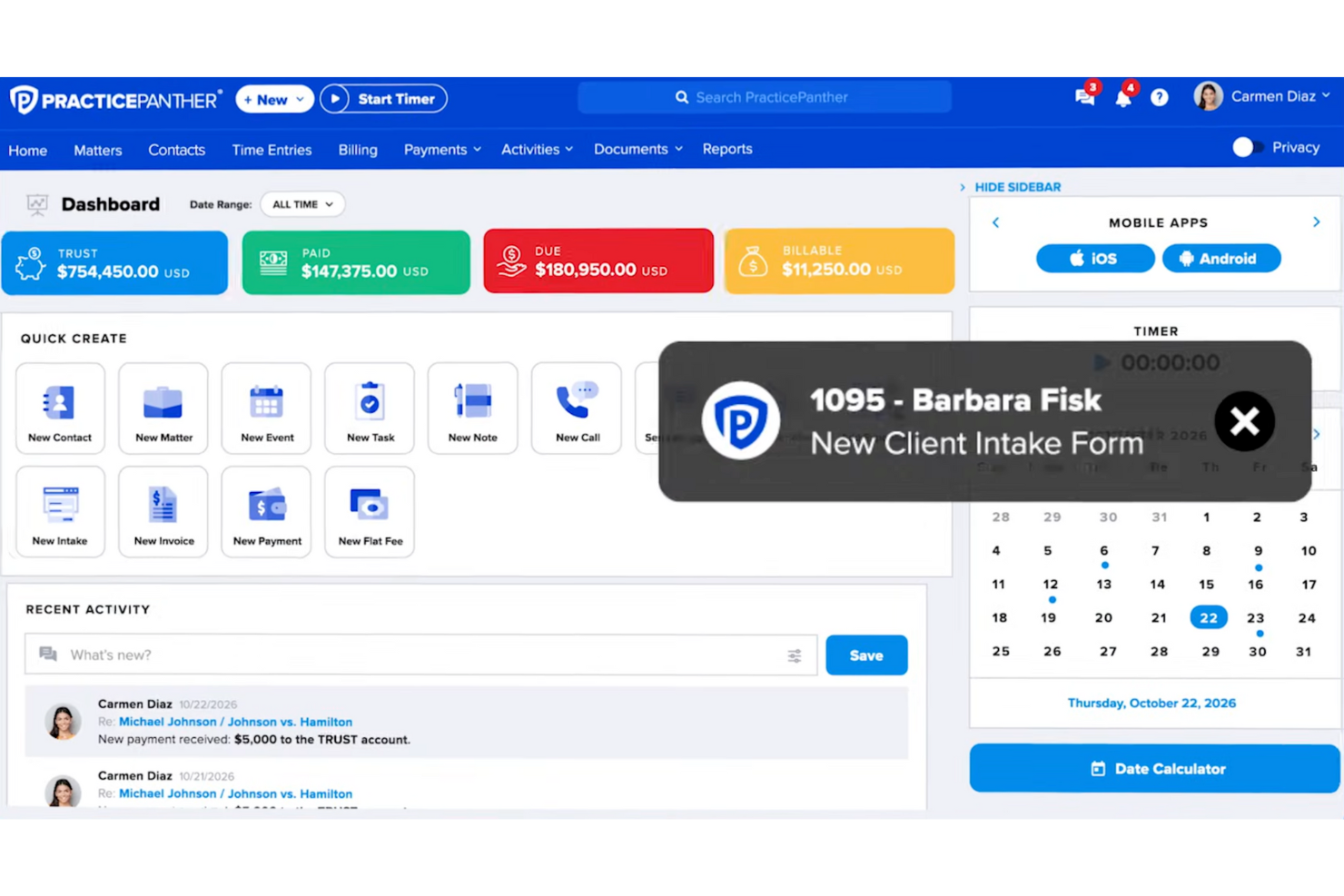
For law firms seeking a dynamic solution to streamline their operations, PracticePanther offers a versatile legal practice management software. Tailored for solo practitioners and large firms alike, it addresses the complexities of case management, billing, and client communication. By automating routine tasks and providing secure document management, PracticePanther helps you focus on what truly matters—serving your clients effectively.
Why I Picked PracticePanther
I picked PracticePanther for its unique ability to integrate case management with financial operations, making it a standout choice for law firms. The legal billing and ePayments feature simplifies invoicing, enabling your firm to handle transactions smoothly and securely. Additionally, the trust accounting feature ensures compliance with legal financial regulations, alleviating the concerns of managing client funds. These functionalities make it an ideal tool for law firms looking to optimize both their legal and financial workflows.
PracticePanther Key Features
In addition to unified case and billing management, PracticePanther offers:
- Document Management: Securely store, organize, and retrieve legal documents with ease, ensuring compliance and accessibility.
- Client Portal: Facilitate seamless communication with clients through a dedicated portal that supports document sharing and messaging.
- Calendar and Task Management: Keep track of important deadlines and appointments with integrated calendaring tools that sync with your existing systems.
- eSignature: Expedite document signing processes with built-in electronic signature functionality, reducing turnaround time for agreements.
PracticePanther Integrations
PracticePanther integrates with popular applications such as QuickBooks Online, Google Calendar, Microsoft Outlook, Zapier, LawPay, NetDocuments, Box, Dropbox, OneDrive, and Gmail, enhancing its functionality and allowing seamless workflow integration.
Pros and Cons
Pros:
- Accessible on various devices, including mobile apps
- Facilitates efficient client communication through a portal
- Automates administrative tasks, saving significant time weekly
Cons:
- Occasional timer resets disrupt time tracking
- Limited customization options for specific workflows
New Product Updates from PracticePanther

PantherAccounting Plus Unveiled
PracticePanther launches PantherAccounting Plus, enhancing financial management for law firms. It enables law firms to manage trust and operating accounting directly within the platform. For more information, visit PracticePanther's official site.
 .
.
8am
Best for centralizing client communications
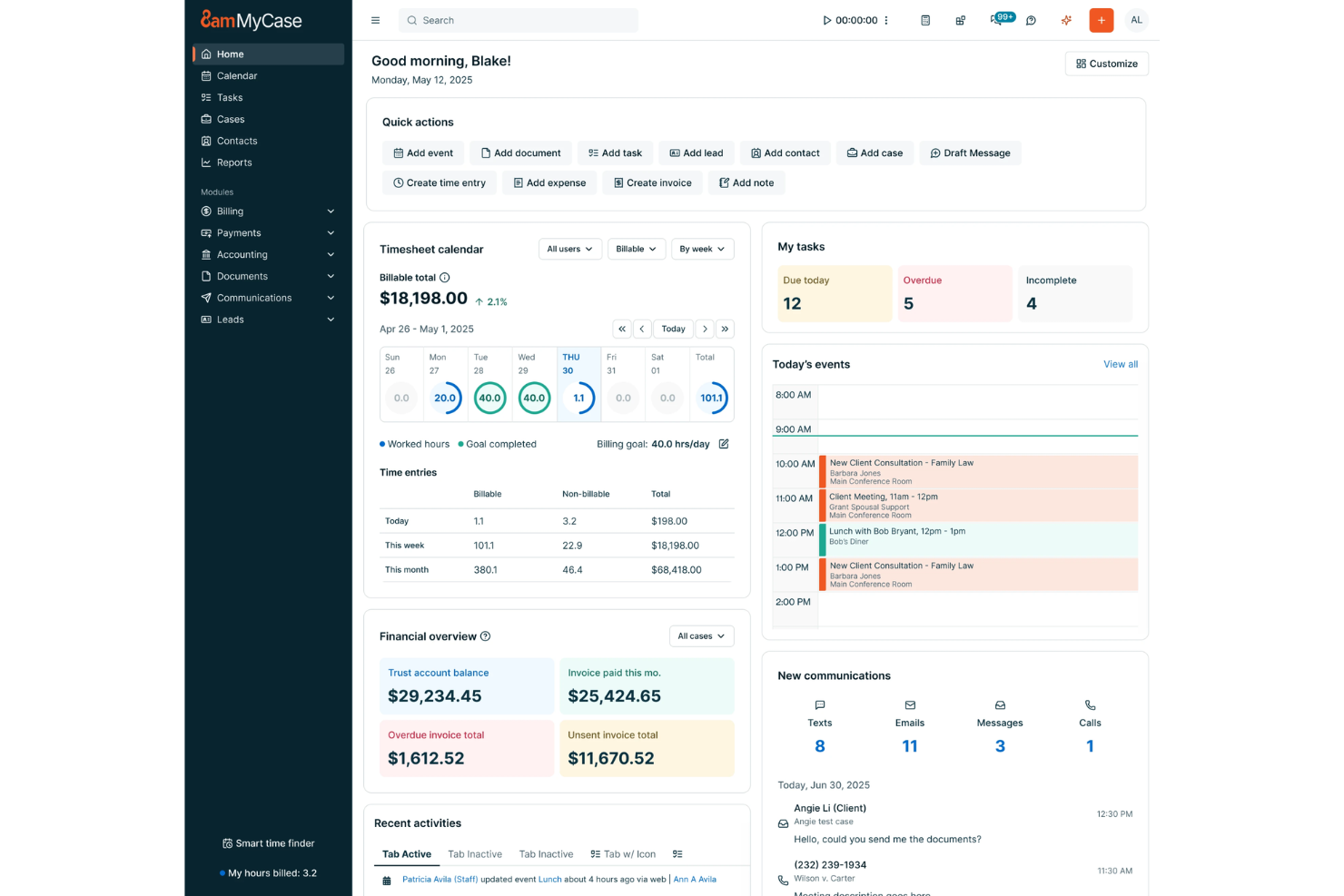
8am is a legal software platform that brings together case tracking, billing, payments, document automation, and compliance tools across purpose-built products for different practice areas.
Who Is 8am Best For?
8am is a strong fit for small to mid-sized law firms that need purpose-built tools tailored to specific practice areas like personal injury, immigration, or family law.
Why I Picked 8am
I've included 8am in my top picks because of how MyCase handles client communication across channels without forcing attorneys to toggle between apps. I like that the built-in text messaging gives each firm a dedicated number, with messages syncing automatically to the relevant case file. The client portal goes even further, letting clients view case details, invoices, and documents in one place, and it takes just one click to set up when a new client is added. When a client sends a message, uploads a file, or completes a task, you get an update immediately, which keeps things moving without anyone needing to chase anyone.
8am Key Features
- AI Writing Assistant: MyCase's built-in AI tool drafts legal documents, emails, and case summaries directly within the platform.
- Online intake forms: Customizable intake forms capture new client details and automatically trigger retainer creation and eSignature requests.
- Trust accounting: Built-in IOLTA-compliant ledgers let you track trust balances, record transactions, and generate compliance reports.
- Deadline and calendar management: LawToolBox integration pulls jurisdiction-specific court rules into your calendar to auto-calculate case deadlines.
8am Integrations
8am offers 60+ native integrations through its MyCase platform, including Dropbox, QuickBooks, Google Calendar, Outlook and LawPay, Lawmatics, Briefpoint, MotaWord, VXT, Mailchimp, and NetDocuments. It also connects with Zapier, and an API is available for custom integrations.
Pros and Cons
Pros:
- Practice-area-specific tools for 10+ specialties
- eSignature included without add-on costs
- Built-in client texting from inside cases
Cons:
- Mobile app trails the desktop version
- Invoice formatting lacks contingency firm support

Best for integrated time tracking and invoicing
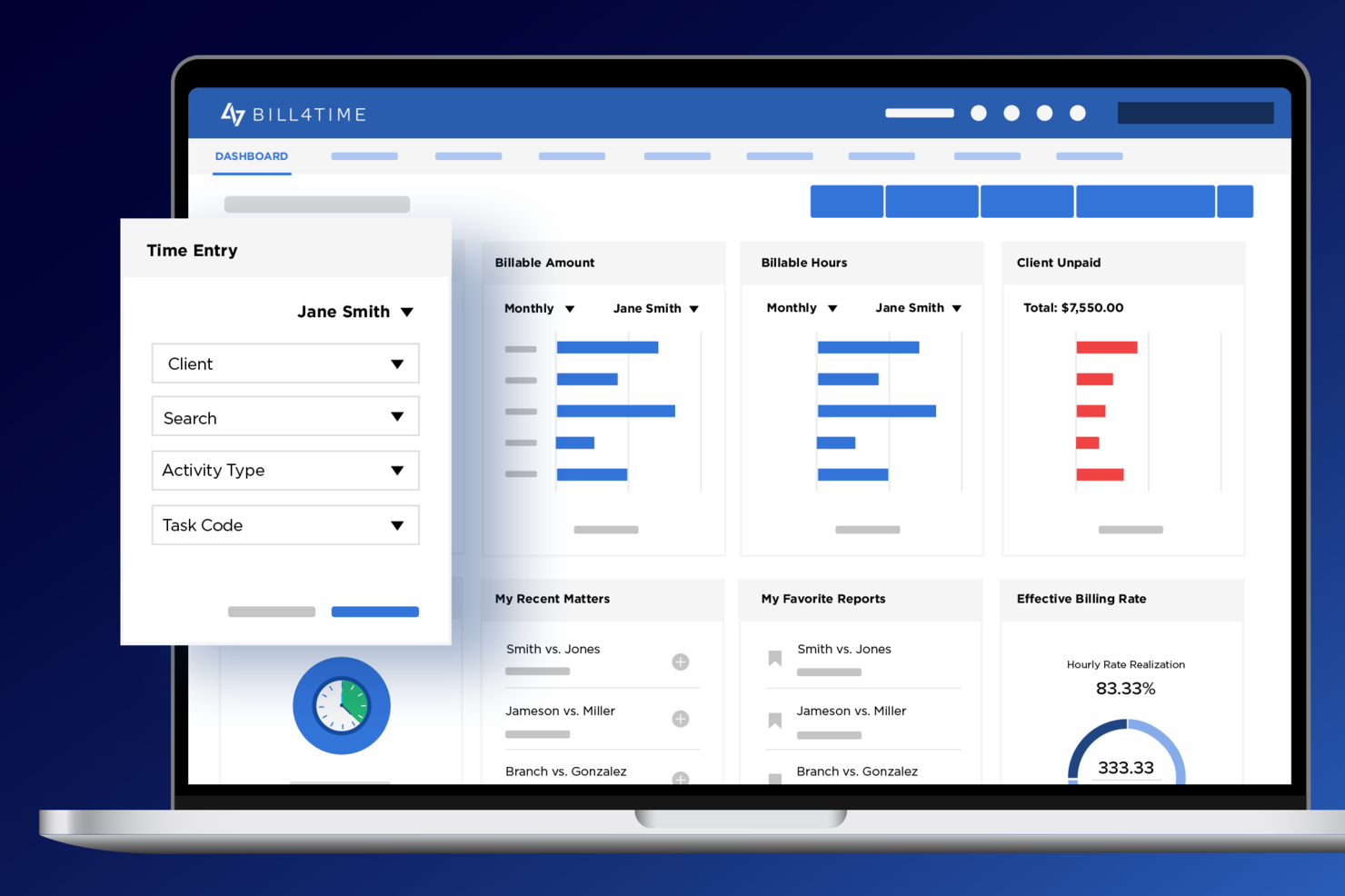
Bill4Time is a legal practice management platform for law firms that brings together time tracking, billing, trust accounting, case management, and a self-service client portal in one place.
Who Is Bill4Time Best For?
Bill4Time is a strong fit for solo attorneys, small to mid-sized law firms, and legal departments that bill by the hour and need purpose-built tools for legal billing and matter management.
Why I Picked Bill4Time
I picked Bill4Time as one of the best because of how tightly time tracking and invoicing connect in a single workflow. You can run simultaneous timers across your phone, tablet, and browser, then convert those entries directly into a batch invoice by client, matter, or date range without any manual reformatting. What I also like is the support for multiple billing arrangements, including hourly, flat-fee, and contingency rates, plus LEDES invoicing for firms that handle corporate clients with specific billing requirements.
Bill4Time Key Features
- Trust accounting: Manage IOLTA and client trust accounts with built-in compliance controls that keep operating and trust funds separate.
- Conflict checker: Search across clients, matters, and contacts to flag potential conflicts of interest before taking on new cases.
- Matter management: Organize cases with matter-level records that link time entries, documents, contacts, tasks, and billing history in one place.
- Online payment processing: Accept credit card, eCheck, and ACH payments directly through Bill4Time, with funds applied to the correct client account automatically.
Bill4Time Integrations
Bill4Time integrates with QuickBooks Online and Desktop, LawPay, PayPal, and Stripe. It also offers native integrations with Box, Google Calendar, Outlook Calendar, and NetDocuments. An API is available that supports get/read operations from Bill4Time to other applications. Zapier support is not clearly documented for Bill4Time directly.
Pros and Cons
Pros:
- Captures time on mobile while in court
- Strong financial and aging invoice reports
- Granular billable hours tracking per matter
- Built-in IOLTA trust account reconciliation
Cons:
- Interface looks dated compared to competitors
- No recurring invoices or auto-pay


OneNotary is a remote online notarization platform that lets you and your clients complete notarizations entirely online. It’s designed for both individuals and businesses, including law firms, to handle notarizations without in-person meetings.
Why I Picked OneNotary: OneNotary offers a secure, fully remote notarization process that fits well into legal workflows. It uses a multi-step identity verification process, including knowledge-based authentication and credential analysis, to ensure the signer's identity is confirmed before the session begins.
This helps law firms meet compliance standards and reduce the risk of fraud. Once the session starts, the notary and signer connect via secure video, and the notarized document is available immediately after the session ends.
Standout Features and Integrations:
Features include 24/7 access to professional notaries, allowing your team to schedule notarizations at any time. The platform offers a "connect your own notary" option, enabling your in-house notaries to conduct remote sessions through OneNotary.
Integrations include a REST API, allowing you to integrate its services directly into your existing systems. You can also integrate the platform with Clio.
Pros and Cons
Pros:
- Notarized documents are accessible immediately
- Capable of notarizing various legal documents
- Utilizes multi-step verification
Cons:
- Extra charges apply for additional signers, seals, or witnesses
- Not ideal for documents that can't be notarized remotely
Clio
Best for cloud-based legal practice management with AI-powered assistance

Clio is a cloud-based legal practice management tool that offers AI-powered assistance to streamline law firm operations. It allows legal professionals to manage cases, clients, documents, and billing from a single platform.
Why I Picked Clio: I chose Clio for the list because it is a well-known and reputable legal practice management tool that offers an AI-powered assistant to automate repetitive tasks and enhance productivity. Clio's strong brand recognition, extensive feature set, and focus on automation make it stand out in the market.
I think Clio is best for cloud-based legal practice management with AI-powered assistance because of its ability to help legal professionals streamline their workflows, increase efficiency, and improve client service.
Standout features and integrations:
Features include an AI-powered assistant, dubbed "Clio Assistant," is a standout feature that can help automate routine tasks such as document generation and time tracking. It also offers robust time and expense tracking, custom workflows, and document management.
Integrations include other legal and productivity tools, including QuickBooks, LawPay, and Microsoft Office. It also has an open API, allowing users to build custom integrations.
Pros and Cons
Pros:
- User-friendly interface with mobile app for on-the-go access
- Integrations with popular apps such as G Suite, QuickBooks, and Zapier
- Robust features for case management, including time tracking, billing, and document management
Cons:
- Limited customization options for invoices and document templates
- Some users report occasional glitches and slow loading times
- Expensive compared to some other options on the market

Filevine
Best for personal injury law firms with built-in settlement tools

Filevine is a legal case management software designed for personal injury law firms with built-in settlement tools to help streamline their workflow.
Why I Picked Filevine: I chose Filevine for this list because of its unique features and focus on personal injury law firms. The settlement tools are especially helpful in this area of law, making it stand out from other case management software. This focus and attention to detail make it the best option for personal injury law firms.
Standout features and integrations:
Features include a built-in settlement tool that allows users to calculate settlement amounts, manage offers and negotiations, and track payments. It also has a robust task management system, document automation, and advanced reporting features.
Integrations include many popular legal tools, including QuickBooks, DocuSign, and LawPay.
Pros and Cons
Pros:
- Strong document management capabilities, including e-signatures and OCR text recognition
- Robust workflow automation and project management features
- Intuitive and customizable interface
Cons:
- Some users have reported slow loading times and occasional glitches
- Steep learning curve for some features
- Limited integrations compared to some competitors

Tabs3
Best for billing and accounting for small to mid-sized firms

Tabs3 is a billing and accounting software designed for small to mid-sized law firms. It offers features specifically tailored to the legal industry, such as time tracking and trust accounting.
Why I Picked Tabs3: I chose Tabs3 for this list because it is a popular choice for small to mid-sized firms due to its focus on billing and accounting. It stands out for its user-friendly interface and features that make it easy for firms to manage their finances.
Tabs3 is best for small to mid-sized law firms that need a billing and accounting software that is easy to use and tailored to the legal industry.
Standout features and integrations:
Features include time tracking, billing, trust accounting, and general ledger accounting.
Integrations include popular legal software such as PracticeMaster, which allows for seamless data sharing.
Pros and Cons
Pros:
- Flexible pricing options to suit the needs of small to mid-sized law firms.
- Tailored specifically for the legal industry, with features such as trust accounting and time tracking.
- User-friendly interface and easy to use for accounting and billing tasks.
Cons:
- Add-ons such as e-billing and credit card processing can add up and become costly.
- Not ideal for larger law firms with more complex financial needs.
- Limited features compared to other legal practice management software.

CosmoLex
Best for fully integrated practice management and accounting

CosmoLex is a cloud-based practice management and accounting software designed specifically for law firms. It offers a fully integrated solution for managing day-to-day law firm operations, including timekeeping, billing, accounting, trust accounting, and document management.
Why I Picked CosmoLex: I chose CosmoLex for its comprehensive practice management and accounting features, all available in one platform. It stands out from other tools because of its all-in-one design, which helps reduce data entry and duplication errors. I believe CosmoLex is best for law firms looking for a one-stop solution for managing their operations.
Standout Features and Integrations:
Features include time and expense tracking, billing, trust accounting, document management, and financial management. Its standout feature is its fully integrated accounting system, which allows law firms to manage their finances without the need for a separate accounting tool.
Integrations include popular third-party tools, including QuickBooks, LawPay, Dropbox, and Box.
Pros and Cons
Pros:
- User-friendly interface: CosmoLex has a simple and easy-to-use interface that is intuitive and customizable to suit your needs.
- Built-in accounting: Unlike many other legal practice management software, CosmoLex includes an integrated accounting system that allows you to track your firm's finances and manage your books all in one place.
- Comprehensive features: CosmoLex offers a wide range of features including time and expense tracking, billing and invoicing, matter management, document management, and trust accounting.
Cons:
- No mobile app: Currently, CosmoLex does not offer a mobile app, which may be inconvenient for attorneys who need to access information while on the go.
- Steep learning curve: Some users have reported that CosmoLex can take some time to get used to due to its extensive features and functions.
- Limited integrations: While CosmoLex offers some integrations, it may not have the integrations you need for your firm.

Best for document management and collaboration for remote teams

CARET Legal is a cloud-based document management and collaboration platform designed specifically for law firms. It helps legal teams streamline their workflows, improve collaboration, and maintain secure access to critical files from any location.
Why I Picked CARET Legal: I picked CARET Legal for this list because it offers a comprehensive solution for document management and collaboration, with features specifically tailored for the needs of legal teams. Its cloud-based approach is ideal for remote teams who need to access files securely from any location.
Standout Features and Integrations:
Features include document management, collaboration tools, email management, and task management. Its document management features include version control, access controls, and tagging to help you easily organize and find files. Its collaboration tools allow teams to collaborate on documents in real-time and communicate within the platform.
Integrations include Microsoft Office 365, Outlook, and G Suite, making it easy to access and work with files from these applications.
Pros and Cons
Pros:
- Integrates with popular office applications like Microsoft Office 365 and G Suite.
- Excellent collaboration tools, including real-time co-authoring.
- Easy to use interface and intuitive document management features.
Cons:
- No mobile app currently available.
- Limited integrations with other legal software.
- Pricing is not publicly available on their website.

Best for mobile time and expense tracking on-the-go

Rocket Matter is a cloud-based legal practice management software designed to help law firms streamline their operations. It offers a wide range of features that help lawyers manage their workflow, collaborate with team members, and track billable hours, among other things.
Why I Picked Rocket Matter: I picked Rocket Matter for the list because of its focus on mobile time and expense tracking. This tool makes it easy for lawyers to manage their practice on-the-go, which is a key consideration for many busy attorneys who are constantly on the move. Its intuitive user interface, robust feature set, and mobile app make it a great choice for law firms of all sizes.
Standout Features and Integrations:
Features include time and expense tracking, billing and invoicing, matter management, and document management.
Integrations include QuickBooks, LawPay, and Dropbox.
Pros and Cons
Pros:
- Integrations with popular tools like QuickBooks, LawPay, and Dropbox
- Robust feature set, including billing and invoicing, matter management, and document management
- Easy-to-use mobile app for on-the-go time tracking and expense management
Cons:
- Limited customization options for invoices and other templates
- Some users have reported issues with customer support
- Higher pricing compared to some other tools on the market
Other Law Firm Software
ere are some additional law firm software options that didn’t make it onto my shortlist, but are still worth checking out:
- Mitratech LegalHold
For automating legal holds
- Litify
For end-to-end legal management from intake to resolution
- Mitratech Casecloud
For customizable legal workflows
- Practical Law by Thomson Reuters
For extensive legal research
- PCLaw
For matter management
- Redactable
For automated document redaction
- LegalDocs
For accessing legal templates
- TypeLaw Automated Brief Formatting
For document compliance with local courts
- Curo365
For real-time decision-making
- LegalEdge
For government legal agencies
- Mitratech AdvanceLaw
For managing outside counsel panels
- Anycase.ai
For Philippine legal research
- Legal Clerk AI
For 24/7 client interaction


How I Evaluate Law Firm Software
I split my evaluation into two layers—the core must-haves every law firm tool needs, like trust accounting and matter tracking, and the differentiators that separate good options from the right fit.
Core Functionality (Table Stakes For This List)
When I'm selecting tools for my list, I rank each one on a scale from 0 (does not offer the functionality) to 5 (excels in this area) for each core functionality listed below. Then, I calculate the tool's total score into a percentage. Each tool needs to achieve a minimum total score of 75% to be considered for inclusion.
- Matter & Case Management: I look for a centralized matter hub where contacts, notes, tasks, and documents are linked—so you're not bouncing between tabs to find a client's case history.
- Time Tracking & Legal Billing: Each tool should support multiple billing structures (hourly, flat fee, contingency) and let attorneys capture time from a timer, calendar, or mobile app.
- Trust & IOLTA Accounting: I check whether the platform handles three-way reconciliation and maintains separate client trust ledgers, since sloppy trust accounting is an ethics violation waiting to happen.
- Document Management & Assembly: The ability to store, version, and generate documents from templates with merge fields matters—especially for firms producing high volumes of pleadings or contracts.
- Legal Calendaring & Deadlines: I evaluate whether the tool calculates deadlines based on court rules and cascades related dates automatically, rather than relying on manual calendar entries.
- Client Intake & Communication Portal: A secure portal where prospective clients can submit intake forms, share documents, and communicate with their attorney keeps sensitive information out of regular email.
Once I have a list of tools that meet this criteria, I consider what sets each platform apart.
Differentiating Factors (What Sets Vendors Apart)
Here's how I compare and contrast different vendors:
Standout Features
Conflict check automation is a big one—I look for tools that scan across all contacts and matters at intake, flagging potential conflicts before you open a new file. Court e-filing integration also saves real time; platforms that connect directly to e-filing systems let you submit filings without leaving your matter workspace. I also evaluate practice-area workflows, since a tool with prebuilt templates for immigration or personal injury cases gets your team productive faster than one that starts from a blank slate.
Beyond Features
Legal compliance and data security deserve close attention—I check for SOC 2 Type II certification and role-based permissions, since protecting attorney-client privilege in a cloud platform is table stakes. Pricing transparency matters too; some vendors gate trust accounting or client portals behind higher tiers, which inflates total cost for firms that need those features from day one. I also evaluate how well each tool handles data migration from legacy systems, because a firm moving off a platform like PCLaw or Time Matters needs a clear, supported path to avoid losing critical matter history.
How to Choose Law Firm Software
It’s easy to get bogged down in long feature lists and complex pricing structures. To help you stay focused as you work through your unique software selection process, here’s a checklist of factors to keep in mind:
| Factors | What to Consider |
|---|---|
| Scalability | Will the software grow with your firm? Consider if it can handle more users, cases, and data as your practice expands. |
| Integrations | Does it work with the tools you already use? Look for integrations with your email, calendars, and billing systems to avoid disrupting workflows. |
| Customizability | Can you tailor it to your specific needs? Check if you can customize workflows, fields, and reports to fit your firm's processes. |
| Ease of use | Is it intuitive for your team? A user-friendly interface reduces the learning curve and training time. |
| Implementation and onboarding | How quickly can you get started? Evaluate the vendor's support during setup and the availability of training resources like videos and guides. |
| Cost | Does it fit your budget? Compare pricing models and watch for hidden fees. Consider if the benefits outweigh the costs. |
| Security safeguards | How secure is your data? Ensure the software complies with legal industry standards and offers encryption and regular security updates. |
| Support availability | When do you need help, is support accessible? Check for 24/7 support options and response times to ensure you can get assistance when needed. |
What is Law Firm Software?
Law firm software is a digital toolkit built to manage legal operations efficiently. It’s used by attorneys, paralegals, and firm administrators to streamline billing, case management, and document handling—reducing errors, saving time, and improving client service.
Features
When selecting law firm software, keep an eye out for the following key features:
- Case management: Organizes and tracks all case-related information, ensuring you have easy access to the details you need. This is also a core function of legal practice management software.
- Billing and invoicing: Automates billing processes, helping you generate invoices quickly and track payments efficiently.
- Document management: Stores and organizes legal documents, making it easier to find and share important files.
- Time tracking: Monitors billable hours accurately, ensuring you capture all time spent on client work.
- Client communication: Offers secure portals for messaging clients, improving communication and collaboration.
- Scheduling: Manages appointments and deadlines, keeping your team on track with important dates.
- Integration capabilities: Connects with existing tools like email and calendars, minimizing disruptions to your workflow.
- Customizable workflows: Allows you to tailor processes to fit your firm's unique needs and practices.
- Security safeguards: Protects sensitive data with encryption and compliance with legal industry standards.
- Training resources: Provides access to tutorials and guides, easing the onboarding process and minimizing disruptions.
Benefits
Implementing law firm software provides several benefits for your team and your business. Here are a few you can look forward to:
- Increased efficiency: Automates routine tasks like billing and scheduling, freeing up time for more important work.
- Improved organization: Centralizes case and document management, making it easier to access and manage information.
- Enhanced communication: Facilitates secure client interactions through portals, improving client satisfaction and collaboration.
- Accurate billing: Tracks billable hours precisely, ensuring you capture all revenue opportunities.
- Data security: Protects sensitive information with encryption and compliance, reducing the risk of data breaches.
- Customizable processes: Offers workflow customization, allowing you to tailor the software to your firm's specific needs.
- Better decision-making: Provides insights through reporting tools, helping you make informed business decisions.
Costs & Pricing
Selecting law firm software requires an understanding of the various pricing models and plans available. Costs vary based on features, team size, add-ons, and more, so the right law firm software for a smaller practice may look different from what a larger firm needs. The table below summarizes common plans, their average prices, and typical features included in law firm software solutions:
Plan Comparison Table for Law Firm Software
| Plan Type | Average Price | Common Features |
|---|---|---|
| Free Plan | $0 | Limited case management, basic document storage, and email support. |
| Personal Plan | $20-$50/user/month | Case management, billing and invoicing, client communication, and document storage. |
| Business Plan | $50-$100/user/month | Advanced reporting, integration options, workflow customization, and secure portals. |
| Enterprise Plan | $100+/user/month | Comprehensive data security, dedicated support, custom integrations, and analytics. |
Law Firm Software FAQs
Here are some answers to common questions about law firm software:
Is law firm software secure?
Yes, most law firm software includes security safeguards to protect your data. Look for features like encryption, two-factor authentication, and compliance with legal standards. It’s essential to ensure the software meets your jurisdiction’s requirements and that the vendor has a good track record in data protection.
Can law firm software integrate with other tools?
Yes, many law firm software solutions offer integrations with tools like email, CRM systems, and billing software. Check the available integrations to ensure they work with your existing systems. This connectivity can save time and reduce errors by allowing data to flow seamlessly across platforms.
How much downtime should I expect during setup?
Most firms experience minimal downtime, usually a day or two, for data migration and user training. Plan for limited access while importing client data and testing integrations. Rolling out the system in phases or during slower periods helps avoid workflow disruption.
How often should software updates or maintenance occur?
Cloud-based systems usually update automatically every few weeks without downtime. For on-premise systems, you’ll need scheduled maintenance windows. Frequent updates help with security, compliance, and usability, so plan for regular testing after each release.
How does client communication work within the software?
Most modern platforms include secure client portals, messaging tools, and document-sharing options. This keeps communications organized and avoids using unsecured email threads. You can also track when clients view or sign documents.