

Power Players: 10 Best Software For Paralegals In 2026

10 Best Software For Paralegals Shortlist


As a paralegal, I know it’s challenging to provide top-notch support to your law office while managing a heavy workload, balancing priorities, and ensuring you’re communicating effectively. Paralegal software can help streamline your workflow, making your seemingly endless list of tasks more manageable and less time-consuming. The software I've carefully selected will empower you to handle eDiscovery, case management, document automation, time tracking, billing, messaging, and more, with ease and precision.
Why Trust Our Software Recommendations
Our team has been testing and reviewing software since 2012. As legal practice leaders ourselves, we know how difficult—and important—it is to choose the right software.
For this guide, we evaluated tools using hands-on testing and independent research, scoring tools using our selection criteria.
Our reviews reflect our human editorial judgment, not a sales pitch.
Best Software for Paralegals Summary
This comparison chart summarizes pricing details for my top software for paralegals selections to help you find the best one for your budget and business needs.
| Tool | Best For | Trial Info | Price | ||
|---|---|---|---|---|---|
| 1 | Best for compliant payments and billing | Free trial available | Pricing upon request | Website | |
| 2 | Best for centralized case and document tracking | 7-day free trial | From $49/user/month (billed annually) | Website | |
| 3 | Best for client communication and collaboration | 10-day free trial | From $50/user/month (billed annually) | Website | |
| 4 | Best for Canadian legal practitioners | Not available | From $34/user/month (billed annually) | Website | |
| 5 | Best for creating document templates | Free demo available | Pricing upon request | Website | |
| 6 | Best for customizable workflows and practice areas | Not available | Pricing upon request | Website | |
| 7 | Best for solo and small law firms | Free demo available | Pricing upon request | Website | |
| 8 | Best for comprehensive case management | Free demo available | Pricing upon request | Website | |
| 9 | Best for legal research and analytics | Not available | Pricing upon request | Website | |
| 10 | Best for automated redaction | Free trial available | From $19/month | Website |
Best Software for Paralegal Reviews
Below are my detailed summaries of the best software for paralegals that made it onto my shortlist. My reviews offer a detailed look at the key features, pros & cons, integrations, and ideal use cases of each tool to help you find the best one for you.

8am
Best for compliant payments and billing
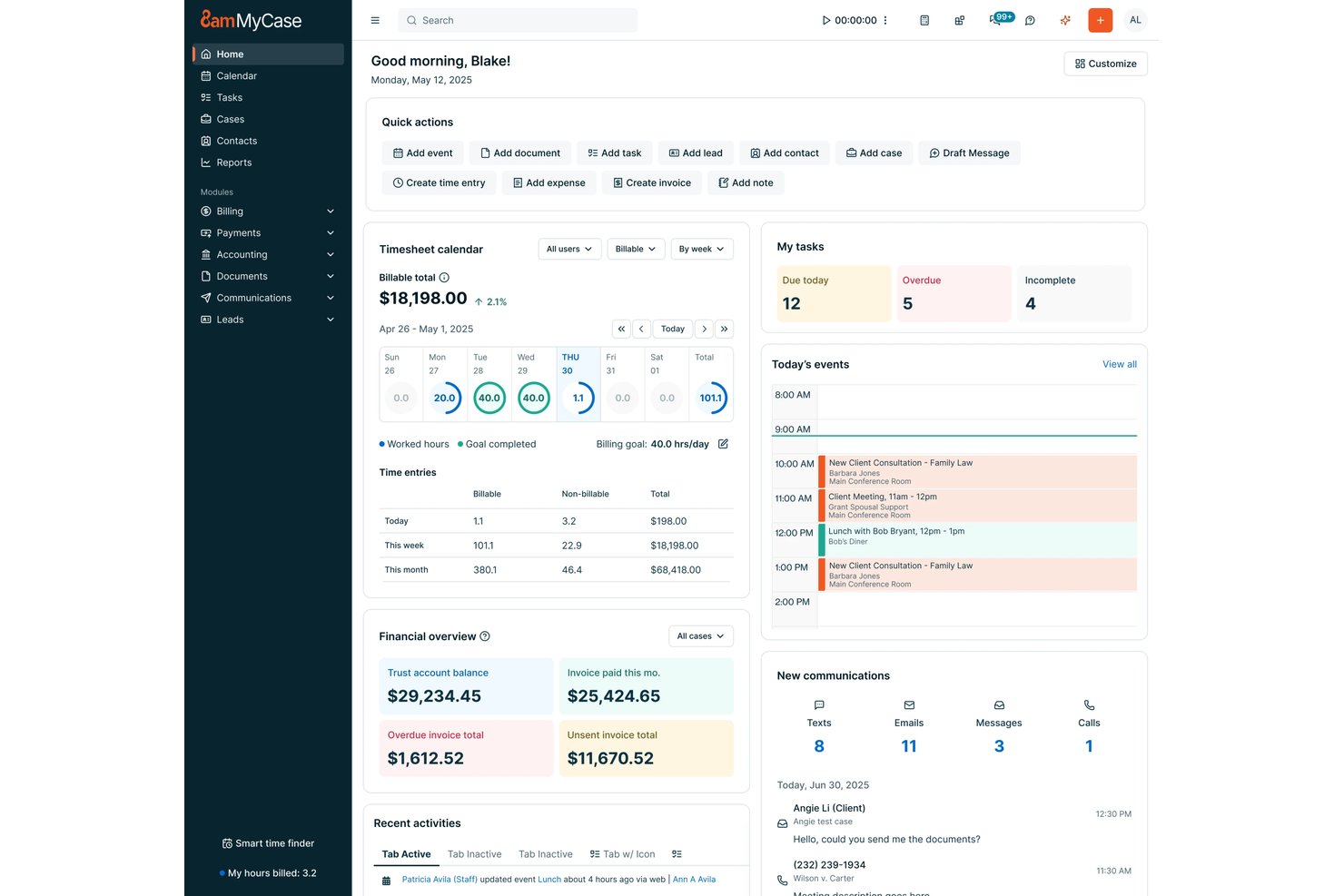
8am is a legal practice management platform designed for paralegals and legal professionals seeking integrated tools for case management, document automation, billing, calendaring, and secure client communications.
Who Is 8am Best For?
Legal teams at small and midsize law firms that want integrated payment, billing, and case management in a single platform.
Why I Picked 8am
I picked 8am as one of the best because I rely on its secure payment processing and compliance-grade billing features, like native trust accounting and built-in LEDES invoicing. My team uses its centralized financial workflows to simplify court-approved payments and client transactions.
8am Key Features
- Matter management: Manage case files, contacts, and notes in one organized workspace.
- Document automation: Create templates and auto-generate legal documents within the platform.
- Legal calendaring: Track deadlines and integrate events with attorney and court calendars.
- Client portal: Share files and communicate securely with clients through a protected portal.
8am Integrations
Native integrations are not currently listed.
Pros and Cons
Pros:
- Native document automation and eSignatures
- Detailed billing and LEDES invoice features
- Built-in trust accounting and compliance workflows
Cons:
- Workflow customization options are somewhat limited
- Customer support can be slow to respond

Best for centralized case and document tracking

PracticePanther is a practical tool for paralegals who need better control over daily legal work. This cloud-based practice management software helps law firms handle case files, organize documents, and communicate with clients in one place. Whether you’re managing multiple matters or working with remote teammates, PracticePanther keeps tasks and information organized so you can focus on supporting your legal team efficiently.
Why I Picked PracticePanther
I picked PracticePanther for its exceptional case management and document management capabilities, which are crucial for paralegals managing multiple legal files and deadlines. The software's secure client portal allows for seamless communication and document sharing, reducing the back-and-forth that often hampers efficiency. Additionally, PracticePanther's automation of client intake forms saves valuable time, allowing you to focus more on client service rather than administrative tasks.
PracticePanther Key Features
In addition to centralized case and document tracking, PracticePanther offers:
- eSignature: This feature allows you to send documents for electronic signatures, reducing the need for physical paperwork and speeding up the approval process.
- Two-Way Business Texting: Enables you to communicate directly with clients via text messages, making it easier to keep them updated on case progress.
- Trust Accounting: Helps you manage client funds in compliance with legal standards, ensuring transparency and accuracy in financial handling.
- Customizable Workflows: Tailor processes to specific practice needs, enhancing productivity by automating routine tasks.
PracticePanther Integrations
Integrations include QuickBooks Online, LawPay, Zapier, Box, Mailchimp, Dropbox, Google Calendar, Microsoft Outlook, OneDrive, and CalendarRules.
Pros and Cons
Pros:
- Client management tools keep matters well structured
- Built-in billing tools improve payment collection workflow
- Automates administrative tasks, saving significant time weekly
Cons:
- Mobile app navigation feels limited and clunky
- Customization options might be limited for specific needs
New Product Updates from PracticePanther

PantherAccounting Plus Unveiled
PracticePanther launches PantherAccounting Plus, enhancing financial management for law firms. It enables law firms to manage trust and operating accounting directly within the platform. For more information, visit PracticePanther's official site.
 .
.
MyCase
Best for client communication and collaboration

MyCase is a legal practice management software that focuses on enhancing client communication and collaboration. It offers a secure and user-friendly platform for managing cases and communicating with clients, making it the top choice for law firms that prioritize client interaction.
Why I Picked MyCase: I selected MyCase for this list due to its exceptional capabilities in facilitating seamless communication between law firms and their clients. MyCase stands out from the competition with its emphasis on client collaboration, making it the best choice for law firms looking to improve their client communication and engagement.
Standout features & integrations:
Key features of MyCase include its secure client portal, case management, document storage, and online payments. The secure client portal enables law firms to communicate and collaborate with clients efficiently, while the case management tools help to organize and track case-related information.
MyCase integrates with popular applications such as QuickBooks Online, Microsoft Office 365, and Google Workspace.
Pros and Cons
Pros:
- Integrates with popular productivity tools
- User-friendly interface
- Strong emphasis on client communication and collaboration
Cons:
- Pricing might be high for smaller law firms
- Limited customization options compared to some competitors
- No monthly billing option, annual commitment required

Best for Canadian legal practitioners
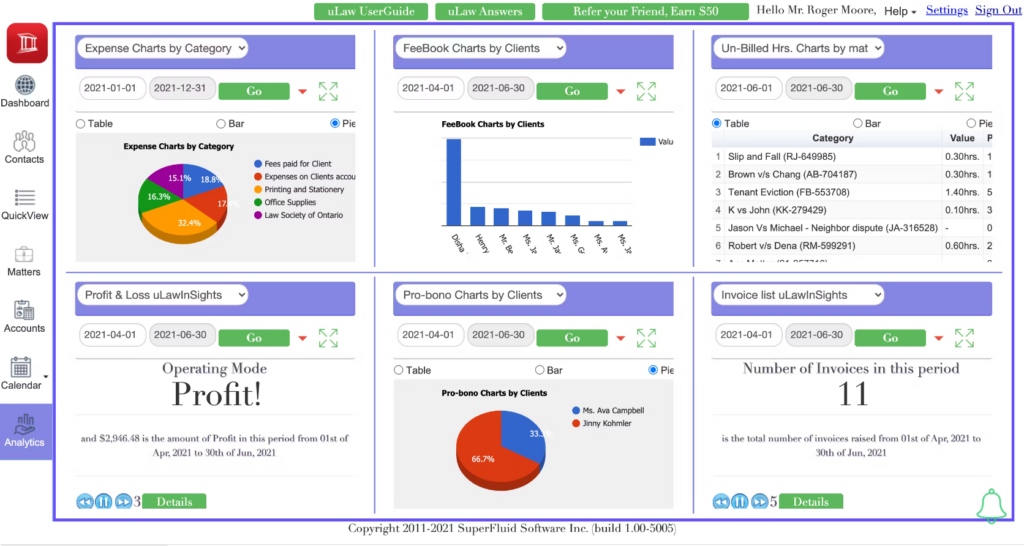
uLawPractice is a legal practice management software specifically designed for Canadian legal practitioners. It offers comprehensive features that cater to the unique regulatory requirements and legal landscape in Canada, making it the top choice for Canadian lawyers and law firms.
Why I Picked uLawPractice: I picked uLawPractice for this list because it stands out as a tailored solution for Canadian legal professionals. Its focus on Canadian legal compliance and its comprehensive features specifically designed for the Canadian legal market make it the best choice for practitioners in Canada.
Standout features & integrations:
Key features of uLawPractice include trust accounting, case management, timekeeping, and billing, all designed to comply with Canadian legal regulations. The platform also offers comprehensive reporting to ensure law firms can meet the unique requirements of Canadian legal practice.
uLawPractice integrates with popular tools such as Microsoft Office 365, Google Workspace, and QuickBooks Online.
Pros and Cons
Pros:
- Integrates with popular productivity tools
- Compliant with Canadian legal regulations
- Tailored for Canadian legal practitioners
Cons:
- No monthly billing option, annual commitment required
- Lacks some advanced features found in other tools
- Not suitable for non-Canadian law firms

Best for creating document templates

HotDocs is a robust document automation software designed to help the creation, generation, assembly, and preparation of complex documents. Commonly used in legal, financial, and government sectors, HotDocs can help reduce the time and effort needed to produce client or customer-specific documents.
Why I Picked HotDocs: One of the most notable features is its document assembly capabilities, which automate the creation of routine legal documents. This automation not only saves time by reducing the need for repetitive data entry but also minimizes the risk of errors. By converting frequently used documents into reusable templates, HotDocs ensures that each document is consistent and complies with legal standards.
Standout features & integrations:
Key features of HotDocs include conditional logic which helps users create dynamic documents by incorporating if/then statements. It also offers batch document processing, digital signatures, and options to perform sophisticated calculations within documents.
HotDocs integrates with Salesforce, Microsoft Dynamics, Sage, Microsoft 365, Microsoft Word, Tabs3, Mitratech Matter Management, Actionstep, Amicus Attorney, and AbacusLaw.
Pros and Cons
Pros:
- Good document workflow automation
- Scalable for growing firms
- Customizable templates
Cons:
- Can be expensive for smaller firms
- Can take time to learn how to create templates

Best for customizable workflows and practice areas

Actionstep is a comprehensive legal practice management software with a strong emphasis on customizable workflows and support for various practice areas. Its adaptability and wide range of features make it the best choice for law firms that require tailored solutions for their unique needs.
Why I Picked Actionstep: I selected Actionstep for this list because its customizable workflows and support for multiple practice areas make it stand out from other legal practice management tools. I believe it is the best option for law firms that need a flexible platform capable of adapting to their specific requirements and practice areas.
Standout features & integrations:
Actionstep's most valuable features include its customizable workflows, matter management, and automation capabilities.
Additionally, it integrates with essential tools like Microsoft Office 365, Xero, and LawPay, allowing for seamless collaboration and financial management.
Pros and Cons
Pros:
- Integrates with popular productivity and financial tools
- Supports multiple practice areas
- Highly customizable workflows
Cons:
- Limited integrations compared to some other practice management tools
- Some users may find the customization options overwhelming
- Annual billing commitment required

LEAP
Best for solo and small law firms

LEAP is a legal practice management software designed specifically for solo practitioners and small law firms. Its user-friendly interface and tailored features make it the best choice for smaller practices seeking a comprehensive solution.
Why I Picked LEAP: I chose LEAP for this list because it's well-suited to the unique needs of solo and small law firms. Its intuitive design and focus on smaller practices set it apart from other legal practice management tools. I believe it's the best option for smaller firms looking for an all-in-one solution that's easy to use and navigate.
Standout features & integrations:
LEAP's most notable features include matter management, document automation, and integrated billing. It also integrates with essential tools like Microsoft Office 365, LawPay, and QuickBooks Online, making it easy to streamline operations and maintain efficiency in a small law firm.
Pros and Cons
Pros:
- Integrates with popular productivity and financial tools
- User-friendly interface
- Tailored for solo and small law firms
Cons:
- Limited customization options compared to some other practice management tools
- Annual billing commitment required
- Expensive for smaller firms on a budget

Best for comprehensive case management

AbacusLaw is a law practice management software designed to help law firms streamline their operations and manage cases effectively. It is an all-in-one solution that automates the essential aspects of law practice, making it the best choice for comprehensive case management.
Why I Picked AbacusLaw: I chose AbacusLaw for this list because it offers a robust and feature-rich platform that simplifies the process of managing cases, documents, and financials for law firms. In comparison to other tools, AbacusLaw provides a more comprehensive approach to case management, making it the best choice for law firms seeking an all-inclusive solution.
Standout features & integrations:
AbacusLaw's most significant features include case management, document automation, calendaring, and billing. These tools allow users to manage their cases effectively, streamline document creation, and stay organized with their schedules.
Some of the most important integrations provided by AbacusLaw include Microsoft Office, QuickBooks, and Abacus Private Cloud.
Pros and Cons
Pros:
- Integrates well with popular productivity tools
- Streamlines document creation through automation
- Comprehensive case management features
Cons:
- Learning curve for first-time users
- Requires an annual commitment
- Can be expensive for smaller law firms


Thomson Reuters is a leading provider of legal research and analytics tools, offering a wide range of solutions for legal professionals. Its expertise in legal research and advanced analytics capabilities make it the best choice for those seeking accurate and comprehensive legal information.
Why I Picked Thomson Reuters: I chose Thomson Reuters for this list because its legal research and analytics tools are unparalleled in the industry. After comparing multiple options, I determined that Thomson Reuters stands out for its extensive legal content, sophisticated analytics, and innovative research technology, making it the best choice for legal research and analytics.
Standout features & integrations:
Some of the most important features of Thomson Reuters include its comprehensive legal research platform, Westlaw Edge, and its cutting-edge analytics tools, such as Litigation Analytics and Quick Check Judicial.
Key integrations include Practical Law, which provides practical guidance and resources for legal professionals, and Drafting Assistant, which assists in document drafting and review.
Pros and Cons
Pros:
- Continuous innovation in legal research technology
- Advanced analytics tools for data-driven insights
- Extensive legal content and resources
Cons:
- Learning curve for some features and tools
- May be expensive for smaller firms or solo practitioners
- Pricing information is not transparent

Redactable
Best for automated redaction

Redactable is a cloud-based document redaction tool designed to help organizations efficiently and securely remove sensitive information from PDF documents.
Why I Picked Redactable: Redactable's AI capabilities automatically detect and remove sensitive information, ensuring that no critical details are overlooked. This feature is particularly beneficial for paralegals who handle large volumes of documents, as it reduces the risk of human error and ensures compliance with data protection regulations. Additionally, Redactable's Redaction Wizard offers the convenience of single-click redaction for documents containing many pages.
Standout features & integrations:
Key features include document scrubbing, which permanently removes metadata and hidden elements to ensure the security of redactions. It also offers real-time collaboration tools, version control, and redaction certificates.
Redactable integrates with Google Drive, Dropbox, OneDrive, and Box.
Pros and Cons
Pros:
- Offers collaboration tools
- Complies with GDPR and other privacy regulations
- Uses AI to enhance its redaction process
Cons:
- Not ideal for broader legal document management
- Limited number of redactions per plan
Other Software for Paralegals
Here are some additional software for paralegals options that didn’t make it onto my shortlist, but are still worth checking out:
- Law Ruler Software
For legal CRM and intake automation
- Soluno
Good for robust timekeeping and billing
- Assembly
For document assembly and automation
- Quickbase
Good for customizable app development
- Checkbox
Good for creating legal automation apps
- CosmoLex
Good for all-in-one legal practice management
- Filevine
Good for comprehensive case management
- Smokeball
Good for automated document management
- Clio
Good for streamlining legal practice workflows
- Rocket Matter
Good for streamlined billing and invoicing
- Disco
Good for AI-driven ediscovery efficiency
- Lawyaw
Good for easy document drafting and editing
- Spellbook
Good for automating document generation


How I Evaluate Software for Paralegals
I split my evaluation into must-have fundamentals—like matter management and legal calendaring—and differentiators that separate the best tools from the rest.
Core Functionality (Table Stakes For This List)
When I'm selecting tools for my list, I rank each one on a scale from 0 (does not offer the functionality) to 5 (excels in this area) for each core functionality listed below. Then, I calculate the tool's total score into a percentage. Each tool needs to achieve a minimum total score of 65% to be considered for inclusion.
- Case & Matter Management: I look for a centralized hub where paralegals can pull up a matter and instantly see linked contacts, notes, documents, and related cases without toggling between screens.
- Document Management & Automation: Template-based drafting is key here—I check whether paralegals can generate standard pleadings, engagement letters, or discovery requests from reusable templates with auto-populated fields.
- Legal Calendaring & Deadlines: I evaluate whether the platform supports court rules-based calendaring, since manually calculating motion response deadlines or statute-of-limitations dates is a recipe for malpractice risk.
- Time Tracking & Billing Support: Paralegals need to log billable hours directly against matters. I look for built-in timers, batch time entry, and the ability to generate client-ready invoices or export in LEDES format.
- Task & Workflow Management: I check for workflow templates that mirror real legal processes—like client intake checklists, discovery response sequences, or closing binders—with task assignment and status tracking across team members.
- Client & Court Communication Tools: Secure client portals, e-signature integration, and e-filing support all fall here. I evaluate how well the tool handles sensitive document exchange beyond basic email.
Once I have a list of tools that meet this criteria, I consider what sets each platform apart.
Differentiating Factors (What Sets Vendors Apart)
Here's how I compare and contrast different vendors:
Standout Features
Conflict checking is a feature I weigh heavily—before a firm takes on new work, paralegals need to run automated searches across all contacts and matters to flag potential ethical issues. Trust accounting with IOLTA compliance also separates stronger platforms, especially for firms that manage retainers and need three-way reconciliation built into the system. AI-powered document review is another differentiator I evaluate, looking at whether a tool can summarize depositions, extract key clauses, or redact sensitive information during discovery.
Beyond Features
Compliance matters—I check whether a platform meets SOC 2 Type II standards and offers role-based access controls, since paralegals routinely handle privileged client data. Integration fit is equally important; I look at whether a tool connects with Microsoft 365, DocuSign, and billing platforms like LawPay that legal teams already rely on. I also consider firm size and practice area fit, since a litigation paralegal at a mid-size firm has very different workflow needs than a solo immigration paralegal.
How to Choose Software for Paralegals
It’s easy to get bogged down in long feature lists and complex pricing structures. To help you stay focused as you work through your unique software selection process, here’s a checklist of factors to keep in mind:
| Factor | What to Consider |
|---|---|
| Scalability | Will the software grow with your firm? Consider if it can handle increased caseloads or additional users without extra costs or performance issues. |
| Integrations | Does it work with existing tools like email or document management systems? Check for seamless data sharing and reduced manual entry. |
| Customizability | Can you tailor the software to fit your specific workflows? Look for options to modify templates and user interfaces to match your team's needs. |
| Ease of use | Is the software intuitive for all team members? A simple interface with clear navigation can save time and reduce training needs. |
| Implementation and onboarding | How long will it take to get up and running? Assess the availability of training resources and support to ensure a smooth transition. |
| Cost | Are there hidden fees? Compare pricing models and consider long-term costs, including upgrades and support fees. |
| Security safeguards | Does it meet industry security standards? Ensure data encryption and regular security updates are part of the package. |
| Compliance requirements | Does it align with legal regulations like GDPR or HIPAA? Verify that the software includes features to support compliance with necessary legal standards. |
What Is Software For Paralegals?
Software for paralegals supports the workflow and tasks of paralegals in legal practices to streamline their work processes, improve efficiency, and enhance productivity. It offers a range of functionalities, including document management, eDiscovery, case management, time tracking, calendaring, legal research, and communication tools.
By leveraging these software solutions, paralegals can effectively manage their workload, maintain accurate records, track deadlines, and improve overall efficiency within the legal practice.
Features
When selecting software for paralegals, keep an eye out for the following key features:
- Document management: Organizes and stores legal documents securely, making it easy to access and share files.
- Time tracking: Monitors billable hours efficiently, ensuring accurate client billing.
- Case management: Helps manage case details, deadlines, and tasks, keeping everything organized in one place.
- Client communication: Facilitates direct communication with clients, improving client relationships and service.
- Compliance support: Ensures adherence to legal standards and regulations, reducing the risk of non-compliance issues.
- Integration capabilities: Connects with other tools like email and calendars to streamline workflow and data sharing.
- Customizable workflows: Allows tailoring of processes to fit specific firm needs, enhancing efficiency.
- Mobile access: Provides the ability to work from anywhere, increasing flexibility and productivity.
- Security measures: Protects sensitive legal data with encryption and regular security updates.
- Training resources: Offers instructional materials like videos and tutorials to ease the onboarding process.
Benefits
Implementing software for paralegals provides several benefits for your team and your business. Here are a few you can look forward to:
- Improved organization: Centralizes case files and documents, making it easier to manage information and deadlines.
- Increased efficiency: Automates repetitive tasks like time tracking and document generation, saving time and reducing errors.
- Enhanced client service: Facilitates better communication and faster response times, improving client satisfaction.
- Cost savings: Reduces manual administrative work, allowing your team to focus on billable tasks and increase revenue.
- Greater compliance: Keeps you aligned with legal standards through compliance support, reducing the risk of penalties.
- Flexibility: Enables work from anywhere with mobile access, offering your team more flexibility and productivity.
- Data security: Protects sensitive information with advanced security measures, ensuring client confidentiality.
Costs & Pricing
Selecting software for paralegals requires an understanding of the various pricing models and plans available. Costs vary based on features, team size, add-ons, and more. The table below summarizes common plans, their average prices, and typical features included in software for paralegals solutions:
Plan Comparison Table for Software for Paralegals
| Plan Type | Average Price | Common Features |
|---|---|---|
| Free Plan | $0 | Basic document management, limited case management, and essential time tracking. |
| Personal Plan | $10-$30/user/month | Document management, basic integrations, client communication, and standard security measures. |
| Business Plan | $40-$80/user/month | Advanced document management, full case management, mobile access, and compliance support. |
| Enterprise Plan | $100-$200/user/month | Customizable workflows, full integrations, enhanced security, dedicated support, and extensive reporting. |
Software for Paralegals FAQs
Here are some answers to common questions about software for paralegals:
How can software for paralegals improve productivity?
Software for paralegals improves productivity by automating routine tasks like document management, time tracking, and case scheduling. This automation frees up time for more complex work, reduces errors, and ensures that legal processes run smoothly, allowing your team to focus on more strategic tasks.
Is training available for new users of paralegal software?
Yes, most paralegal software providers offer training resources for new users. These may include tutorials, webinars, and interactive guides to ease the onboarding process. Access to comprehensive training ensures that your team can quickly adapt to the new system and maximize its benefits.
How does software for paralegals ensure data security?
Paralegal software ensures data security through encryption, secure access controls, and regular security updates. These measures protect sensitive legal information from unauthorized access and data breaches, helping your firm comply with legal standards and maintain client confidentiality.
How easy is it to migrate existing case data into new software?
Data migration is often the trickiest part of a switch. You should check if the vendor offers import tools, API support, or migration services. Also see whether they’ll map your old fields and formats cleanly into the new system, or if you’ll need manual cleanup. A good proof of concept or sample migration helps you test before full rollout.
What’s Next:
If you're in the process of researching software for paralegals, connect with a SoftwareSelect advisor for free recommendations.
You fill out a form and have a quick chat where they get into the specifics of your needs. Then you'll get a shortlist of software to review. They'll even support you through the entire buying process, including price negotiations.