

10 Best Small Law Firm Document Management Tools for 2026

10 Best Small Law Firm Document Management Software Shortlist


I understand how critical the right document management software can be for your firm. The best legal document management software needs to accommodate specific practice areas, streamline case management, and improve communication with effective messaging tools. It should be flexible enough to work on Mac as well as on-premise systems, conforming to the unique demands of the legal industry.
Document management tools solve the pain points associated with document storage, retrieval, collaboration, and security—issues that most practitioners in the legal field grapple with daily. With the right software, you will have more time to dedicate to what really matters: your clients.
Why Trust Our Software Recommendations
Our team has been testing and reviewing software since 2012. As legal practice leaders ourselves, we know how difficult—and important—it is to choose the right software.
For this guide, we evaluated tools using hands-on testing and independent research, scoring tools using our selection criteria.
Our reviews reflect our human editorial judgment, not a sales pitch.
Small Law Firm Document Management Software Comparison Table
This comparison table summarizes pricing details for my top small law firm document management software selections:
| Tool | Best For | Trial Info | Price | ||
|---|---|---|---|---|---|
| 1 | Best for task and document collaboration | Free trial available | Pricing upon request | Website | |
| 2 | Best for Microsoft 365 integration | 30-day free trial | From $4.15/user/month (billed annually) | Website | |
| 3 | Best for comprehensive legal practice management and document storage | Free trial available | From £79/user/month | Website | |
| 4 | Best for case-centric document organization | Free demo available | Pricing upon request | Website | |
| 5 | Best for legal accounting and document management | 10-day free trial | From $49/user/month (billed annually) | Website | |
| 6 | Best for robust data analytics and insightful reporting | Free demo available | Pricing upon request | Website | |
| 7 | Best for metadata-driven search and accessibility | Free demo available | From $65/user/month | Website | |
| 8 | Best for secure cloud-based document management | Free demo available | Pricing upon request | Website | |
| 9 | Best for client engagement with secure file sharing | Free demo available | Pricing upon request | Website | |
| 10 | Best for seamless integration and workflow automation | Free demo available | Pricing upon request | Website |
Best Small Law Firm Document Management Software Review
Below are my detailed summaries of the best small law firm document management software that made it onto my shortlist. My reviews offer a detailed look at the key features, pros & cons, integrations, and ideal use cases of each tool to help you find the best one for you.

8am
Best for task and document collaboration
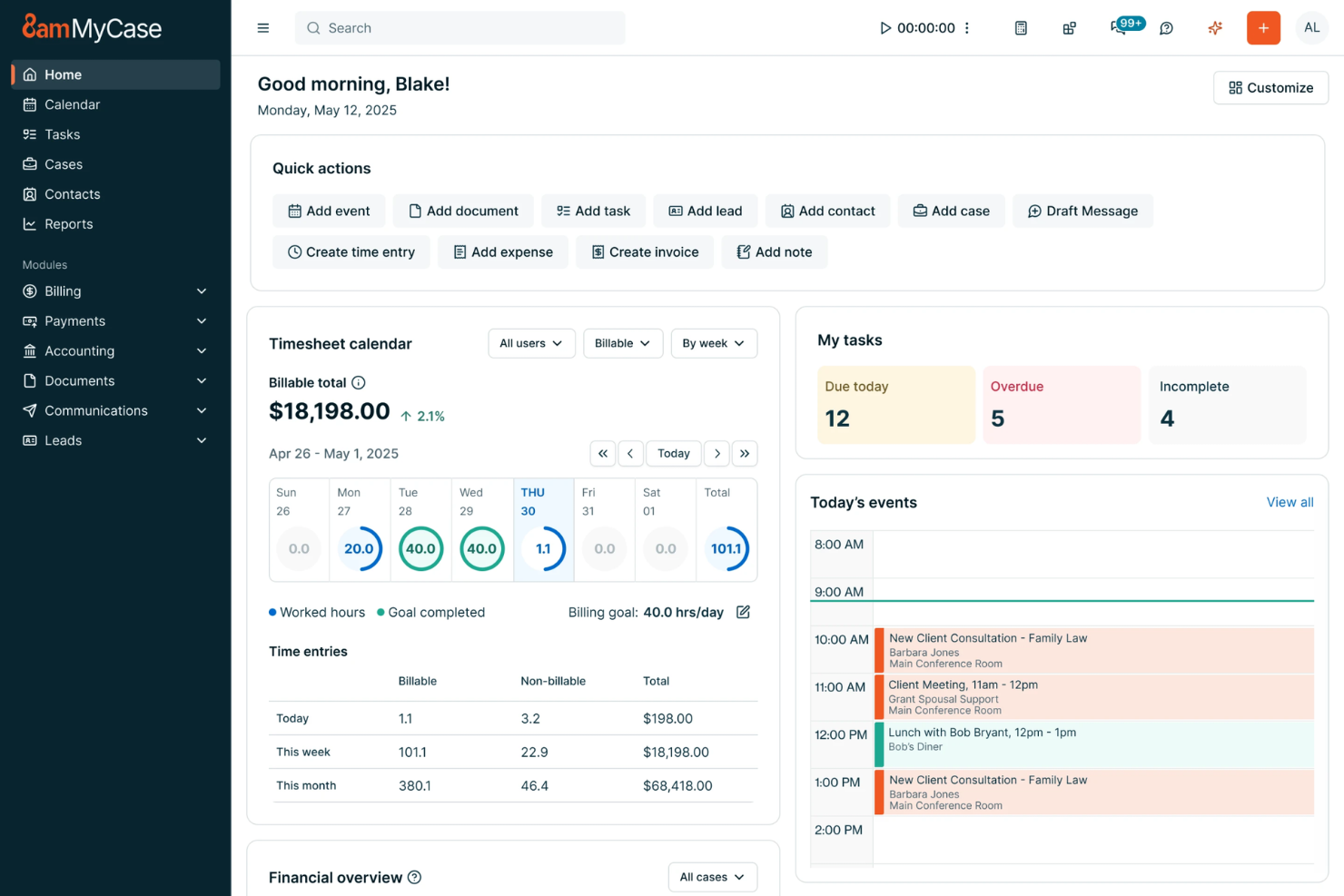
8am MyCase helps small law firms organize case documents, client communications, deadlines, time entries, and billing without switching between separate systems. Its case-linked document management and built-in legal workflows make it best suited for solo attorneys and small legal teams seeking an all-in-one practice management platform.
Who Is 8am Best For?
8am is a good fit for solo attorneys and small law firms that need a single platform to manage cases, documents, and client communication without juggling multiple tools.
Why I Picked 8am
I picked 8am MyCase because it connects documents, tasks, deadlines, and client activity within each case record, helping small law firms avoid switching between separate systems. Your team can assign tasks alongside the relevant files, making it easier to understand what needs attention and why. Workflow automation can create tasks and documents when a case reaches a specific stage, reducing missed steps in repeatable legal processes. I also like that MyCase Drive syncs desktop file changes to the cloud, so team members can work from the most current document version.
8am Key Features
- Document automation: Generate court-ready documents from pre-built Word templates populated with case and client data.
- Unlimited eSignature: Send documents for electronic signature directly from the platform without a third-party tool.
- Secure client portal: Share case documents with clients through an encrypted portal where they can view and upload files.
- Full-text document search: Locate any file across your case library using keyword search powered by OCR scanning.
8am Integrations
Integrations include Dropbox, NetDocuments, Gmail, Microsoft Outlook, Google Calendar, QuickBooks Online, Mailchimp, LawToolBox, InfoTrack, and Lawmatics.
Pros and Cons
Pros:
- Secure client portal supports document sharing and electronic signatures
- Organizes documents, tasks, and communications within each case record
- MyCase Drive syncs desktop edits directly with cloud files
Cons:
- Simultaneous document editing can create conflicting or outdated versions
- Large case folders may load slowly on weaker computers


For small law firms seeking to enhance their document management capabilities, MacroView offers a tailored solution that aligns with the specific needs of legal professionals. By integrating seamlessly with Microsoft platforms, MacroView simplifies the organization, storage, and retrieval of documents and emails.
Why I Picked MacroView
I picked MacroView for small law firms because of its unique ability to integrate directly with Microsoft 365, providing a familiar interface that encourages user adoption. This integration allows your team to save emails and attachments directly to SharePoint, Teams, and OneDrive, reducing the time spent on manual filing. I also appreciate its customizable document generation and filing automation features, which help maintain consistent document management practices. These capabilities address the need for efficient organization and secure storage, making MacroView an ideal choice for small legal practices.
MacroView Key Features
In addition to its Microsoft 365 integration, I also found several other features that enhance its functionality for small law firms:
- Email Management: Allows you to save emails and attachments directly to SharePoint, Teams, and OneDrive, facilitating easy retrieval and organization.
- Document Assembly: Provides tools for creating standardized documents quickly, ensuring consistency across your practice.
- SharePoint Migration: Offers specialized tools for moving existing documents to SharePoint, simplifying the transition to a digital document management system.
- Records Management: Supports compliance by automating records retention and disposal, reducing the risk of non-compliance.
MacroView Integrations
Integrations include Microsoft SharePoint, Microsoft Teams, Microsoft OneDrive, Microsoft Outlook, Microsoft Word, and Microsoft Excel.
Pros and Cons
Pros:
- Automated metadata capture improves document organization.
- Familiar file-explorer-style interface simplifies user navigation.
- Seamless integration with Microsoft 365 enhances existing tools.
Cons:
- Not ideal for organizations not using Microsoft products.
- Limited support for mobile applications restricts accessibility.
Clio
Best for comprehensive legal practice management and document storage

Clio is a web-based legal practice management software that provides an all-encompassing suite of tools, making it possible for law firms to manage cases, clients, and documents from a single platform. The platform's wide-ranging capabilities, particularly its robust document storage features, make it an exceptional choice for comprehensive legal practice management and document storage.
Why I Picked Clio: I chose Clio for this list because of its breadth of features and its standout document storage capabilities. Compared to other similar tools, Clio's offering is comprehensive, giving users a wide array of tools and features. Moreover, its document storage system is one of the most robust I've seen, leading me to decide that it's the best tool for comprehensive legal practice management and document storage.
Standout features & integrations:
Clio offers a suite of features like time tracking, billing, case management software, and especially document storage. The document management system allows for secure storage, easy organization, e-signature, automated template, and quick retrieval of documents.
Clio integrates well with many other tools, such as Dropbox, QuickBooks, Google Workspace, and Microsoft 365, which enhances its functionality and flexibility.
Pros and Cons
Pros:
- Wide array of integrations with popular software
- Robust document storage capabilities
- Comprehensive set of features for full-scale practice management
Cons:
- Advanced features may require more expensive plans
- Learning curve may be steep due to the vast number of features
- The cost may be higher compared to more basic tools

Filevine
Best for case-centric document organization

Filevine offers a comprehensive document management solution, primarily catering to law firms seeking organized, case-centric document systems. It seamlessly centralizes all relevant case files and materials, facilitating improved organization and access.
Why I Picked Filevine: I picked Filevine because it brings a case-focused approach to document management. This design differs from many other tools which organize documents based on types or departments. I believe Filevine to be the "Best for" case-centric document organization as it allows users to intuitively navigate case materials, streamlining the process of locating pertinent documents.
Standout features & integrations:
Filevine comes packed with useful features such as case timelines, task management, and custom reports. Moreover, its ability to integrate with popular services like Gmail, Outlook, and Dropbox significantly enhances productivity and workflow efficiency.
Pros and Cons
Pros:
- Includes features for task management and custom reports
- Integration with popular email and cloud storage services
- Case-centric design for enhanced document organization
Cons:
- May require an initial learning curve for those used to different document organization methods
- Premium plans are needed for a full range of features
- Higher starting price compared to some competitors

CosmoLex
Best for legal accounting and document management

CosmoLex is a specialized tool that offers both legal accounting and document management capabilities. With this solution, legal firms can track their financials while also managing their critical documents, essentially bringing two crucial functions together in a single platform.
Why I Picked CosmoLex: In my selection process, I chose CosmoLex because it fills a unique niche by combining legal accounting with document management. It stands out by consolidating these two critical areas into one platform, eliminating the need for multiple disparate systems. This integrated approach makes CosmoLex the best for legal accounting and document management, especially for law firms aiming to streamline their operations.
Standout features & integrations:
CosmoLex comes with a host of essential features like time and expense tracking, comprehensive reporting, and secure document and file storage. It integrates with tools such as LawPay for secure payment processing and Box for additional document storage capabilities.
Pros and Cons
Pros:
- Offers a comprehensive suite of features
- Integrates with LawPay and Box
- Combines legal accounting and document management
Cons:
- The interface may have a learning curve for some users
- Pricing may be high for smaller firms
- May not be suitable for firms not needing legal accounting features

Best for robust data analytics and insightful reporting

Caret LEGAL provides a versatile platform for law firms, revolutionizing their workflow by offering robust data analytics and insightful reporting. By processing large volumes of data, this software generates meaningful insights that aid in decision-making and enhance productivity.
Why I Picked Caret LEGAL: In my analysis of document management tools, I selected Caret LEGAL for its emphasis on data-driven insights and superior reporting capabilities. I found that it outperformed its counterparts when it came to its data analysis capabilities, making it an ideal solution for firms that prioritize data-driven decision-making. This software is "best for" robust data analytics and insightful reporting as it can transform raw data into actionable insights, aiding lawyers in optimizing their strategies and improving client outcomes.
Standout features & integrations:
Key features of Caret LEGAL include smart document tracking, team collaboration tools, and customizable dashboards for data visualization. These features all support the software's primary strength: turning data into a valuable resource.
In terms of integrations, Caret LEGAL is compatible with a variety of popular productivity tools such as Google Workspace, Microsoft 365, and Sharepoint, allowing for a smooth transition and simplified workflow.
Pros and Cons
Pros:
- Smart document tracking for easier document retrieval
- Integrates with popular productivity tools for seamless collaboration
- Advanced analytics capabilities for data-driven decision-making
Cons:
- Annual billing might not be ideal for all firms
- Learning curve for those unfamiliar with data analytics
- Pricing is on the higher side for small law firms

M-Files
Best for metadata-driven search and accessibility

M-Files is a dynamic legal document management system designed to handle and manage documents based on what they are (metadata) rather than where they are stored. This approach promotes an intuitive and comprehensive search, cementing its position for metadata-driven search and accessibility.
Why I Picked M-Files: The reason I chose M-Files is its unique, metadata-based approach to document management. It stands out with its ability to organize and locate documents based on content, providing a more intelligent and intuitive system for managing a plethora of legal documents. Therefore, I believe M-Files is "Best for" metadata-driven search and accessibility, offering a solution that cuts through the clutter and directly addresses the document you seek.
Standout features & integrations:
M-Files excels with features such as automated workflows, secure mobile access, and electronic signatures. Plus, its extensive integration capabilities with systems like Salesforce, Microsoft Dynamics, SAP, and NetSuite make it a flexible solution for diverse firm needs.
Pros and Cons
Pros:
- Offers secure mobile access and electronic signature features
- Extensive integration capabilities with various systems
- Unique metadata-based approach for precise document searching
Cons:
- Metadata-based approach may require a shift in user habits and expectations
- The interface may be less user-friendly compared to some competitors
- One-time setup fee not included in the monthly cost

Best for secure cloud-based document management

NetDocuments provides a robust document management platform that relies on secure, cloud-based technology. This platform focuses on facilitating efficient document handling and storage while prioritizing data security.
Why I Picked NetDocuments: I chose NetDocuments for its impressive commitment to secure, cloud-based solutions for document management. Compared to other tools, its emphasis on high-grade security standards sets it apart. In my view, NetDocuments is "Best for" secure cloud-based document management due to its rigorous data protection measures alongside its robust document handling features.
Standout features & integrations:
NetDocuments boasts important features like version control, full-text search, and an intuitive user interface. It also integrates seamlessly with API and many popular software suites, including Microsoft Office, facilitating streamlined workflows and better productivity.
Pros and Cons
Pros:
- User-friendly interface and efficient document handling
- Integration with Microsoft Office and other popular software
- High-grade security features
Cons:
- Can be complex to set up initially, requiring a learning curve
- Full feature access requires higher-priced plans
- More expensive starting price compared to some competitors

HighQ
Best for client engagement with secure file sharing

HighQ is a tool that serves as a secure platform for document management and collaboration, enhancing client engagement with secure file sharing. Its focus is facilitating productive, interactive work environments while maintaining high-security standards.
Why I Picked HighQ: I selected HighQ because of its balanced focus on secure document sharing and client engagement. What differentiates HighQ is its client-centric approach to document management, making it an ideal pick. In my opinion, it stands as the "Best for" client engagement with secure file sharing, particularly due to its strong emphasis on collaboration, accessibility, and security.
Standout features & integrations:
HighQ provides a collaborative workspace that includes features such as task management, file synchronization, and secure file sharing. It integrates well with a host of third-party applications, including Microsoft Office, which enhances its usability and functionality.
Pros and Cons
Pros:
- Integration with Microsoft Office and other third-party applications
- Excellent collaboration tools for client engagement
- Robust security features for file sharing
Cons:
- It may take some time to fully understand and utilize all its features
- The full range of features requires a more expensive plan
- Higher starting price than some competitors

Centerbase
Best for seamless integration and workflow automation

Centerbase, a versatile document management software, brings integration and workflow automation to the forefront of its features. It offers comprehensive tools designed to unify all your law firm operations, making it ideal for streamlining workflows and promoting efficient collaboration.
Why I Picked Centerbase: In my quest for the most effective tools, I chose Centerbase for its strong focus on unifying various processes through integration and automation. Its unique selling point lies in its capability to tie in all aspects of law firm operations, eliminating disjointed systems and improving efficiency. I identified Centerbase as "best for" seamless integration and workflow automation as it reduces manual work and allows for a more coordinated approach to case management.
Standout features & integrations:
Centerbase stands out with its advanced billing and accounting features, a client portal for better engagement, and customizable workflows to adapt to your firm's specific needs.
In terms of integrations, Centerbase pairs well with a host of productivity tools, such as Microsoft 365, QuickBooks, and LawPay, enabling a smooth and continuous work process.
Pros and Cons
Pros:
- Advanced billing and accounting features
- Customizable workflows allow for firm-specific optimization
- Provides a unified system for various law firm operations
Cons:
- It requires a yearly commitment which might not suit all firms
- Initial setup can be complex due to its comprehensive features
- The cost might be high for very small law firms
Other Small Law Firm Document Management Software
Here are some additional small law firm document management software options that didn’t make it onto my shortlist, but are still worth checking out:
- iManage Work
For integrated email and document management
- Redactable
For automated redaction
- Disco
For e-discovery with AI-driven insights
- Ontra
For AI-powered document assembly and management
- Document360
For legal approval pipelines
- PracticePanther
For intuitive navigation and organization
- LEAP
Good for matter-centric document management
- Actionstep
Good for workflow-driven document management
- Smokeball
Good for automated legal form filling and document assembly
- LinkSquares
Good for AI-driven contract analytics
- LegalTrek
Good for project management-oriented document management
- HoudiniESQ
Good for document management with real-time analytics
- Legal Files
Good for comprehensive case and matter management
- PerfectLaw
Good for all-in-one document management and legal software
- Amicus Attorney
Good for document management with built-in legal calendaring
- Newgen
Good for robust scalability in document management
- ProTempus
Good for integrated time, billing, and document management
- Legal Works
Good for secure and compliant document management


How I Evaluate Small Law Firm Document Management Software
I evaluate tools against two layers: baseline requirements like matter-centric filing and secure client portals, then differentiators that set apart the best fits for small-firm practice.
Core Functionality (Table Stakes For This List)
When I'm selecting tools for my list, I rank each one on a scale from 0 (does not offer the functionality) to 5 (excels in this area) for each core functionality listed below. Then, I calculate the tool's total score into a percentage. Each tool needs to achieve a minimum total score of 65% to be considered for inclusion.
- Matter-Centric File Organization: I check whether documents are structured around client/matter hierarchies rather than generic folders, so attorneys can pull up everything tied to a case in seconds.
- Legal Document Templates & Assembly: Tools should offer merge-field templates for contracts, pleadings, and correspondence that auto-populate client and matter data from existing records.
- Version Control & Audit Trails: I look for automatic versioning with check-in/check-out and detailed logs showing who opened, edited, or downloaded a file and when.
- Secure Client Sharing & Portals: Each tool's approach to encrypted document exchange matters, whether that's a branded client portal or permission-controlled share links with access tracking.
- Full-Text Search & OCR: I evaluate whether the platform can OCR scanned intake forms and pleadings and return results from inside PDFs, Word files, and emails in one search.
- Legal Practice Management Integration: Connections to tools like Clio, MyCase, or PracticePanther should allow email filing to matters and bi-directional data sync without manual re-entry.
Once I have a list of tools that meet this criteria, I consider what sets each platform apart.
Differentiating Factors (What Sets Vendors Apart)
Here's how I compare and contrast different vendors:
Standout Features
Court e-filing integration is a major differentiator. I look for platforms that let attorneys submit filings directly to state and federal court systems without switching tools. Native e-signature is another feature I evaluate closely, since it removes the need to route engagement letters or settlement agreements through a separate app. I also check for ethical wall controls that restrict document access between matters, which matters when a firm takes on clients with competing interests.
Beyond Features
Pricing structure matters a lot for small firms. I look for per-user plans without enterprise minimums or hidden storage fees that catch a two-attorney practice off guard. Migration support is another factor I weigh, since most small firms are moving from shared drives or Dropbox and need hands-on help transferring years of case files. Security and compliance also factor in. I check for AES-256 encryption and SOC 2 certification, especially when firms handle sensitive matters like family law or personal injury records.
How to Choose Small Law Firm Document Management Software
It’s easy to get bogged down in long feature lists and complex pricing structures. To help you stay focused as you work through your unique software selection process, here’s a checklist of factors to keep in mind:
| Factor | What to Consider |
|---|---|
| Scalability | Consider whether the software can grow with your firm. Ask about user limits and data storage expansion. Choose a tool that won't need replacing as your team or client base grows. |
| Integrations | Check if the software integrates with your existing tools, like billing systems or email platforms. Lack of integration can lead to manual work, so ensure smooth data flow between systems. |
| Customizability | Look for software that allows you to tailor workflows to your firm's needs. Avoid tools that lock you into rigid processes, as flexibility can improve your team's efficiency. |
| Ease of use | Evaluate how intuitive the software is for all users. A steep learning curve can slow down adoption, so prioritize user-friendly interfaces and clear navigation. |
| Implementation and onboarding | Assess the time and resources needed to get started. Tools with guided setups or dedicated onboarding support can save you headaches and ensure a smooth transition. |
| Cost | Compare the pricing models and see if they fit your budget. Watch out for hidden fees or costs for additional features. Aim for transparency in pricing to avoid unexpected expenses. |
| Security safeguards | Ensure the software has strong encryption and data protection measures. Legal documents are sensitive, so top-notch security is non-negotiable. Confirm compliance with relevant regulations like GDPR or HIPAA if applicable. |
What Is Small Law Firm Document Management Software?
Small law firm document management software is a tool designed to help legal professionals store, organize, and manage their documents efficiently. Attorneys, paralegals, and administrative staff typically use these tools to improve workflow and ensure compliance with legal standards. Document storage, file sharing, and version control features help with organization, collaboration, and security. Overall, these tools provide significant time savings and reduce the risk of errors in document handling.
Features
When selecting small law firm document management software, keep an eye out for the following key features:
- Document storage: Allows for efficient organization and easy retrieval of legal documents, saving time and reducing clutter.
- File sharing: Enables secure sharing of documents with clients and colleagues, facilitating collaboration and communication.
- Version control: Keeps track of document changes, ensuring access to the latest versions and reducing errors.
- Access permissions: Provides control over who can view or edit documents, enhancing security and compliance.
- Integration capabilities: Connects with other legal tools and systems, ensuring seamless data flow and reducing manual work.
- Customizable workflows: Allow users to tailor processes to fit their specific needs, improving efficiency and user satisfaction.
- Encryption and security: Protects sensitive legal information with top-notch security measures, ensuring confidentiality and compliance.
- User-friendly interface: Offers an intuitive design that makes navigation easy, encouraging widespread adoption and minimizing training time.
Benefits
Implementing small law firm document management software provides several benefits for your team and your business. Here are a few you can look forward to:
- Time savings: Quickly store and retrieve documents, reducing the time spent searching for files and improving productivity.
- Enhanced collaboration: Share documents easily and securely with colleagues and clients, fostering better communication and teamwork.
- Error reduction: Use version control to ensure everyone accesses the latest document versions, minimizing mistakes and confusion.
- Improved security: Protect sensitive information with encryption and access permissions, ensuring compliance with legal standards.
- Customizable processes: Tailor workflows to fit your firm's specific needs, increasing efficiency and user satisfaction.
- Cost efficiency: Reduce the need for physical storage and paper, leading to cost savings on office supplies and space.
- Scalability: Choose a solution that grows with your firm, allowing you to add users and storage as your business expands.
Costs & Picing
Selecting small law firm document management software requires an understanding of the various pricing models and plans available. Costs vary based on features, team size, add-ons, and more. The table below summarizes common plans, their average prices, and typical features included in small law firm document management software solutions:
Plan Comparison Table for Small Law Firm Document Management Software
| Plan Type | Average Price | Common Features |
|---|---|---|
| Free Plan | $0 | Basic document storage, limited file sharing, and basic security. |
| Personal Plan | $5-$25/user/month | Enhanced document storage, version control, and email support. |
| Business Plan | $30-$75/user/month | Advanced security features, integration capabilities, and customizable workflows. |
| Enterprise Plan | $80-$150/user/month | Unlimited storage, dedicated account management, and advanced compliance tools. |
Small Law Firm Document Management Software FAQs
Here are some answers to common questions about small law firm document management software:
Is cloud-based document management better for small law firms?
Cloud-based solutions offer flexibility and remote access, which can be beneficial for small law firms with remote or hybrid work setups. They typically provide regular updates and maintenance, reducing the burden on your IT resources, but ensure they meet your security and compliance needs.
Can clients securely view or upload documents through the system?
Yes. Some tools include a client portal or secure share feature so clients can log in, see documents, and sometimes upload files directly. That replaces risky email attachments. Just confirm that uploads go into your document structure automatically and trigger appropriate permissions. Always check that the portal is encrypted end to end.
Will we need IT support to manage the software?
Most tools are cloud-based and don’t need in-house IT to run. Your team can usually manage settings and user roles without outside help. That said, setting things up—like migrating old files or configuring permissions—might need extra support. Some vendors offer onboarding help or charge for white-glove setup.
Can small law firm document management software integrate with legal billing and time tracking?
Yes, most tools made for law firms offer integrations with billing, calendaring, and timekeeping systems. Some platforms include these features natively. This makes it easier to tie documents to billable hours or prepare invoices without re-entering data.
Is it easy to switch to document management software from paper or shared drives?
Most providers offer migration tools or services to move documents from physical files, Dropbox, or local drives. You can often bulk upload and apply tags or categories as you go. Expect some setup time, but most small firms complete the switch without needing IT staff.