

Legal Files Review 2026: Pros, Cons, Features and Pricing
Legal Files is a case and matter management software designed for legal teams, offering structured workflows and tracking tools, though its interface may feel dated for some users.

We review tools independently, and commissions help fund our testing. See our transparency policy, our methodology, or suggest a tool.
Legal Files is a legal case management software built for in-house legal departments, government agencies, and insurance organizations that need to track cases, documents, deadlines, and contacts in one place. I'd consider it over Clio if your team operates outside a traditional law firm—Legal Files is designed around the workflows of corporate and government legal teams, where Clio skews heavily toward private practice billing and client intake.
Legal Files Evaluation Summary
3.3/5
- Pricing upon request
- Not available
Why Trust Our Software Recommendations
6,700+
Reviews
20
Industry experts
16+
Evaluation factors
14
Years
Our team has been testing and reviewing software since 2012. As legal practice leaders ourselves, we know how difficult—and important—it is to choose the right software.
For this guide, we evaluated tools using hands-on testing and independent research, scoring tools using our selection criteria.
Our reviews reflect our human editorial judgment, not a sales pitch.
Legal Files Overview
When I compare Legal Files to other legal case management software, I think its customization options and reporting tools stand out, especially for in-house teams and government agencies with complex workflows. The interface feels dated, and onboarding can take time, but the support team is responsive, and integrations cover most needs. Pricing is mid-range, making it a solid pick if you’re judging value for larger teams that need flexibility over flashy design.
If you’re selecting software for a high-volume, document-heavy environment, Legal Files is going to meet most of your requirements.
Pros
- Responsive customer support with tailored onboarding
- Strong document and matter organization features
- Highly customizable workflows for different legal departments
Cons
- Mobile access is limited and lacks advanced features
- Reporting setup can be complex for new users
- Interface looks outdated compared to newer platforms
Is Legal Files Right For Your Needs?
Who Would be a Good Fit for Legal Files?
Legal Files is a strong choice for organizations that need customizable workflows, centralized document management, and robust matter tracking. Teams with complex reporting needs or those handling high volumes of cases will appreciate its flexibility and support. It’s especially well-suited for legal departments in regulated industries, government agencies, and organizations with multiple stakeholders who need secure collaboration.
- Nonprofit OrganizationsNonprofits benefit from centralized matter tracking and secure collaboration tools.
- Healthcare OrganizationsIt supports HIPAA-compliant document storage and complex case management.
- Insurance CompaniesLegal Files handles claims, litigation, and regulatory matters with strong document controls.
- Higher EducationUniversities can manage contracts, compliance, and legal requests in one system.
- Government AgenciesThe platform offers compliance features and workflow customization for public sector requirements.
- In-House Legal TeamsLegal Files supports matter tracking, document management, and reporting for corporate legal departments.
Who Would be a Bad Fit for Legal Files?
Legal Files isn’t ideal for teams that want a modern interface, lightweight tools, or advanced mobile capabilities. Small firms or solo practitioners may find it too complex or costly for their needs. If you need deep integration with niche legal tech or require extensive automation, you might want to look elsewhere.
- Remote-First TeamsLimited mobile and remote access features hinder fully distributed teams.
- Real Estate LawLegal Files doesn’t offer specialized real estate transaction tools.
- Plaintiff Litigation FirmsFirms needing advanced calendaring and court rules may find features lacking.
- Tech StartupsStartups often prefer lightweight, modern tools with faster onboarding.
- Small Law FirmsSmaller teams may not need the advanced features or customization.
- Solo PractitionersThe platform’s complexity and cost outweigh benefits for solo users.
How We Test & Score Tools
We’ve spent years building, refining, and improving our software testing and scoring system. The rubric is designed to capture the nuances of software selection and what makes a tool effective, focusing on critical aspects of the decision-making process.
Below, you can see exactly how our testing and scoring works across seven criteria. It allows us to provide an unbiased evaluation of the software based on core functionality, standout features, ease of use, onboarding, customer support, integrations, customer reviews, and value for money.
Core Functionality (25% of final scoring)
The starting point of our evaluation is always the core functionality of the tool. Does it have the basic features and functions that a user would expect to see? Are any of those core features locked to higher-tiered pricing plans? At its core, we expect a tool to stand up against the baseline capabilities of its competitors.
Standout Features (25% of final scoring)
Next, we evaluate uncommon standout features that go above and beyond the core functionality typically found in tools of its kind. A high score reflects specialized or unique features that make the product faster, more efficient, or offer additional value to the user.
We also evaluate how easy it is to integrate with other tools typically found in the tech stack to expand the functionality and utility of the software. Tools offering plentiful native integrations, 3rd party connections, and API access to build custom integrations score best.
Ease of Use (10% of final scoring)
We consider how quick and easy it is to execute the tasks defined in the core functionality using the tool. High scoring software is well designed, intuitive to use, offers mobile apps, provides templates, and makes relatively complex tasks seem simple.
Onboarding (10% of final scoring)
We know how important rapid team adoption is for a new platform, so we evaluate how easy it is to learn and use a tool with minimal training. We evaluate how quickly a team member can get set up and start using the tool with no experience. High scoring solutions indicate little or no support is required.
Customer Support (10% of final scoring)
We review how quick and easy it is to get unstuck and find help by phone, live chat, or knowledge base. Tools and companies that provide real-time support score best, while chatbots score worst.
Customer Reviews (10% of final scoring)
Beyond our own testing and evaluation, we consider the net promoter score from current and past customers. We review their likelihood, given the option, to choose the tool again for the core functionality. A high scoring software reflects a high net promoter score from current or past customers.
Value for Money (10% of final scoring)
Lastly, in consideration of all the other criteria, we review the average price of entry level plans against the core features and consider the value of the other evaluation criteria. Software that delivers more, for less, will score higher.
Core Features
Matter Management
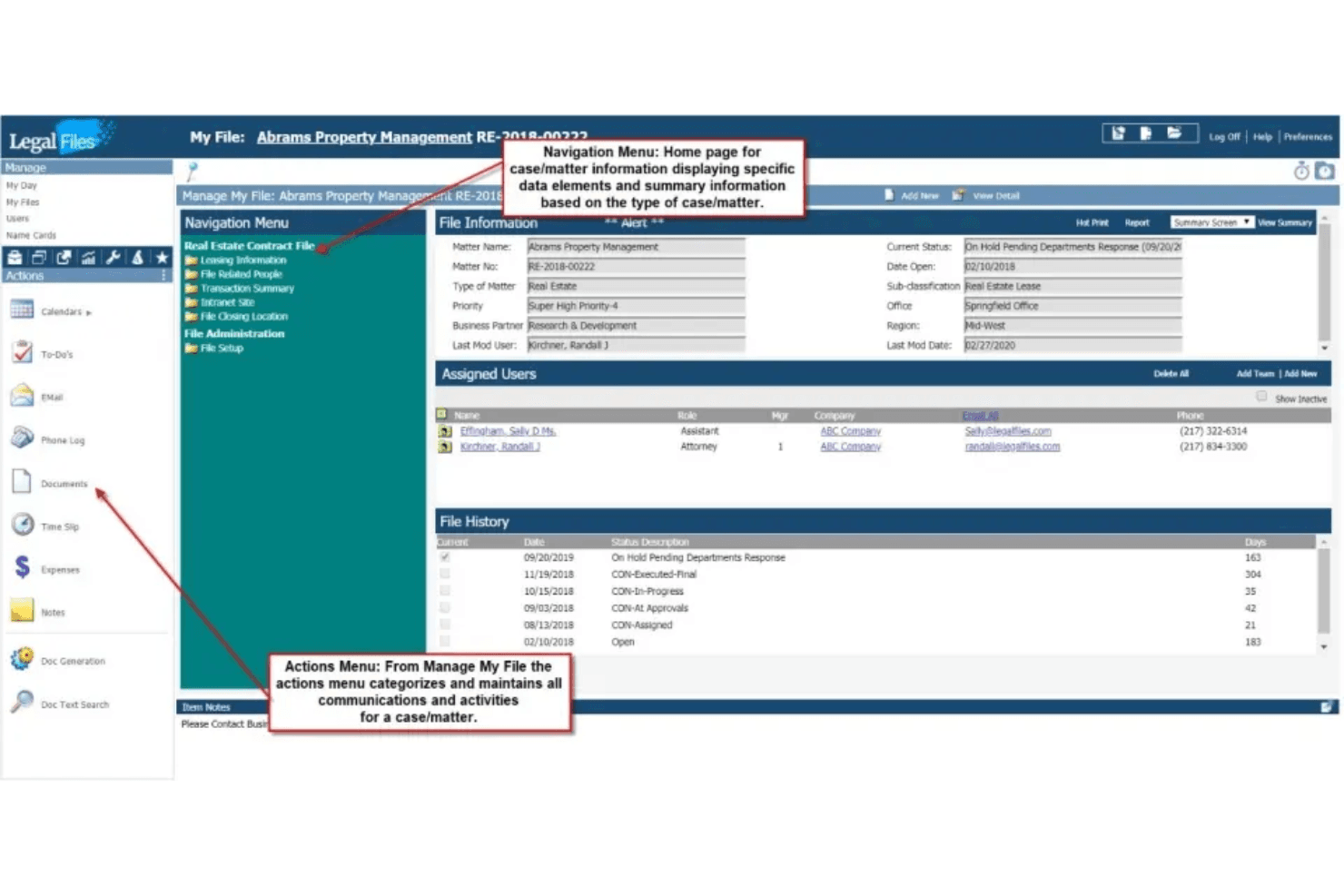
Track, organize, and update all case details, deadlines, and related documents in one centralized workspace.
Document Management
Store, categorize, and search documents with version control and secure sharing for easy collaboration.
Customizable Workflows
Automate routine tasks and tailor workflows to match your team’s unique processes and approval steps.
Calendar and Task Management
Sync calendars, set reminders, and assign tasks to keep teams on top of deadlines and appointments.
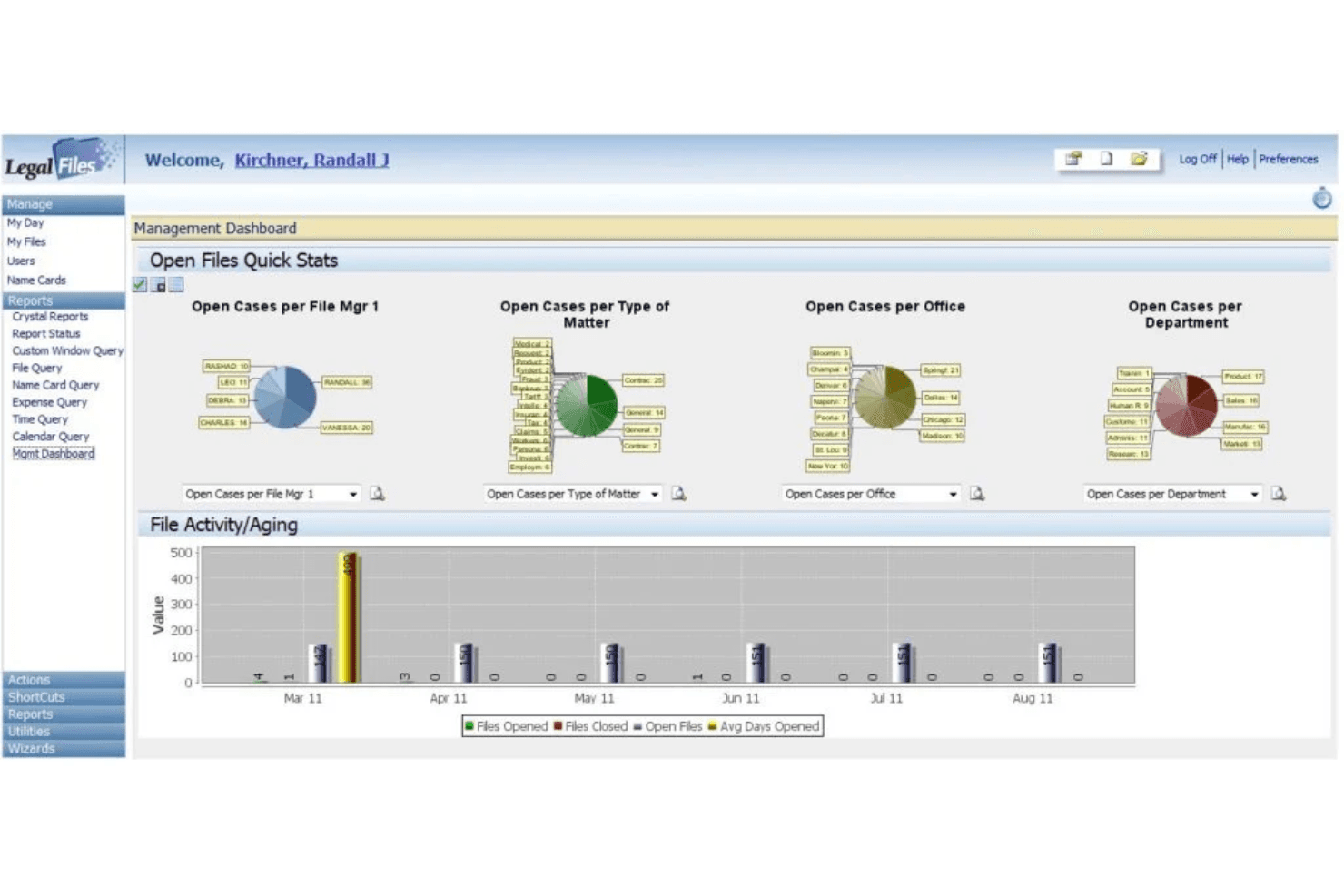
Reporting and Analytics
Generate custom reports on case status, workload, and performance metrics to support data-driven decisions.
Email Integration
Capture and link emails directly to matters using Microsoft Outlook integration, keeping all correspondence organized.
Standout Features
Role-Based Access Controls
Set granular permissions for users, teams, or departments to control who can view or edit sensitive information. This helps organizations meet strict compliance requirements and protect confidential data.
Intake and Request Management
Capture, route, and track legal service requests or new matters from internal or external clients. This streamlines intake processes and ensures nothing falls through the cracks.
Ease of Use
Legal Files isn’t the most modern-looking platform, but it’s straightforward once you get past the initial setup. Users mention the interface feels dated and navigation can be clunky, especially for new team members. However, the customization options and detailed dashboards make it easier to adapt to complex workflows over time.
If you value flexibility and depth over visual polish, you’ll find Legal Files gets the job done after some onboarding investment.
Onboarding
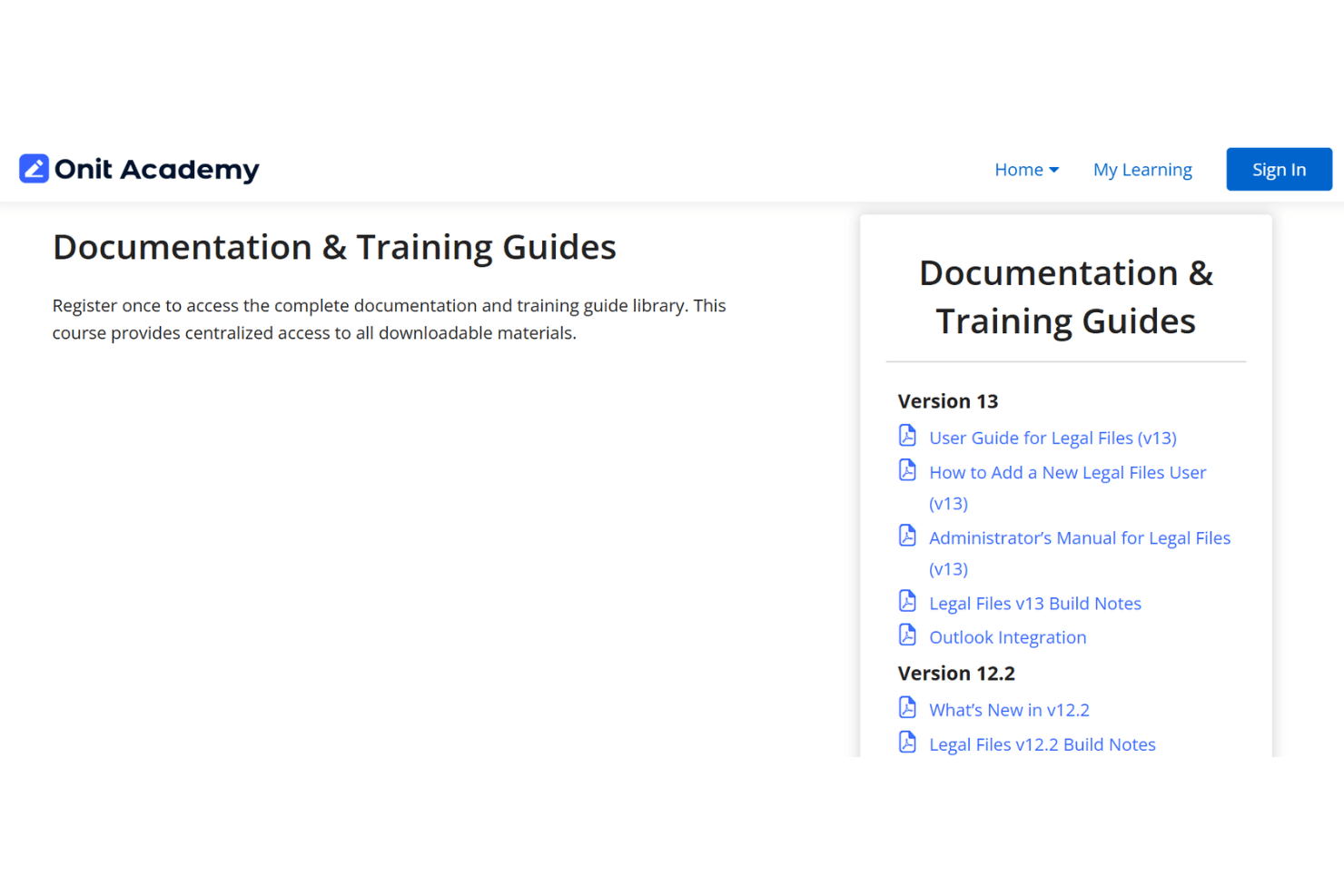
Legal Files offers personalized onboarding with dedicated support, which users say helps ease the transition despite the platform’s complexity. Training sessions, detailed documentation, and responsive customer service are available, but the setup process can still feel lengthy for teams with limited IT resources.
Many users appreciate the tailored approach, but expect a learning curve before reaching full productivity. The onboarding investment pays off most for organizations with complex or highly customized workflows.
Customer Support
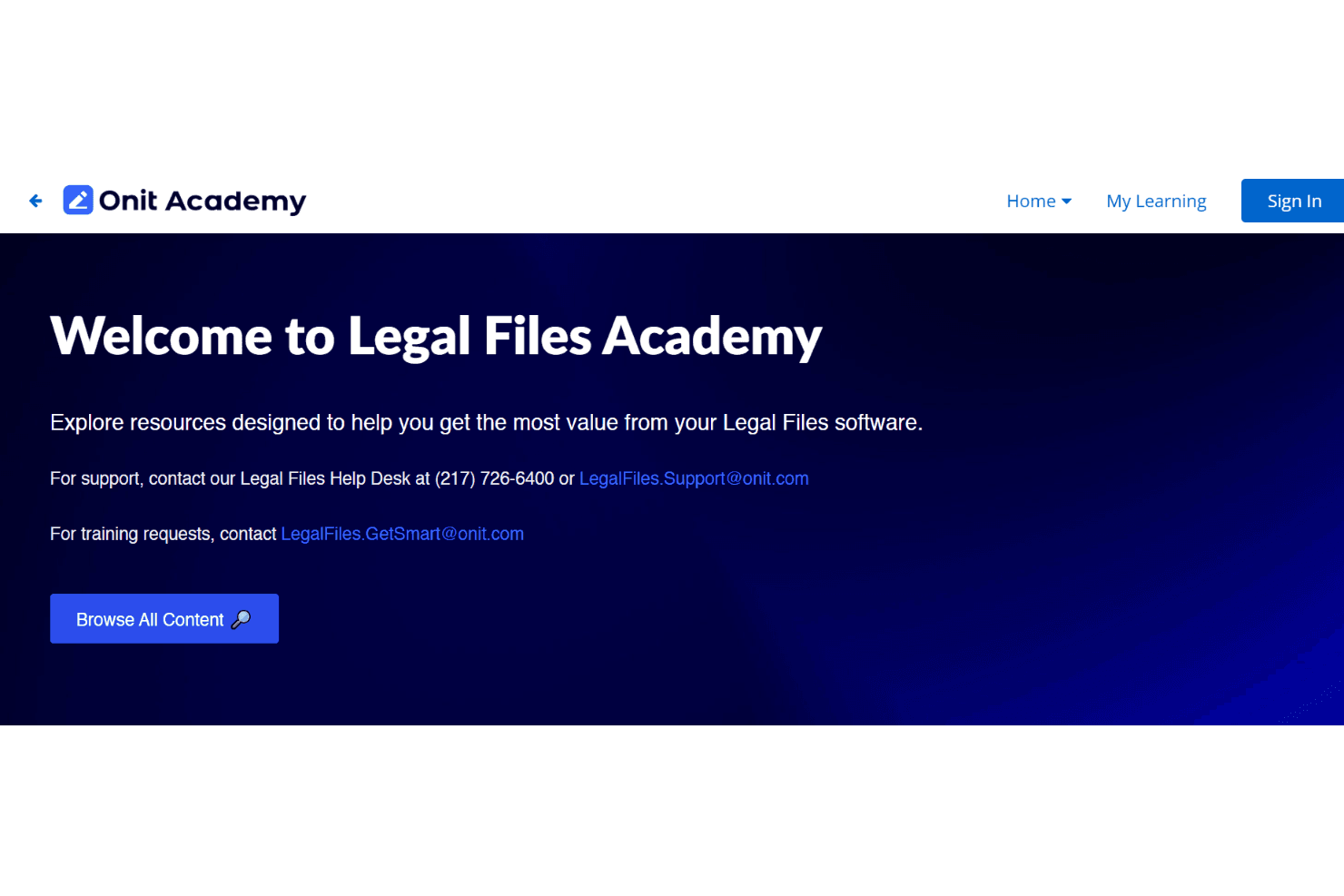
Legal Files is known for responsive and knowledgeable customer support, with users often highlighting quick turnaround times and helpful guidance. Support is available via phone, email, and an online portal, and many users mention that issues are resolved efficiently.
The team provides ongoing assistance beyond initial onboarding, which is valuable for organizations with evolving needs. Documentation and training resources are thorough, making it easier to troubleshoot or learn new features as your team grows.
Integrations
Legal Files integrates with tools such as Microsoft Outlook, Microsoft Office, NetDocuments, iManage, and e-signature solutions like DocuSign and Adobe Acrobat.
Legal Files does not publicly highlight a full list of integrations or an open API, though additional connections may be available through Onit or custom configurations.
Value for Money
Legal Files does not publicly disclose its pricing, so organizations need to contact the vendor for a custom quote. Its depth of features, customization options, and support are positioned to meet the needs of larger teams or complex organizations, while smaller teams may find it more than they require depending on their use case.
Legal Files Specs
- 2-Factor Authentication: No
- API: No
- Approval Workflows: Yes
- Audit Trail: Yes
- Calendar Management: No
- Compliance Tracking: Yes
- Contract Management: No
- Custom Reports: Yes
- Customer Management: No
- Data Export: Yes
- Data Import: Yes
- Document Management: Yes
- External Integrations: Yes
- Multi-User: Yes
- NDA Management: No
- Notifications: Yes
- Policy Management: No
- Scheduling: Yes
- Workflow Management: Yes
Legal Files FAQs
Legal Files Company Overview & History
Legal Files Software, Inc. is headquartered in Springfield, Illinois, and was founded in 1990. The company employs around 27–37 people and focuses exclusively on its flagship product, Legal Files, a centralized legal case and matter management platform. Legal Files is used by government agencies, corporate legal departments, law firms, universities, and insurance organizations.
The company reports annual revenue between $6.5 and $8 million and is privately held, with no public stock or known affiliations with other products or companies.
Legal Files Major Milestones
- 1990: Legal Files Software, Inc. founded in Springfield, Illinois.
- 1990: Legal Files product launched for legal matter management.
- 2020: Estimated annual revenue reached $6.5–$8 million.
- 2023: Workforce reported at approximately 27–37 employees.
- 2025: Acquired by Onit and integrated into its enterprise legal management platform.