

O software de faturação jurídica para advogados em prática individual fornece-lhe as ferramentas para gerir a faturação de clientes, a contabilidade de fundos fiduciários e o registo de tempos num só lugar — para que possa tratar da conformidade e do fluxo de caixa sem precisar de um administrador dedicado. Se é proprietário de um escritório de advocacia individual e precisa de cumprir as regras da Ordem, gerir contas IOLTA e manter ao mínimo os obstáculos à faturação, sabe como é urgente escolher uma ferramenta que se adapte verdadeiramente ao seu fluxo de trabalho diário.
Neste guia, encontrará as melhores plataformas de faturação jurídica para advogados em prática individual em 2026, com cada opção concebida para o trabalho jurídico real — quer pretenda melhorar a preparação para auditorias, precise de contabilidade de fundos fiduciários integrada ou esteja a planear expandir um pequeno escritório.
Why Trust Our Software Recommendations
6,700+
Reviews
20
Industry experts
16+
Evaluation factors
14
Years
Our team has been testing and reviewing software since 2012. As legal practice leaders ourselves, we know how difficult—and important—it is to choose the right software.
For this guide, we evaluated tools using hands-on testing and independent research, scoring tools using our selection criteria.
Our reviews reflect our human editorial judgment, not a sales pitch.
Tabela comparativa de software de faturação jurídica para advogados em prática individual
Esta tabela comparativa resume os detalhes de preços das minhas principais seleções de software de faturação jurídica para advogados em prática individual:
| Tool | Best For | Trial Info | Price | ||
|---|---|---|---|---|---|
| 1 | Best for trust accounting built into solo billing | 7-day free trial + free demo available | From $59/user/month | Website | |
| 2 | Best for bar-endorsed trust and payment compliance | 10-day free trial available | From $50/user/month (billed annually) | Website | |
| 3 | Best for trust accounting and IOLTA compliance | 10-day free trial | From $69/user/month | Website | |
| 4 | Best for passive time capture on solo matters | 10-day free trial + free demo available | From $59/user/month (billed annually) | Website | |
| 5 | Best for midsize firms scaling past solo | Free demo available | Pricing upon request | Website | |
| 6 | Best for bar-compliant trust and billing in one plan | 7-day free trial | From $49/user/month | Website | |
| 7 | Best for bar-compliant trust accounting built in | 10-day free trial + demo available | Pricing upon request | Website | |
| 8 | Best for passive time capture across email and docs | Free demo available | Pricing upon request | Website | |
| 9 | Best for built-in trust accounting and IOLTA billing | 10-day free trial + free demo available | From $49/user/month (billed annually) | Website | |
| 10 | Best for scaling solos with compliance-heavy billing | Free demo available | Pricing upon request | Website |


Avaliações de software de faturação jurídica para advogados em prática individual
Seguem-se os meus resumos detalhados dos melhores softwares de faturação jurídica para advogados em prática individual que entraram na minha lista final. As minhas avaliações apresentam uma análise detalhada das funcionalidades, dos melhores casos de utilização e das capacidades de conformidade de cada plataforma, para o ajudar a encontrar a melhor opção para si.
 Best for trust accounting built into solo billing
- 7-day free trial + free demo available
- From $59/user/month
Visit WebsiteCustomer Rating:4.3/5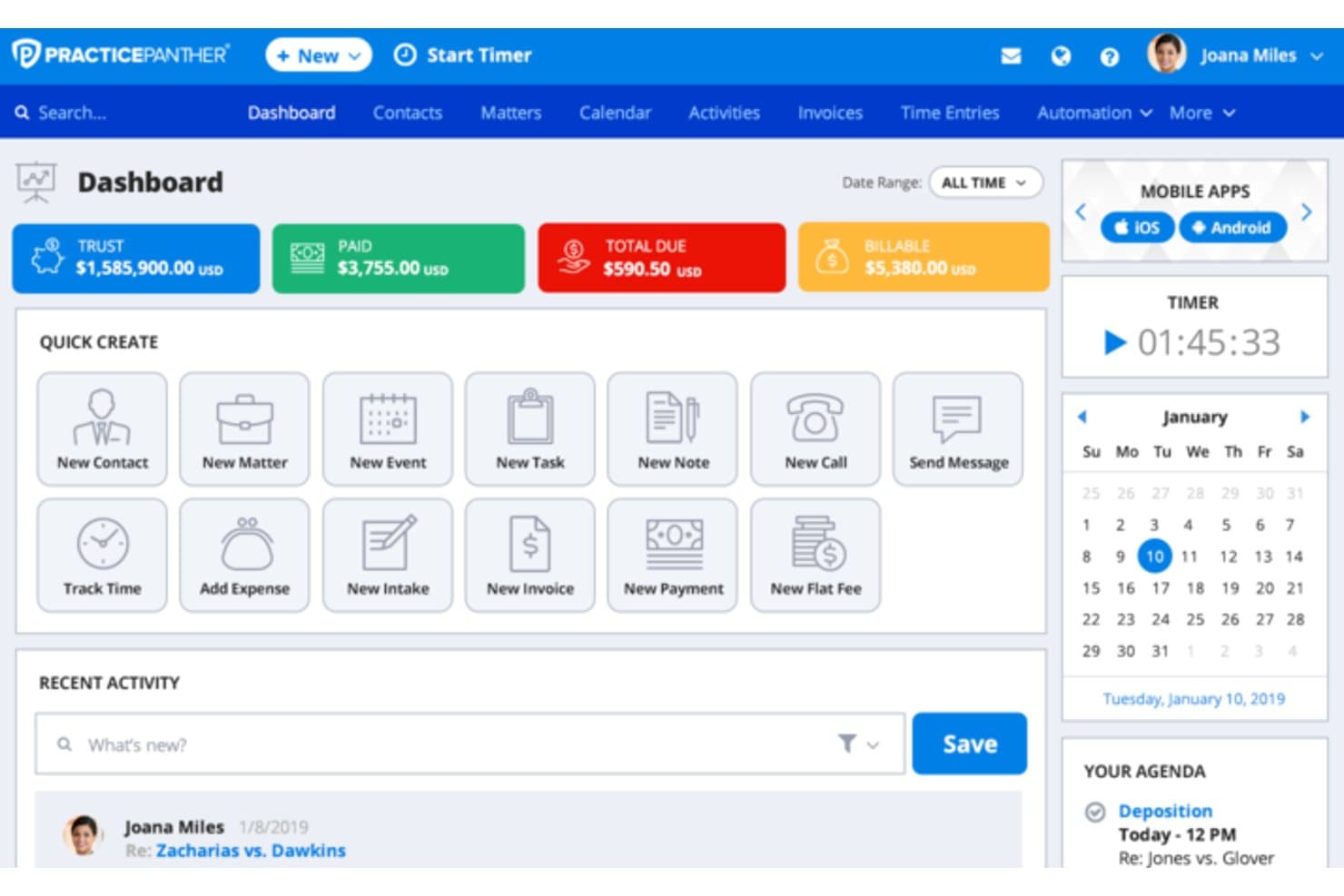
PracticePanther manages cases, court calendars, billing, tasks, and documents. PracticePanther is a cloud-based legal practice management platform for solo attorneys that combines time tracking, invoicing, trust accounting, online payments, and client portal access in one subscription.
Who Is PracticePanther Best For?
Solo attorneys who handle their own books will get the most out of PracticePanther, thanks to its built-in IOLTA trust accounting, guided three-way reconciliation, and native payment processing under one subscription.
Why I Picked PracticePanther
I've included PracticePanther in my top picks because its trust accounting isn't bolted on as an afterthought—it's woven into every billing action. The guided three-way reconciliation wizard walks you through balancing your bank statement, client ledger, and trust account in one sitting, producing audit-ready reports on demand. I also like that evergreen retainer alerts fire automatically when a matter's trust balance dips below your set threshold, prompting a replenishment request without any manual monitoring on your end.
PracticePanther Key Features
- MoneyFinder: Scans tasks, events, and communications with no logged time and surfaces them in a dedicated view so you can recover unbilled hours before invoicing.
- PantherPayments: A built-in payment processor that accepts credit cards at 2.95% and eCheck/ACH at 1%, with no monthly fee and automatic routing to your operating or trust account.
- Secure client portal: A branded, encrypted space included on every plan where clients can view invoices, pay online, share documents, and send two-way messages.
- Batch invoicing: Lets you generate invoices across multiple matters simultaneously, with automated follow-up reminders sent via email, portal, or SMS payment link.
PracticePanther Integrations
PracticePanther offers native integrations with QuickBooks Online, Gmail, Microsoft Outlook, Google Calendar, Dropbox, Google Drive, Box, LawToolBox, and Lawmatics. It also supports custom integrations through its open API and Zapier.
Pros and Cons
Pros:
- Secure branded client portal in every plan
- Automated retainer replenishment alerts by matter
- Built-in IOLTA trust accounting and reconciliation
Cons:
- Full accounting features require highest tier plan
- AI billing narrative generation not included
Learn more about PracticePanther: Best for bar-endorsed trust and payment compliance
- 10-day free trial available
- From $50/user/month (billed annually)
Visit WebsiteCustomer Rating:4.6/5
MyCase centralizes case timelines, tasks, and status updates in one view. MyCase is a legal practice management platform that combines time tracking, invoicing, trust accounting, online payments, and a secure client portal in a single subscription built for solo and small-firm attorneys.
Who Is MyCase Best For?
MyCase is a strong fit for solo attorneys and small firms who need built-in IOLTA-compliant payment processing and trust accounting without piecing together separate tools.
Why I Picked MyCase
I've included MyCase in my top picks because it's the only platform here endorsed by the ABA and 130+ bar associations specifically for trust and payment compliance. I particularly like how its native LawPay integration routes IOLTA payments so that processing fees never touch a trust account, and the MyCase Accounting add-on handles three-way reconciliation with automated overdraft safeguards. Smart Time Finder also runs passively in the background, surfacing unbilled activities from your day so nothing slips through.
MyCase Key Features
- Smart Time Finder: Reviews all billable activities logged in MyCase throughout the day and surfaces any that haven't been converted to time entries yet.
- Batch invoicing: Generates multiple client invoices simultaneously from tracked time and expenses, rather than creating each one individually.
- Secure client portal: Gives clients 24/7 access to case updates, documents, messages, invoices, and payment—without going through email.
- Work-in-progress (WIP) report: Displays all unbilled time and expenses across active matters in real time, available on Pro and Advanced plans.
MyCase Integrations
MyCase offers 75+ integrations, including LawPay, QuickBooks Online, Google Calendar, Microsoft Outlook, Dropbox, and LawToolBox. Advanced includes an Open API for custom integrations, and Zapier is also supported.
Pros and Cons
Pros:
- Secure client portal for payment and updates
- Smart Time Finder for passive time capture
- Built-in IOLTA safeguards and trust alerts
Cons:
- No native LEDES or e-billing export
- Three-way reconciliation requires a paid add-on
 Best for trust accounting and IOLTA compliance
- 10-day free trial
- From $69/user/month
Visit WebsiteCustomer Rating:4.5/5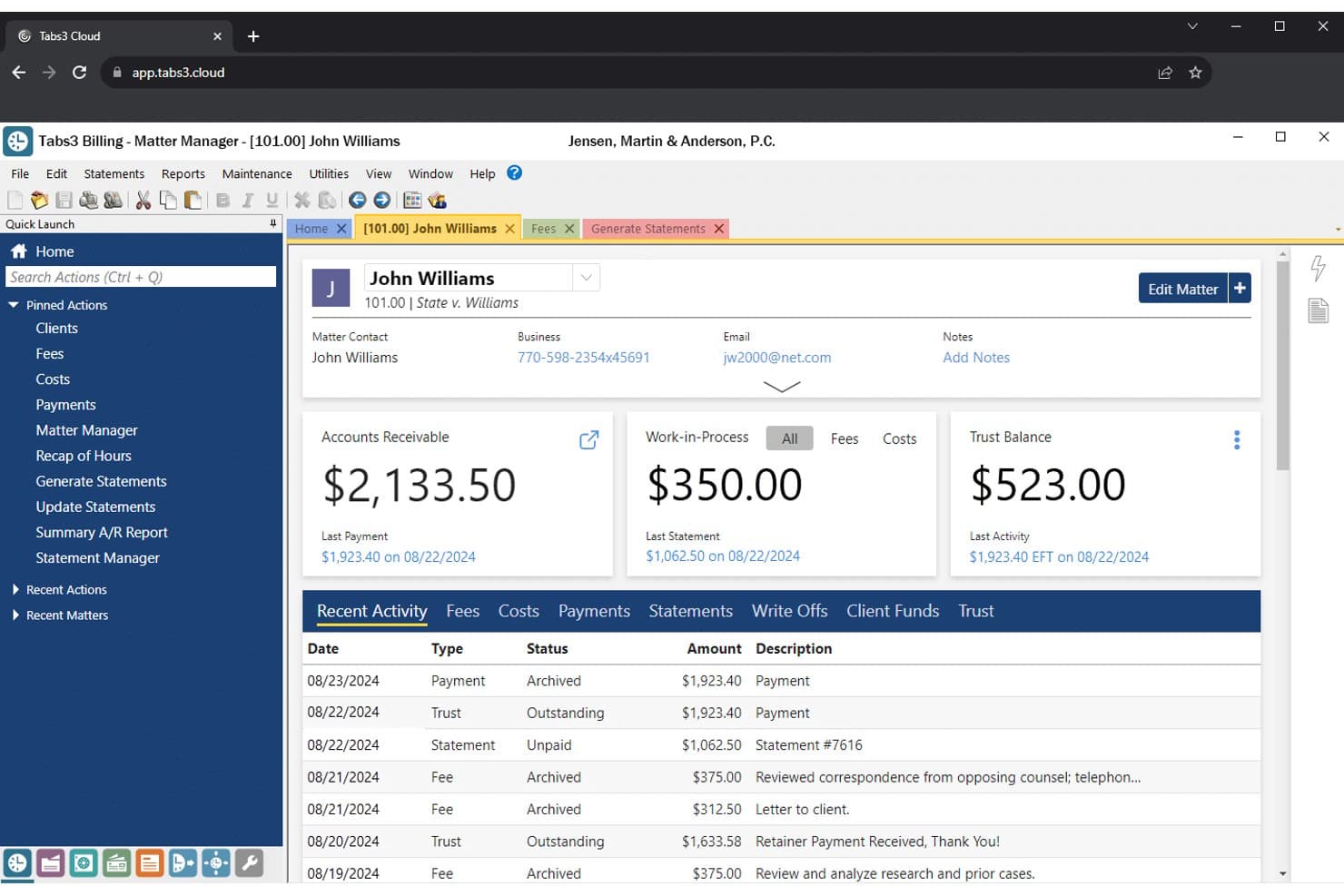
Tabs3 centralizes client billing, trust, and A/R data in one matter view. Tabs3 is a legal billing platform built around time tracking, flexible fee arrangements, trust accounting, and integrated payment processing via Tabs3Pay.
Who Is Tabs3 Best For?
Tabs3 is a strong fit for solo attorneys and small firms who need rigorous trust accounting and IOLTA compliance built directly into their billing workflow.
Why I Picked Tabs3
I picked Tabs3 as one of the best because its trust accounting module is genuinely purpose-built for compliance, not an afterthought. Three-way reconciliation reports that compare your bank statement, client trust ledgers, and internal ledger are built directly into the workflow, which is exactly what state bar auditors expect to see. I also like that Tabs3Pay routes credit card processing fees to your operating account automatically, keeping your IOLTA balance clean without any manual intervention.
Tabs3 Key Features
- Flexible fee arrangements: Set hourly, flat fee, contingency, retainer, progress, or split-fee billing rates per client, matter, or individual timekeeper.
- Tabs3 Connect: Log time, access case files, and view the firm calendar from any smartphone, tablet, or laptop.
- Batch invoicing: Generate and email password-protected PDF statements to multiple clients in a single workflow.
- QuickBooks sync: Push financial data from Tabs3 Billing directly to your QuickBooks general ledger to reduce duplicate data entry.
Tabs3 Integrations
Tabs3 has documented integrations with QuickBooks, Taskbill, LawPay, LexCharge, Microsoft Outlook and 365, and CalendarRules. It also connects with Copitrak, Equitrac, and PaperCut for cost recovery.
Pros and Cons
Pros:
- Detailed reporting for audit and tax
- Wide range of legal billing options
- Trust accounting designed for legal compliance
Cons:
- Manual time tracking without AI features
- Client portal locked behind premium tier
Learn more about Tabs3: Best for passive time capture on solo matters
- 10-day free trial + free demo available
- From $59/user/month (billed annually)
Visit WebsiteCustomer Rating:4.4/5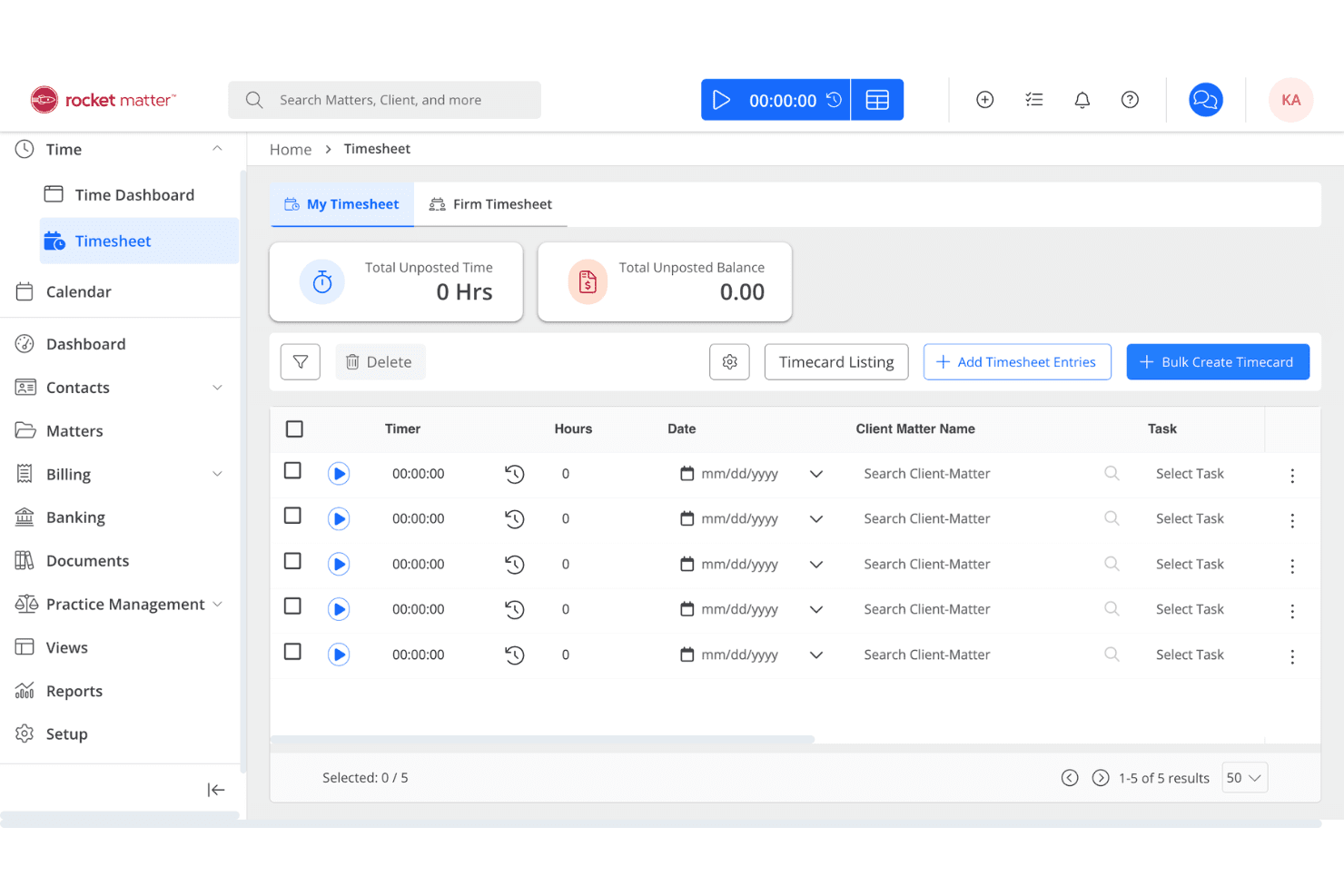
Rocket Matter centralizes law firm tasks, time tracking, billing, and trust accounting. Rocket Matter is a legal practice management and billing platform built for solo and small law firms, covering time tracking, invoicing, trust accounting, online payments, and passive time capture via its Rocket Matter Track add-on.
Who Is Rocket Matter Best For?
Rocket Matter is a strong fit for solo attorneys who need passive time capture to recover billable hours lost across desktop apps, emails, and documents throughout the workday.
Why I Picked Rocket Matter
Rocket Matter earns its spot on my shortlist because of Rocket Matter Track, its passive time capture add-on that runs in the background across all your office apps and devices, automatically logging billable activity without manual input. I find this especially valuable for solo practitioners juggling client calls, document review, and email all at once, since time slips through the cracks constantly. When I look at a busy litigation day, Track captures time spent in Outlook, OneDrive, and desktop apps down to the minute, which Rocket Matter claims can recover up to 50% more billable hours.
Rocket Matter Key Features
- Batch invoicing: Review, approve, and send multiple invoices simultaneously from a single billing run.
- IOLTA-compliant trust accounting: Maintain separate trust accounts per matter with evergreen retainer alerts and audit-ready reports.
- Rocket Matter Pay: Accept credit cards, ACH, PayPal, and Venmo with processing fees automatically routed away from trust accounts.
- QuickBooks Online sync: Bidirectional sync keeps invoices, payments, expenses, and trust transactions current across both platforms.
Rocket Matter Integrations
Rocket Matter offers native integrations with QuickBooks Online, Microsoft 365 including Outlook and OneDrive, Google Calendar, Dropbox, Box, and NetDocuments. It also supports custom integrations through its open API and Zapier.
Pros and Cons
Pros:
- Invoicing supports LEDES and split billing
- Trust accounting explicitly addresses bar audit needs
- Passive time capture reduces missed billables
Cons:
- CRM and intake require costly add-on
- Mobile app misses key desktop features
Learn more about Rocket Matter: Best for midsize firms scaling past solo
- Free demo available
- Pricing upon request
Visit WebsiteCustomer Rating:4.5/5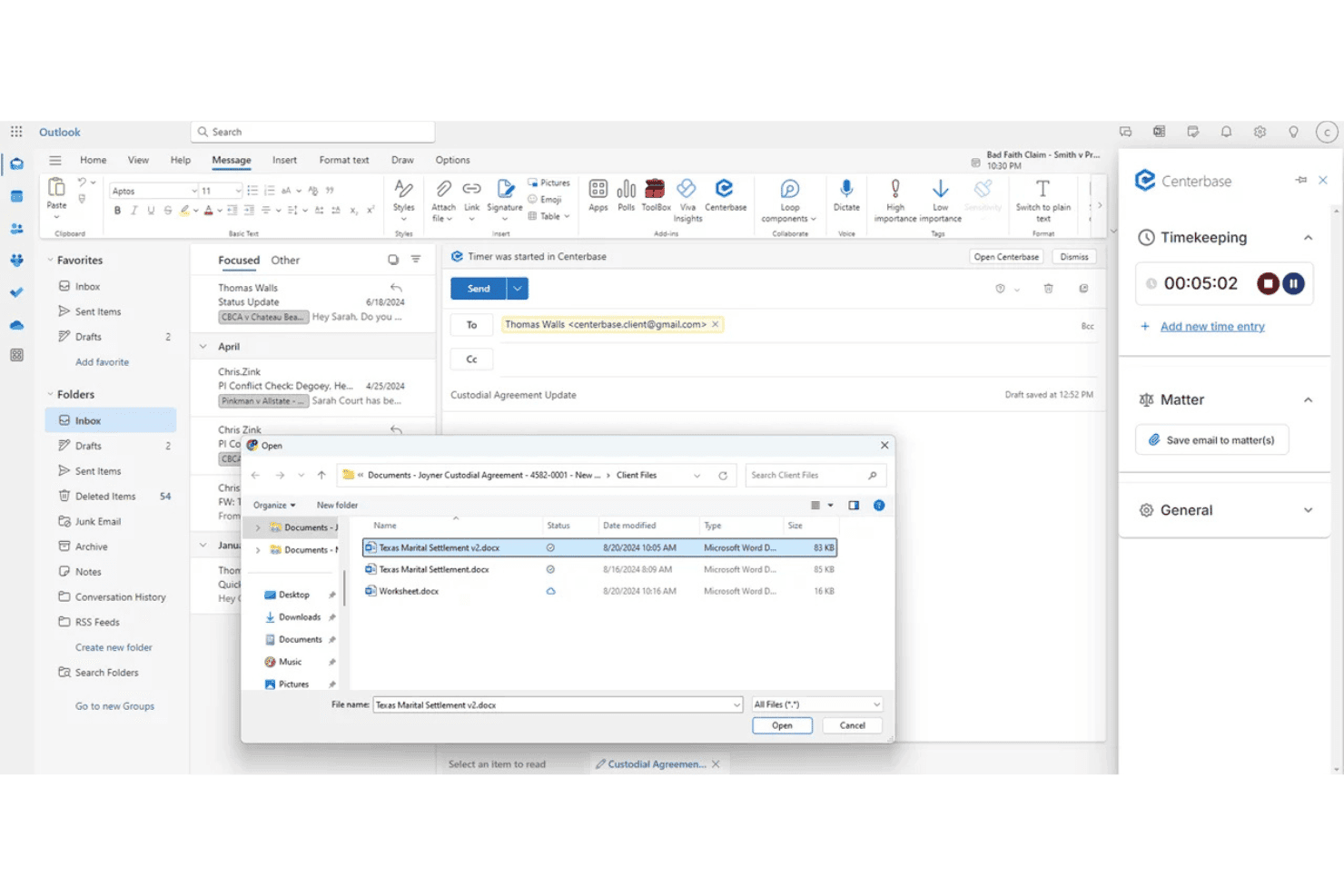
Centerbase ties tasks, deadlines, and follow-ups to matters, with Outlook email and calendar sync. Centerbase is a cloud-based legal practice management platform built for midsize law firms, combining time tracking, billing, trust and IOLTA accounting, online payments, and client matter management in one system.
Who Is Centerbase Best For?
Centerbase suits growing law firms of five or more attorneys that have outgrown solo-focused tools and need billing, trust accounting, and matter management in one platform.
Why I Picked Centerbase
I've included Centerbase in my top picks because it's the natural next step when your firm outgrows solo-focused tools and needs something built for the complexity of a growing team. I particularly like its ePre-bill review workflow, which routes pre-bills through an approval chain before they reach clients, and its multi-trust account setup, which automatically creates a trust account when a matter opens and supports minimum balance triggers for retainer replenishment.
Centerbase Key Features
- Automated time capture: Runs in the background to record billable activity across calls, emails, meetings, and document work without manual input.
- LEDES e-billing file generation: Produces
.datand.txtLEDES-formatted files for electronic billing submissions, including consolidated files covering multiple invoices. - Centerbase Payments: A native, Stripe-powered payment processor that accepts credit cards, debit cards, and ACH transfers with no monthly platform fee.
- Client portal: Gives clients 24/7 self-service access to view, download, and pay invoices and share documents directly through the platform.
Centerbase Integrations
Centerbase offers documented integrations with QuickBooks Online, LawPay, Microsoft 365, NetDocuments, iManage, LawToolBox, Plaid, and Billables AI.
Pros and Cons
Pros:
- Multi-step pre-bill approval workflow
- Advanced trust accounting with IOLTA safeguards
- Automated time capture across all activities
Cons:
- Overkill complexity for solo practitioners
- Long, mandatory onboarding for all customers
Learn more about Centerbase: Best for bar-compliant trust and billing in one plan
- 7-day free trial
- From $49/user/month
Visit WebsiteCustomer Rating:4.7/5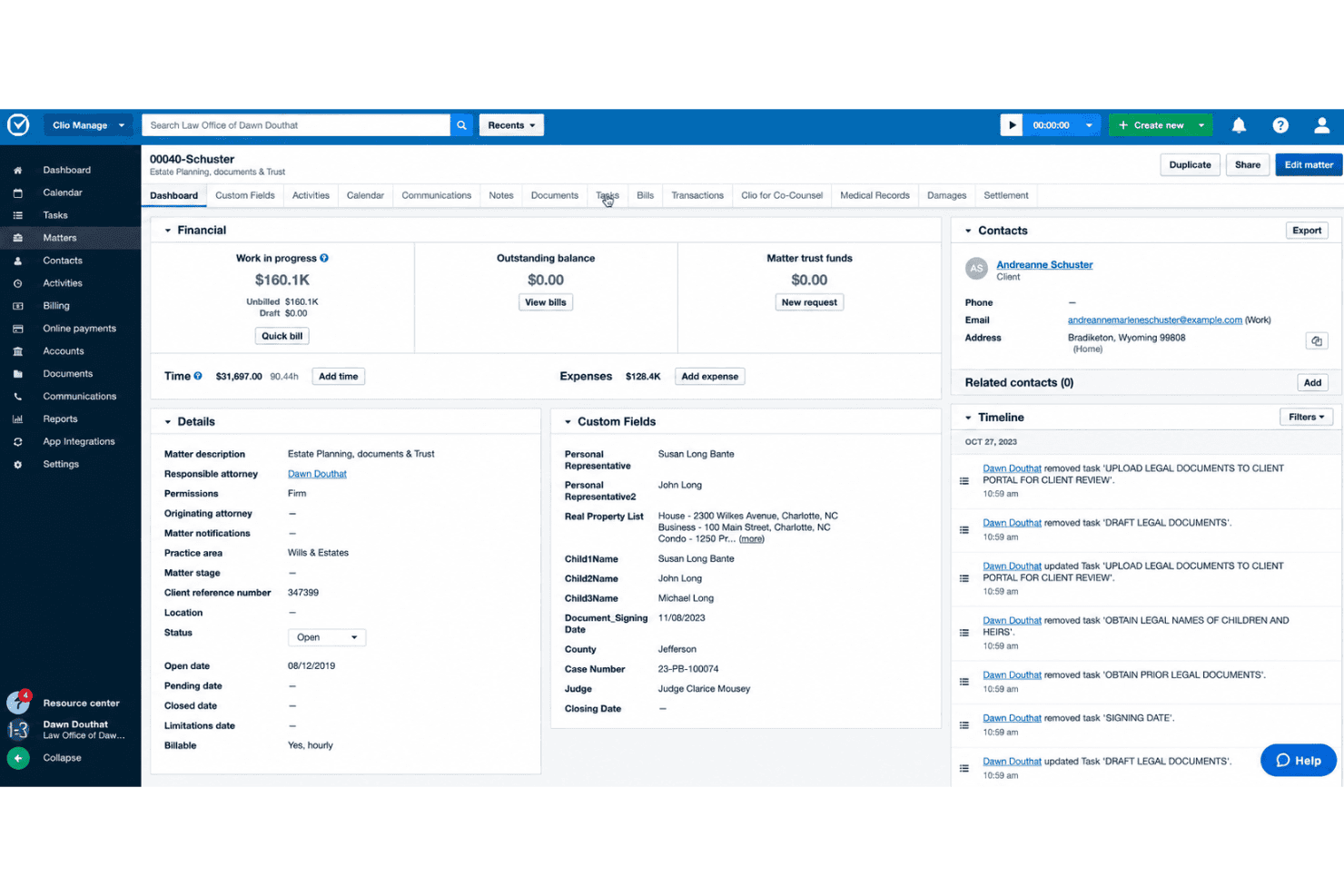
Clio Manage handles matter tasks, court deadlines, time tracking, and client collaboration. Clio Manage is a legal practice management platform that covers time tracking, invoicing, trust and IOLTA accounting, online payments, and matter management in a single subscription built for legal professionals.
Who Is Clio Manage Best For?
Clio Manage is a strong fit for solo attorneys who need billing, trust accounting, and online payments in one place without juggling multiple tools.
Why I Picked Clio Manage
I've included Clio Manage in my top picks because it's the only legal billing tool I know of that's been approved by 100+ bar associations, making it a genuinely trustworthy choice for trust and IOLTA compliance. I particularly like how it keeps earned and unearned funds strictly separate, with per-client trust ledgers and evergreen alerts that automatically notify you when a balance dips below your set threshold. Its native Clio Payments processor routes funds to the correct operating or trust account automatically, so there's no manual sorting after a client pays.
Clio Manage Key Features
- Batch invoicing: Generate all your monthly bills across every matter in a single action, rather than building each invoice one at a time.
- LEDES/UTBMS e-billing codes: Assign standard electronic billing codes to time entries and expenses to meet client billing compliance requirements.
- Mobile tap-to-pay: Collect client payments in person directly from the iOS or Android app using tap-to-pay or QR code scanning.
- QuickBooks Online and Xero two-way sync: Automatically sync contacts, bills, payments, and trust transactions between Clio Manage and your accounting software.
Clio Manage Integrations
Clio Manage offers 250+ marketplace integrations, including QuickBooks Online, Xero, MagicTime, Billables AI, Microsoft 365, Google Workspace, Dropbox, DocuSign, and Adobe Sign. Its Advanced plan includes an open REST API, and Zapier is also supported.
Pros and Cons
Pros:
- AI-generated billing narratives reduce manual entry
- Batch invoicing for all clients at once
- Bar association approval for trust compliance
Cons:
- Credit card fees higher than some rivals
- Client portal not on Starter plan
Learn more about Clio Manage: Best for bar-compliant trust accounting built in
- 10-day free trial + demo available
- Pricing upon request
Visit WebsiteCustomer Rating:4.5/5
TimeSolv lets solo practitioners log billable hours with task codes and rates. TimeSolv is a legal billing platform built for law firms and solo practitioners that covers time tracking, LEDES-compliant invoicing, trust/IOLTA accounting, online payments, and matter management.
Who Is TimeSolv Best For?
TimeSolv is a strong fit for solo attorneys and small firm practitioners who handle trust accounts and need built-in IOLTA compliance without a separate accounting tool.
Why I Picked TimeSolv
TimeSolv earns its spot on my shortlist because trust accounting is built directly into the Legal plan, not bolted on as a paid add-on. I especially like the automated three-way reconciliation, which keeps the client ledger, trust bank balance, and overall trust account in sync without manual intervention. The minimum balance alerts tied to individual matters are a practical safeguard I haven't seen as cleanly implemented elsewhere, triggering automatically when a client's trust funds drop below a threshold you set.
TimeSolv Key Features
- Batch invoicing: Generate and send invoices across multiple matters and clients simultaneously from a single action.
- PointOne AI integration: Connects to a passive time-capture tool that tracks billable activity in the background and surfaces draft entries for your review.
- Matter budgets: Set hour and cost thresholds per matter and track estimated vs. actual figures in real time.
- Mobile app with offline mode: Log time and expenses on iOS or Android without an internet connection; entries sync automatically when you reconnect.
TimeSolv Integrations
TimeSolv integrates with QuickBooks, Xero, AccountEdge, LawPay, Microsoft 365, OneDrive, NetDocuments, Dropbox, LexShare, and PointOne. It also offers an Open API for custom integrations.
Pros and Cons
Pros:
- Batch invoicing across multiple matters
- Passive AI time tracking via PointOne
- Automated three-way trust account reconciliation
Cons:
- No native court calendaring or docketing
- Payment processing fees not disclosed publicly
 Best for passive time capture across email and docs
- Free demo available
- Pricing upon request
Visit WebsiteCustomer Rating:4.4/5
CARET Legal organizes matter tracking with visual analytics and status breakdowns. CARET Legal is a practice management and legal billing platform that brings together time tracking, LEDES invoicing, trust accounting, and native payment processing in a single system.
Who Is CARET Legal Best For?
CARET Legal is best suited for midsize law firms that bill institutional or insurance defense clients and need LEDES invoicing, native trust accounting, and passive time capture in one platform.
Why I Picked CARET Legal
I've included CARET Legal in my top picks because of CARET Capture, its passive time tracking feature that runs in the background across email, calendar, and documents without requiring you to start or stop a timer. If you spend a morning drafting in Word and answering client emails, it surfaces those activities as draft time entries automatically. Pair that with LEDES invoicing and native trust accounting, and you get a billing setup built for firms with institutional clients.
CARET Legal Key Features
- LEDES invoicing: Generate LEDES-format electronic invoices for compliance with billing mandates from insurance carriers and corporate clients.
- Three-way trust reconciliation: Automatically reconciles bank balance, book balance, and balance by matter to meet state bar audit requirements.
- Multiple concurrent timers: Run simultaneous timers across different matters so you're never switching contexts to log time manually.
- CARET Pay: Accept credit card, ACH, and e-check payments natively, with automatic routing to trust or operating accounts.
CARET Legal Integrations
CARET Legal offers documented integrations with Microsoft 365, Google Workspace, QuickBooks Online, Lawmatics, OneDrive, NetDocuments, and LawToolBox. It also provides API access for custom integrations.
Pros and Cons
Pros:
- Branded client portal supports secure client payments
- Automated three-way trust reconciliation included
- Passive time capture across email and documents
Cons:
- User interface feels dated and cluttered
- Minimum 25-user contract excludes solo lawyers
Learn more about CARET Legal: Best for built-in trust accounting and IOLTA billing
- 10-day free trial + free demo available
- From $49/user/month (billed annually)
Visit WebsiteCustomer Rating:4.3/5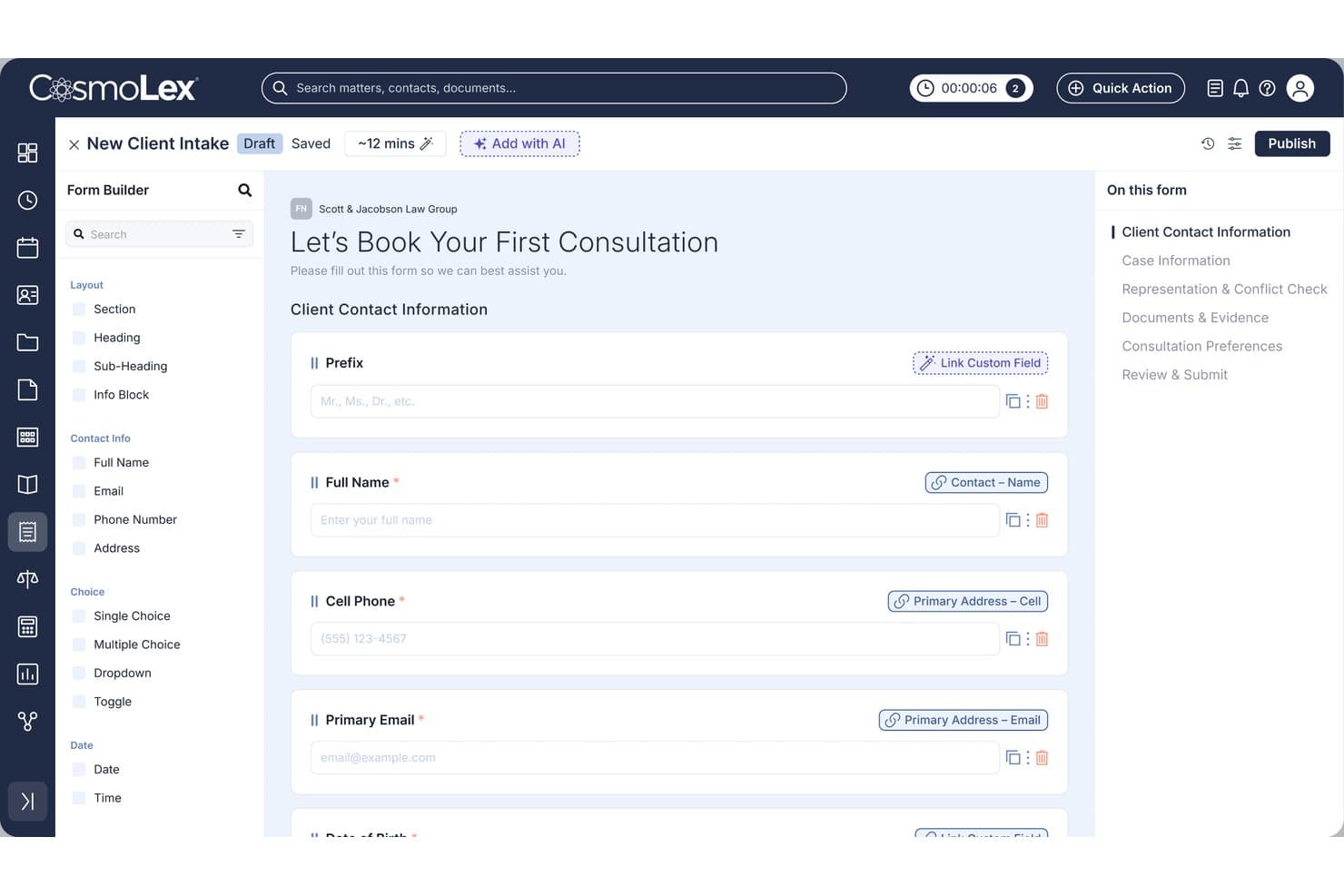
CosmoLex lets users build custom client intake forms with linked fields. CosmoLex is a cloud-based legal practice management platform that combines time tracking, invoicing, trust accounting, online payments, and built-in double-entry legal accounting in a single system.
Who Is CosmoLex Best For?
CosmoLex is a strong fit for solo attorneys who need to manage trust accounting, IOLTA compliance, and client billing in one system without a separate bookkeeper or accounting tool.
Why I Picked CosmoLex
CosmoLex earns its spot on my shortlist because it's one of the only legal billing platforms that treats trust accounting as a core feature rather than an afterthought. I particularly like the one-click three-way reconciliation, which simultaneously matches the trust bank balance, the CosmoLex book balance, and each client's individual ledger. The Money Finder feature is also genuinely useful, scanning matter history for unbilled calendar events and flagging them before you close out a billing cycle.
CosmoLex Key Features
- Batch invoicing: Generate and email all client invoices at once, with personalized notes added per client before sending.
- LEDES/UTBMS e-billing: Full legal e-billing support with task code sets that can be toggled on or off at the firm or matter level.
- Retainer replenishment alerts: Set minimum trust balance thresholds per matter and trigger automatic client-facing replenishment requests when balances fall below them.
- Secure client portal: Clients can view invoices, make payments, exchange messages, and upload or download matter documents through a branded, permission-controlled portal.
CosmoLex Integrations
CosmoLex offers native integrations with Microsoft 365, QuickBooks Online, Dropbox, Google Drive, Box, NetDocuments, Gmail, and Google Calendar. It also supports Chrometa, LexSign, LexShare, and Zapier.
Pros and Cons
Pros:
- Retainer replenishment alerts automate client requests
- Money Finder recovers missed billable time
- Native trust accounting with three-way reconciliation
Cons:
- One-way QuickBooks integration disables native accounting
- Passive time tracking requires separate Chrometa subscription
Learn more about CosmoLex: Best for scaling solos with compliance-heavy billing
- Free demo available
- Pricing upon request
Visit WebsiteCustomer Rating:4.2/5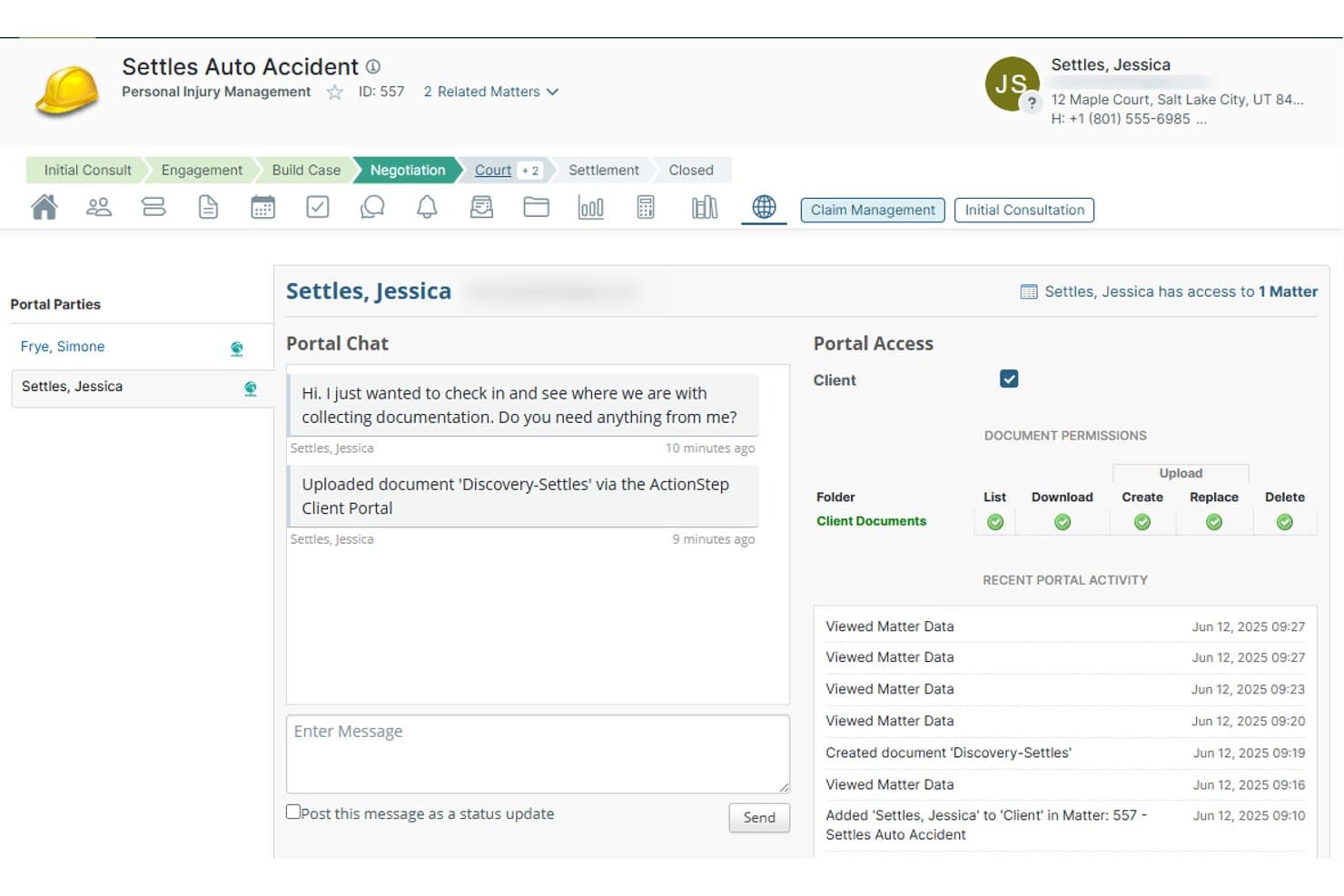
Actionstep lets clients upload documents and chat directly via the portal. Actionstep is a practice management and legal billing platform that combines time tracking, LEDES-compliant invoicing, native trust/IOLTA accounting, online payments, and matter-based workflow automation in a single system.
Who Is Actionstep Best For?
Actionstep suits solo attorneys in compliance-heavy practice areas—like insurance defense or immigration—who are actively growing toward a small firm and need native trust accounting from day one.
Why I Picked Actionstep
I've included Actionstep in my top picks because its native trust/IOLTA accounting is genuinely built in, not bolted on, making it a strong fit for solos in compliance-heavy areas like insurance defense or immigration. Three-way trust reconciliation, per-client ledgers, and overdraft prevention come standard, and LEDES e-billing is supported natively for submitting invoices to corporate clients or insurers with outside counsel guidelines.
Actionstep Key Features
- Concurrent timers: Run multiple timers simultaneously from any screen, assigning each to a specific client and matter as you switch between tasks.
- Automated invoice reminders: Schedule payment reminder emails for upcoming or overdue invoices without manual follow-up.
- Matter workflow automation: Build template-driven workflows per practice area that auto-assign tasks, set deadlines, and trigger client communications.
- Conflict check: Run a one-click search across all matters, documents, file notes, and emails to flag potential conflicts before taking on new clients.
Actionstep Integrations
Actionstep advertises 50+ integrations, including Microsoft Office 365/Outlook, QuickBooks Online, Xero, LawPay, and ALB (Accurate Legal Billing), plus Confido Legal. It also supports API access and Zapier for custom connections.
Pros and Cons
Pros:
- AI-driven passive time tracking across software
- Matter-centric workflows automate legal processes
- Native trust/IOLTA accounting with compliance checks
Cons:
- Designed for midsize firms, not solo practices
- Requires paid setup and certified implementation
Learn more about Actionstep:
Outro software de faturação jurídica para advogados em prática individual
Eis algumas opções adicionais de software de faturação jurídica para advogados em prática individual que não entraram na minha lista final, mas que ainda vale a pena consultar:
- 11PCLawBest for legal billing with built-in trust accounting
- 12LeanLawBest for billing built around QuickBooks Online
- 13FilevineBest for litigation billing with IOLTA-safe payments
- 14CaseFoxBest for solos billing corporate clients on LEDES
- 15SmokeballBest for passive time capture as a solo firm
- 16AbacusLawBest for LEDES billing and e-billing compliance
- 17Bill4TimeBest for trust billing without a seat minimum
- 18LawPayBest for bar-endorsed trust and IOLTA compliance
- 19Amicus AttorneyBest for passive time capture across email and calls
- 20PageLightPrimeBest for Microsoft 365-native trust billing
Related Reviews
How I Evaluate Legal Billing Software for Solo Practitioners
I split my evaluation into baseline functionality every tool must cover—like trust accounting and time tracking—and the differentiators that separate a genuinely solo-friendly platform from a generic billing tool.
Core Functionality (Table Stakes for This List)
When I'm selecting tools for my list, I rank each one on a scale from 0 (does not offer the functionality) to 5 (excels in this area) for each core functionality listed below. I then calculate the tool's total score into a percentage, using 65% as a benchmark to help assess its overall fit for the list.
- Time tracking: I check whether the tool offers timers and manual entry tied to specific matters, and whether it supports passive capture or AI-assisted narratives for billing descriptions.
- Legal invoicing: Each tool needs to go beyond generic templates, so I evaluate support for hourly, flat-fee, and contingency arrangements along with LEDES formatting and batch invoicing.
- Trust/IOLTA accounting: I look for dedicated trust ledgers with three-way reconciliation and audit-ready reporting, since mishandling client funds is the fastest path to a bar complaint.
- Online payments: The platform should accept credit card and ACH payments with built-in separation between operating and trust deposits—tools like Clio and CosmoLex handle this natively, while others rely on third-party processors.
- Expense and disbursement tracking: I evaluate whether expenses can be logged at the matter level and pulled directly into invoices, including soft and hard cost categorization and receipt capture.
- Client and matter management: Every billing entry should tie back to a client and matter record, so I look for conflict checks, matter-level rate settings, and custom fields that keep financial data organized alongside case details.
Once I have a list of tools that meet the criteria, I consider what sets each platform apart.
Differentiating Factors (What Sets Vendors Apart)
Here's how I compare and contrast different vendors:
Standout Features
I look for passive time capture that runs in the background across email, calendar, and documents—tools like Clio and CARET Legal surface missed billable activity you'd otherwise lose between court and client calls. AI billing narratives matter too: I evaluate whether a platform can rewrite vague time notes into clear, defensible descriptions that reduce write-downs. I also check for retainer replenishment alerts that auto-trigger when trust balances drop below a matter-specific threshold, since manually monitoring every retainer is unsustainable as a solo.
Beyond Features
I check whether a platform's trust accounting safeguards actually block commingling and overdrafts, since a single disbursement against uncleared funds can trigger a bar complaint. Total cost matters too—I evaluate whether billing, trust, and payments are bundled or stacked across separate subscriptions, because solos rarely have budget for three tools. I also look at data portability: tools like Clio and CosmoLex let you export complete matter and financial records, which is essential if you ever switch vendors or close a practice.
Como escolher um software de faturação jurídica para advogados em prática individual
Antes de escolher um software de faturação jurídica, pergunte a si próprio: Que necessidades de faturação, gestão de fundos fiduciários e conformidade determinam verdadeiramente o seu trabalho diário enquanto advogado em prática individual, e de que forma deve o seu software dar-lhes resposta?
| Se a sua prioridade é... | Procure... |
| Contabilidade de fundos fiduciários em conformidade com as regras da Ordem | Reconciliações a três vias e regras IOLTA codificadas |
| Registo de tempos rápido e preciso | Registo passivo de tempos e revisão das descrições |
| Expandir de uma prática individual para um pequeno escritório | Controlos multiutilizador e exportações preparadas para auditorias |
| Faturação e gestão de clientes numa só solução | Plataforma unificada com ligação integrada de processos |
| Integração imediata com as ferramentas de contabilidade existentes | Integrações nativas com o QuickBooks Online ou o Xero |
Como avaliar a sua lista final
- Testar o tratamento de IOLTA: Configure uma conta de demonstração e efetue um desembolso fiduciário simulado; verifique se o sistema bloqueia descobertos ou a mistura de fundos em todas as situações.
- Auditar o registo de tempos: Utilize a plataforma durante um dia de trabalho completo com a captura de tempos em segundo plano ativada; analise a descrição resultante do tempo faturável para detetar registos em falta ou duplicados.
- Simular uma auditoria realizada por terceiros: Exporte o histórico completo de faturação, fundos fiduciários e pagamentos de um processo de cliente, conforme exigido numa auditoria de conformidade; verifique se o relatório cumpre as normas de formato e integralidade da sua jurisdição.
- Solicitar uma confirmação escrita de conformidade: Peça ao fornecedor uma cláusula ou declaração que confirme a conformidade do sistema com as regras de contabilidade de fundos fiduciários da sua associação de advogados.
- Ponderar uma solução integrada face à melhor solução especializada: Decida se aceitará trocar a simplicidade do software por uma integração mais profunda — as plataformas integradas são mais fáceis de gerir, mas uma solução de faturação autónoma combinada com as suas ferramentas preferidas oferece mais possibilidades de personalização.
O que é o software de faturação jurídica para advogados em prática individual?
O software de faturação jurídica para advogados em prática individual consiste em plataformas digitais concebidas para ajudar advogados que trabalham individualmente a gerir a faturação de clientes, a contabilidade de fundos fiduciários e o registo de tempos a partir de um único sistema. Estas ferramentas ajudam a cumprir os regulamentos jurídicos e financeiros, ao mesmo tempo que facilitam a gestão de processos e do fluxo de caixa sem apoio administrativo. Normalmente, incluem funcionalidades adaptadas a práticas jurídicas individuais, como a associação a processos, os pagamentos online e os relatórios prontos para auditoria. Isto permite-lhe concentrar-se mais no exercício da advocacia e menos na administração.
Funcionalidades do software de faturação jurídica para advogados em prática individual
Ao selecionar software de faturação jurídica para advogados em prática individual, procure as seguintes funcionalidades essenciais:
- Registo de tempos: Permite iniciar cronómetros ou introduzir tempos manualmente, para que cada minuto faturável associado a um processo específico seja registado com precisão. As ferramentas de registo passivo de tempos podem revelar trabalho que, de outro modo, poderia não ser contabilizado.
- Faturação jurídica: Cria faturas que suportam a faturação à hora, com honorário fixo e com base em honorários de contingência, incluindo formatos de faturação LEDES e a criação de faturas em lote para agilizar a comunicação com os clientes.
- Contabilidade de fundos fiduciários/IOLTA: Disponibiliza livros-razão fiduciários dedicados com reconciliação a três níveis, relatórios prontos para auditoria e salvaguardas para impedir a mistura de fundos de clientes com fundos operacionais.
- Pagamentos online: Aceita pagamentos por cartão de crédito e ACH, com separação integrada entre contas fiduciárias e contas operacionais, ajudando-o a cobrar honorários mais rapidamente e a manter a conformidade.
- Registo de despesas e desembolsos: Permite registar despesas ao nível do processo, guardar recibos e incluir os custos diretamente nas faturas, com categorias para custos indiretos e diretos.
- Gestão de clientes e processos: Associa cada registo de tempo e despesa a clientes e processos, inclui verificações de conflitos, permite definir taxas personalizadas e garante que a faturação se mantém organizada por processo.
- Gestão de provisões: Permite configurar alertas simples para o reforço de provisões e notificações automáticas quando os saldos fiduciários dos clientes descem abaixo dos limites definidos.
- Controlos de conformidade: Bloqueia descobertos e deteta erros antes de estes resultarem em infrações, ajudando a cumprir as regras rigorosas das associações de advogados e de contabilidade de fundos fiduciários.
- Relatórios e registos de auditoria: Gera históricos detalhados de faturação, fundos fiduciários e pagamentos que cumprem os requisitos dos auditores e das associações de advogados, caso necessite de exportar ou rever dados.
- Integrações com software de contabilidade: Sincroniza a faturação e os pagamentos com sistemas externos, como o QuickBooks Online, para facilitar a reconciliação no final do ano e a gestão financeira.
Vantagens do software de faturação jurídica para advogados em prática individual
A implementação de software de faturação jurídica para advogados em prática individual proporciona várias vantagens para a sua equipa e para a sua atividade. Eis algumas das vantagens que pode esperar:
- Maior precisão na faturação: O registo integrado do tempo e os lançamentos baseados em processos ajudam a registar todas as horas faturáveis e a eliminar erros manuais.
- Contabilidade fiduciária em conformidade com as regras da Ordem: As reconciliações automatizadas de três vias e os livros-razão fiduciários dedicados garantem o cumprimento dos requisitos da IOLTA e das jurisdições relativos à gestão de fundos de clientes.
- Cobrança de pagamentos mais rápida: Os pagamentos online integrados, com opções de cartão de crédito e ACH, permitem que os clientes paguem mais rapidamente, mantendo a separação entre as contas fiduciárias e operacionais.
- Maior preparação para auditorias: As ferramentas detalhadas de elaboração de relatórios e exportação facilitam a produção de históricos de clientes, processos e pagamentos que cumprem as normas de auditoria e conformidade.
- Gestão automática de provisões: Os alertas em tempo real e os pedidos automatizados de reposição evitam défices no saldo fiduciário antes de estes se tornarem um risco de conformidade.
- Gestão unificada de clientes e processos: A associação de cada lançamento de faturação, desembolso e pagamento aos registos de clientes e processos organiza os seus dados financeiros e apoia verificações de conflitos mais eficazes.
- Integração fácil com sistemas de contabilidade: A sincronização direta com plataformas como o QuickBooks Online permite gerir a faturação e os dados financeiros num só local, sem introdução adicional de dados.
Custos e preços de software de faturação jurídica para profissionais em prática individual
A seleção de software de faturação jurídica para profissionais em prática individual exige uma compreensão dos vários modelos de preços e planos disponíveis. Os custos variam consoante as funcionalidades, a dimensão da equipa, os complementos e outros fatores. A tabela abaixo resume os planos mais comuns, os respetivos preços médios e as funcionalidades habitualmente incluídas nas soluções de software de faturação jurídica para profissionais em prática individual:
Tabela de comparação de planos de software de faturação jurídica para profissionais em prática individual
| Tipo de plano | Preço médio | Funcionalidades comuns |
| Plano gratuito | $0 | Registo básico do tempo, acesso para um único utilizador, faturação simples e gestão limitada de clientes. |
| Plano pessoal | $25-$40/utilizador/mês | Registo normalizado do tempo, faturação jurídica, contabilidade fiduciária/IOLTA, processamento de pagamentos online e elaboração básica de relatórios. |
| Plano empresarial | $40-$70/utilizador/mês | Funcionalidades avançadas de faturação, acompanhamento de despesas e desembolsos, controlos de conformidade, integrações e ferramentas de exportação preparadas para auditorias. |
| Plano empresarial avançado | $70-$120/utilizador/mês | Opções avançadas de conformidade, fluxos de trabalho personalizados, faturação consolidada, acesso à API e apoio prioritário ao cliente. |
Software de faturação jurídica para profissionais em nome individual: perguntas frequentes
\u003cspan style=\u0022font-weight: 400\u0022\u003eEis algumas respostas a perguntas comuns sobre software de faturação jurídica para profissionais em nome individual:\u003c/span\u003e