

10 Best Legal Client Intake Software in 2026

10 Best Legal Client Intake Software Shortlist


Legal client intake software automates how law firms capture, qualify, and onboard potential clients. If you’re searching for the best legal client intake software, you already know that first impressions can make or break a matter—missed follow-ups, disorganized forms, and gaps between intake and case management can cost your firm both clients and revenue. In this guide, I’ll walk you through the leading options that give law practices customizable workflows, marketing ROI tracking, e-signatures, conflict checks, and direct integration with your matter management tools. Expect practical insights that’ll help you pick the right fit for smoother onboarding and lasting client relationships.
Why Trust Our Software Recommendations
Our team has been testing and reviewing software since 2012. As legal practice leaders ourselves, we know how difficult—and important—it is to choose the right software.
For this guide, we evaluated tools using hands-on testing and independent research, scoring tools using our selection criteria.
Our reviews reflect our human editorial judgment, not a sales pitch.
Legal Client Intake Software Comparison Table
This comparison table summarizes pricing details for my top legal client intake software selections:
| Tool | Best For | Trial Info | Price | ||
|---|---|---|---|---|---|
| 1 | Best for intake-to-matter sync within Clio | 7-day free trial | From $49/user/month (billed annually) | Website | |
| 2 | Best for AI-driven lead intake and follow-up | 14-day free trial | From $39/user/month | Website | |
| 3 | Best for AI-driven intake and marketing ROI | Free demo available | Pricing upon request | Website | |
| 4 | Best for intake built into trust accounting | 10-day free trial | From $49/user/month (billed annually) | Website | |
| 5 | Best for conflict checks in mid-to-large firm intake | Free demo available | Pricing upon request | Website | |
| 6 | Best for intake-to-matter flow in one platform | Free demo available | Pricing upon request | Website | |
| 7 | Best for all-in-one intake within your case files | 10-day free trial | From $50/user/month (billed annually) | Website | |
| 8 | Best for CRM-grade intake and marketing ROI tracking | Free demo available | Pricing upon request | Website | |
| 9 | Best for mid-size firm intake and conflict checks | Free demo available | Pricing upon request | Website | |
| 10 | Best for e-signature via SMS at intake | Free demo available | Pricing upon request | Website |
Legal Client Intake Software Reviews
Below are my detailed summaries of the best legal client intake software that made it onto my shortlist. My reviews offer a detailed look at the features, best use cases, and integrations of each platform to help you find the best one for you.
Best for intake-to-matter sync within Clio
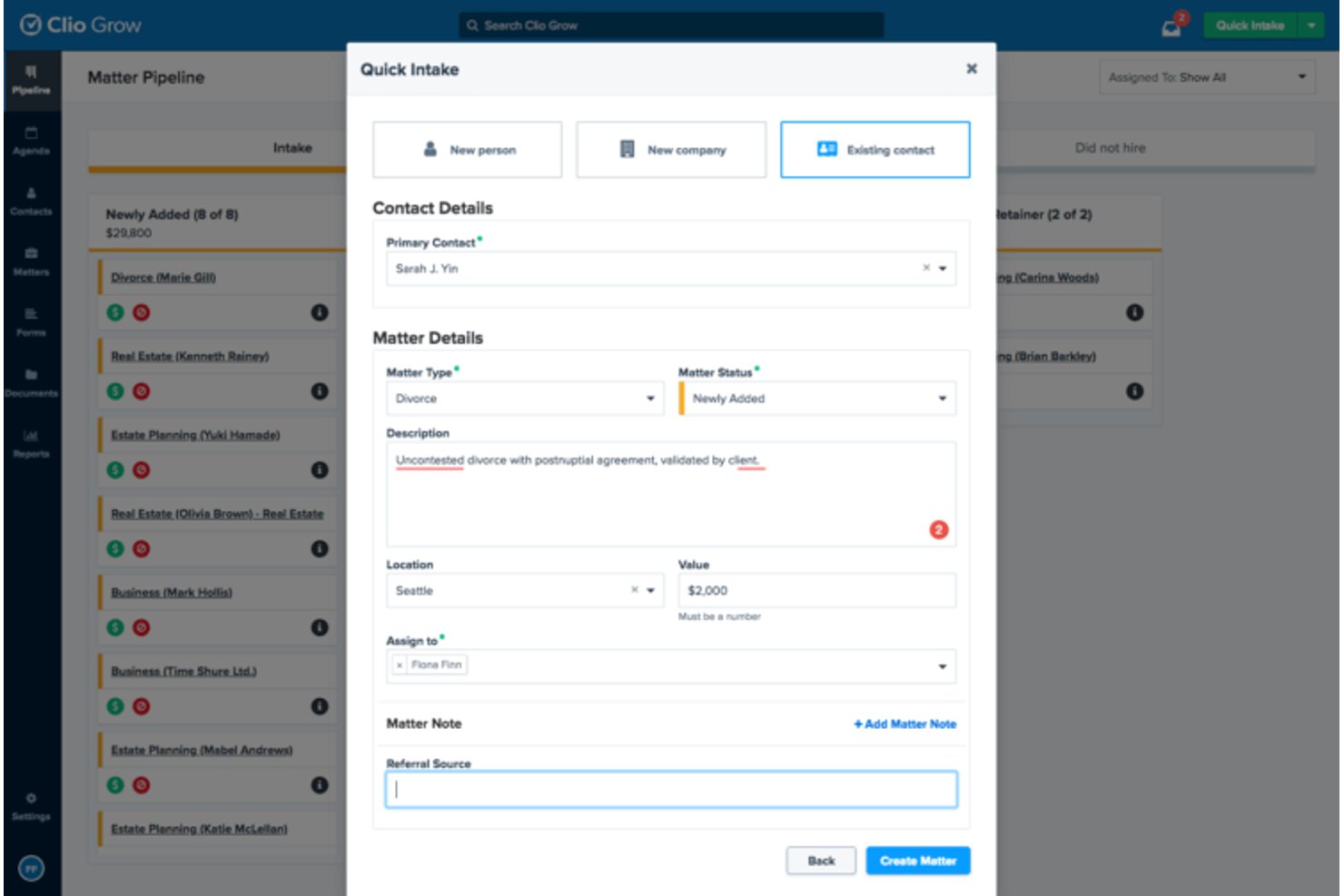
Clio Grow is a cloud-based legal client intake platform that covers online intake forms, lead pipeline tracking, e-signatures, automated task generation, and direct data sync into Clio Manage.
Who Is Clio Grow Best For?
Clio Grow is a natural fit for law firms already running Clio Manage who want client intake and matter management to live in one connected system.
Why I Picked Clio Grow
I picked Clio Grow as one of the best because no other intake tool on this list converts a completed intake form directly into a matter in Clio Manage without any manual re-entry. When a prospect fills out your form, their contact details, matter information, and uploaded documents flow straight into your practice management system. I also like the pipeline view, which lets you track every lead from first inquiry through signed retainer, with automated task lists and e-signatures built into the same workflow.
Clio Grow Key Features
- Customizable intake forms: Build practice area-specific forms with custom fields to capture the exact client and matter details your firm needs.
- Lead inbox: Centralize all incoming potential client inquiries from your website, referrals, and marketing channels in one place.
- Conflict checks: Run firm-wide searches for conflicts of interest or duplicate records directly within the Clio platform.
- Appointment scheduling: Let prospective clients book consultations online, cutting out the back-and-forth of manual scheduling.
Clio Grow Integrations
Clio Grow taps into Clio's app directory of 250+ integrations, including Clio Manage, QuickBooks, Xero, Google Drive, Dropbox, Microsoft 365, Outlook, Google Calendar, Gmail, and Zapier. An API is also available for custom integrations.
Pros and Cons
Pros:
- Offers firm-wide conflict checks
- Tracks leads from inquiry to signed retainer
- Converts intake forms directly to matters
Cons:
- Reporting options can feel inflexible
- Intake automation limited outside Clio ecosystem

Lawcus
Best for AI-driven lead intake and follow-up
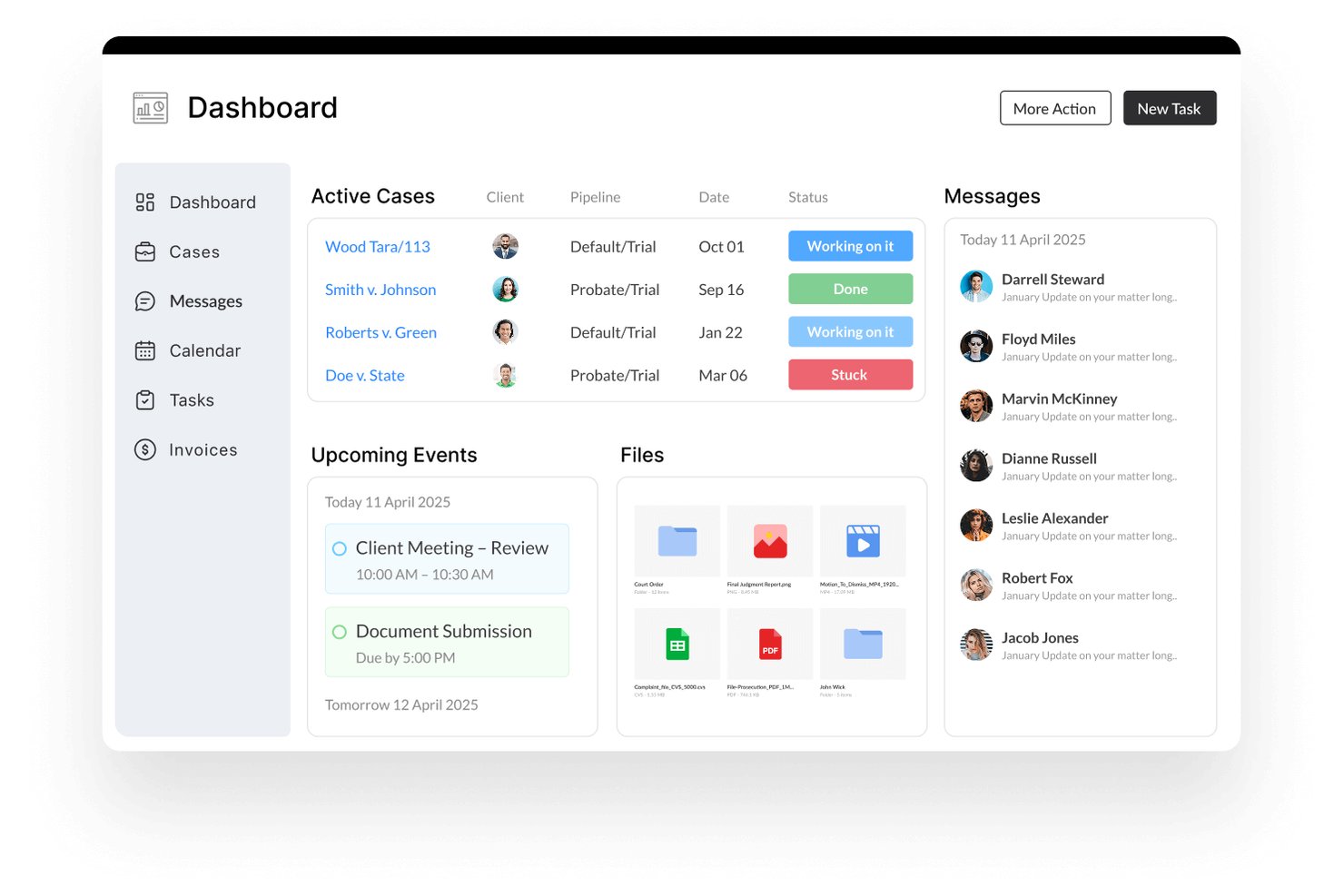
Lawcus is a legal practice management platform that combines client intake, CRM, matter management, billing, and AI-powered lead follow-up within a single system built for law firms.
Who Is Lawcus Best For?
Lawcus works well for small to mid-sized law firms that want AI-powered lead follow-up and client intake built into the same platform they use to manage matters, billing, and workflows.
Why I Picked Lawcus
Lawcus earns its spot as one of the best on my shortlist because of Lead Autopilot, its AI intake engine that handles full intake cycles, from call routing and lead qualification to automated questionnaire distribution, all synced directly into the Lawcus CRM. Nova AI then generates personalized follow-up emails and messages, so leads that don't convert immediately don't go cold. I like that both tools operate inside the same platform your team uses for matters, billing, and task management.
Lawcus Key Features
- Legal e-signature: Send engagement agreements for electronic signature directly from within Lawcus, letting clients sign from any device without leaving the platform.
- Two-way SMS messaging: Send and receive client text conversations through a system-generated phone number, with all messages stored in one place.
- Appointment scheduling: Book and manage consultations from within the CRM, keeping intake and scheduling connected to the same client record.
- Kanban board for matter tracking: Visualize matters and lead stages across a drag-and-drop board so your team can see the status of every active file at a glance.
Lawcus Integrations
Lawcus offers native integrations with Gmail, Microsoft 365, Microsoft Outlook, Google Drive, Dropbox, QuickBooks, Xero, LawPay, Calendly, and Mailchimp, and it connects with Zapier. An API is available for custom integrations, and Lawcus also connects with legal-specific tools like Smith.ai, LexReception, and Decision Vault for intake and reception workflows.
Pros and Cons
Pros:
- Two-way SMS keeps intake and communication connected
- Follow-up messaging personalized by built-in AI
- AI-driven intake automates lead qualification
Cons:
- Limited customization for intake workflows
- No public pricing transparency

Filevine
Best for AI-driven intake and marketing ROI
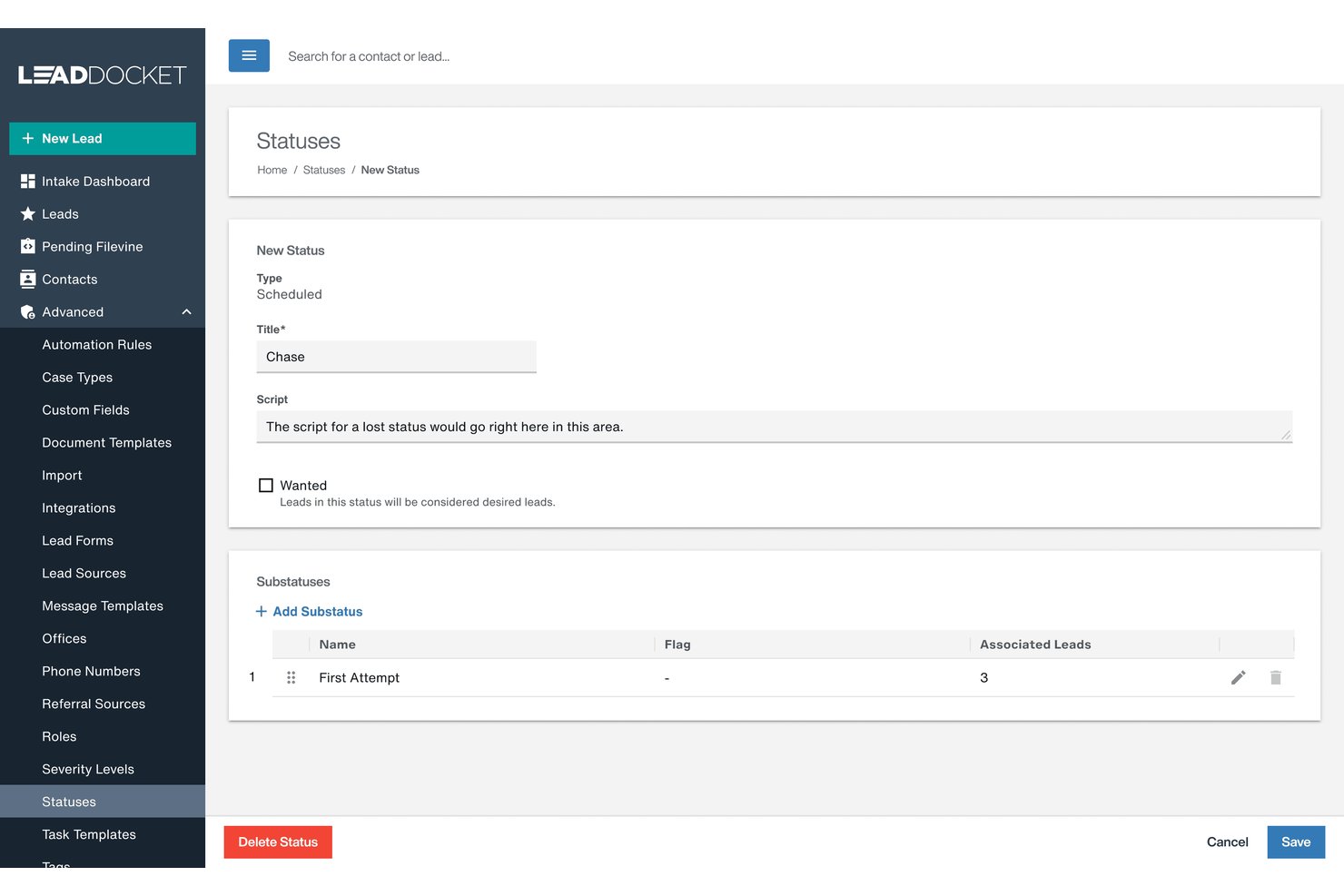
Filevine is an AI-powered legal practice management platform covering client intake, matter management, document automation, deadline tracking, and payment processing—with AI agents built on a purpose-built legal data foundation spanning 40M+ matters.
Who Is Filevine Best For?
Filevine is a strong fit for plaintiff-side law firms and high-volume legal practices that need to connect client intake directly to marketing attribution and matter management in one platform.
Why I Picked Filevine
I picked Filevine as one of the best because its LeadsAI tool does something most intake platforms don't: it uses AI to generate instant lead summaries and predictive case analysis, so your intake team can decide whether to accept, refer, or reject a lead without sifting through pages of intake forms. What really sets it apart is the marketing attribution layer built into Lead Docket, which connects every lead source directly to final settlement value so you can see exactly which ad campaigns are generating revenue, not just clicks.
Filevine Key Features
- Text-to-Case-File messaging: Send and receive client text messages directly within a case file, with an SMS pending response list to flag unanswered texts.
- Client portal: Give clients 24/7 access to case status, deadlines, and secure document uploads, with the option to invite outside parties like co-counsel or medical providers with restricted access.
- Vinesign e-signatures: Send forms via text or email and collect electronic signatures without leaving the platform.
- AI data mapping: Upload documents and let FilevineAI extract and map key data into designated fields automatically, cutting down manual data entry during intake.
Filevine Integrations
Filevine offers 40+ native and partner integrations, including QuickBooks, Microsoft 365, Outlook, Gmail, Google Calendar, Microsoft Teams, Slack, RingCentral, Dialpad, and Domo, and it connects with Zapier. An API is also available for custom integrations, and Workato is supported for building deeper workflow automations.
Pros and Cons
Pros:
- Connects intake directly to marketing attribution
- Predictive analysis helps qualify legal cases
- AI generates instant intake lead summaries
Cons:
- Intake tools may feel complex for small firms
- Advanced AI features require initial configuration

CosmoLex
Best for intake built into trust accounting
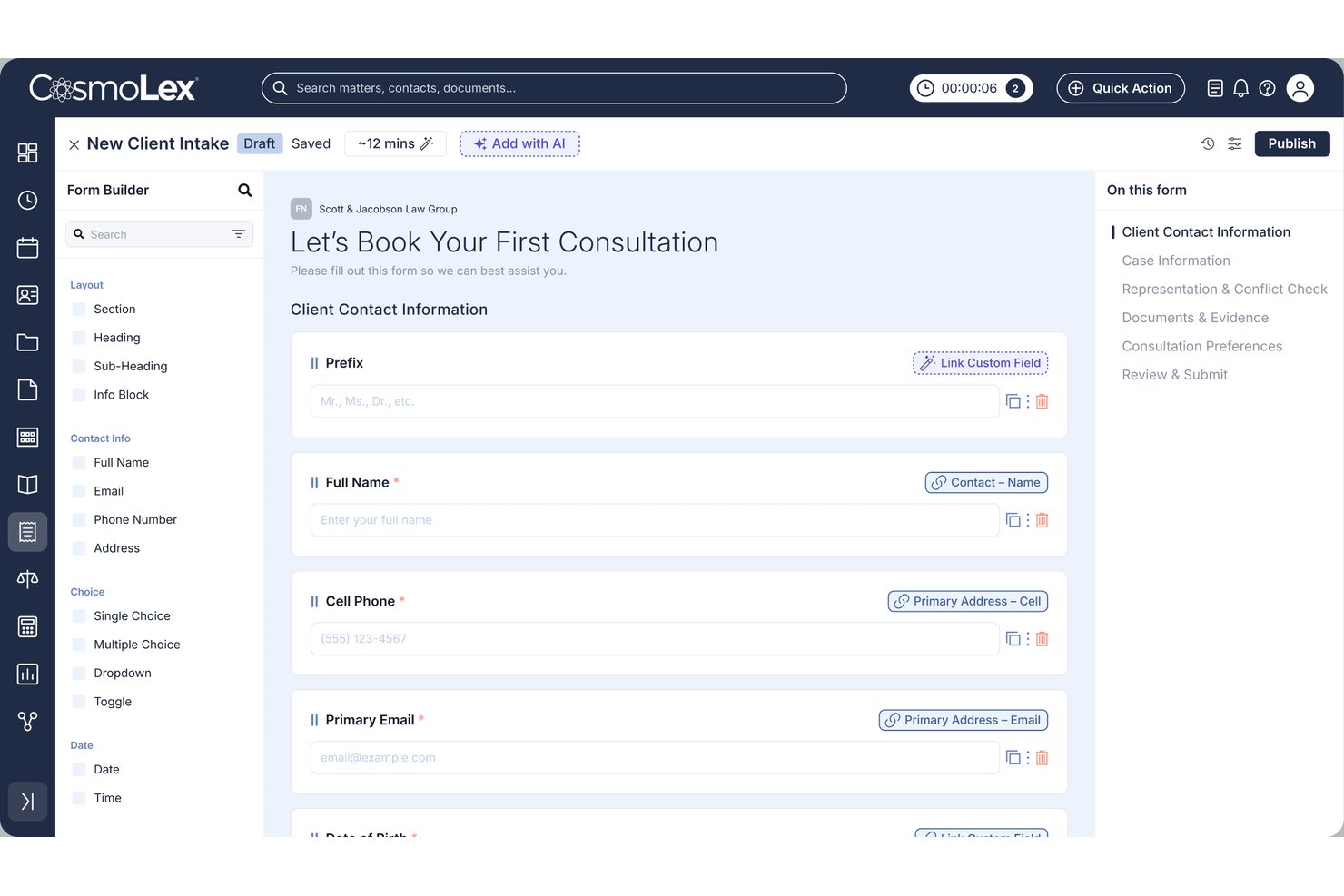
CosmoLex is a cloud-based legal practice management platform that covers client intake, matter tracking, billing, and built-in trust accounting—all in one system designed for law firms.
Who Is CosmoLex Best For?
CosmoLex is a strong fit for small to mid-sized law firms that want to manage client intake and trust accounting in a single platform without juggling separate tools.
Why I Picked CosmoLex
I picked CosmoLex as one of the best because it's the only legal client intake tool I've found that connects intake directly to built-in trust accounting, not a third-party add-on. When a new client matter opens, funds collected at intake flow into a dedicated trust ledger with automatic real-time bookkeeping. I particularly like the one-click three-way reconciliation, which keeps your firm audit-ready and prevents commingling from day one of the client relationship.
CosmoLex Key Features
- AI intake form builder: Generate a custom intake form from a text prompt, or convert existing PDF and Word forms into editable digital versions.
- One-click eSignatures: Send and collect client engagement agreements directly within the platform during the intake process.
- Automated post-submission workflows: Once a client submits a form, consultations get scheduled and task assignments trigger automatically.
- Secure client portal: Clients submit documents and communicate with your firm through a branded portal that auto-files uploads to the correct matter.
CosmoLex Integrations
CosmoLex offers native integrations with Gmail, Outlook, Microsoft 365, Apple Mail, Yahoo Mail, Google Calendar, Google Drive, Dropbox, Box, OneDrive, NetDocuments, LexShare, Chrometa, LawPay, and CosmoLexPay, and it connects with Zapier for access to 4,000+ additional apps.
Pros and Cons
Pros:
- Secure portal auto-files client uploads
- Three-way reconciliation for audit readiness
- Intake connects directly to trust accounting
Cons:
- Custom field mapping limited in intake forms
- Reporting features require manual setup

Best for conflict checks in mid-to-large firm intake
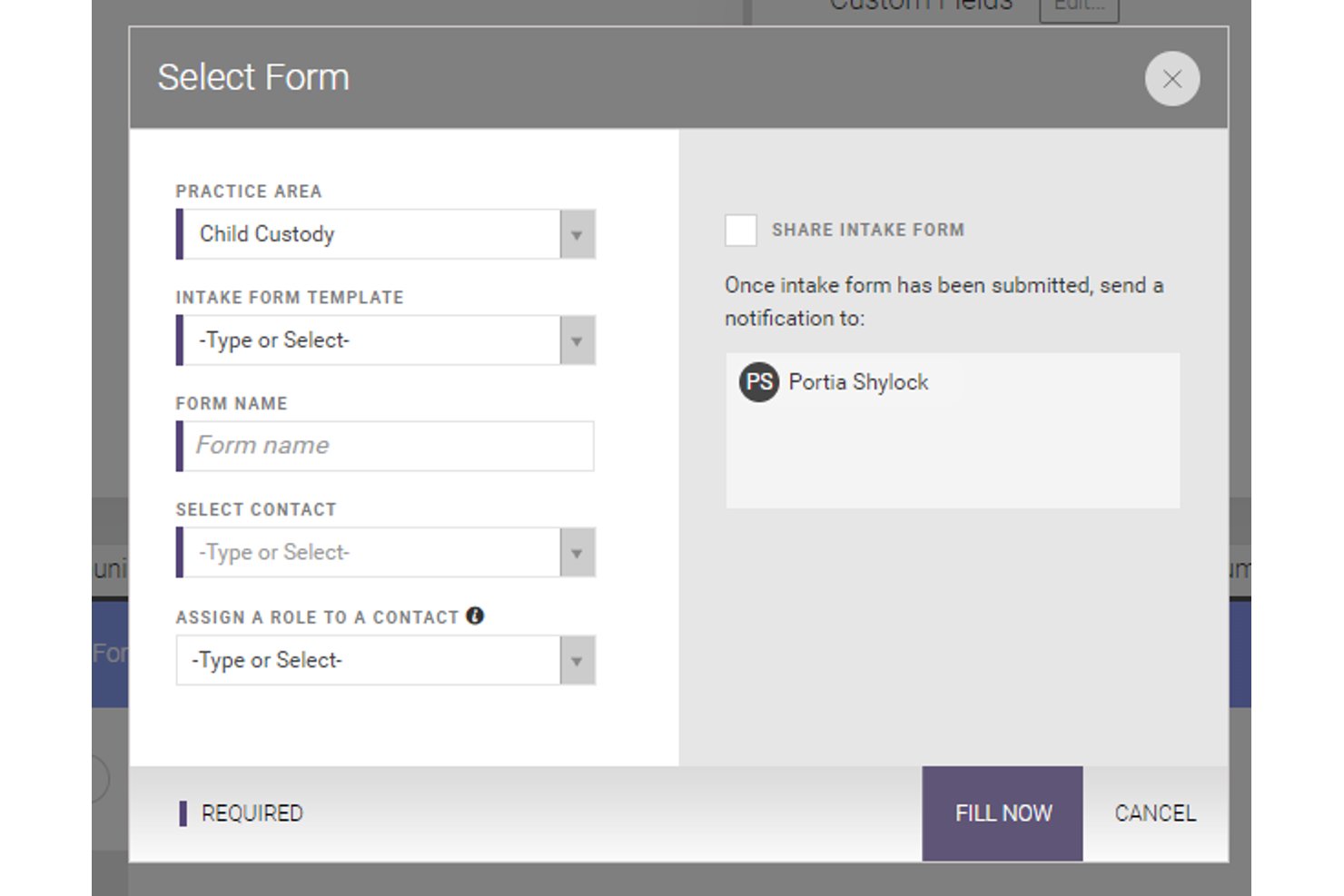
CARET Legal is a cloud-based legal practice management platform that covers client intake, conflict checking, matter management, billing, document management, and client communication in one system.
Who Is CARET Legal Best For?
CARET Legal is a strong fit for mid-to-large law firms that need structured conflict checking built directly into their client intake and matter management workflow.
Why I Picked CARET Legal
I picked CARET Legal as one of the best because its conflict checking is built directly into intake, not bolted on as an afterthought. When a new prospect enters the system, CARET Legal searches across active matters, archived cases, communication logs, and internal notes in one pass. That kind of reach into historical data matters most at mid-to-large firms, where manual checks across disconnected systems are where conflicts get missed. I also like that intake data automatically populates matter fields and triggers task assignments, cutting the duplicate entry that slows intake teams down.
CARET Legal Key Features
- Client portal: A built-in client portal lets clients access matter updates, exchange messages, and review documents without requiring a phone call or email thread.
- Two-way texting: Send and receive SMS messages with clients directly from within CARET Legal, keeping all communication logged against the relevant matter record.
- Document automation: Generate templated documents using matter data already in the system, reducing manual drafting time for routine client-facing paperwork.
- Time tracking and trust accounting: Log billable hours and manage trust accounts from within the same platform, with invoicing tied directly to matter records.
CARET Legal Integrations
CARET Legal offers native integrations with Microsoft 365, Google Workspace, Microsoft Outlook, Microsoft Word, OneDrive, NetDocuments, HotDocs, Lawmatics, LawToolBox, QuickBooks Online, RMail, and CARET Pay, plus IMAP support for other email accounts. Zapier support and a public API for custom integrations are not clearly documented.
Pros and Cons
Pros:
- Built-in portal supports secure client communication
- Intake populates matter records automatically
- Conflict checking scans all historical data
Cons:
- Intake workflow heavily structured for larger firms
- Public API support is not clearly documented

Best for intake-to-matter flow in one platform
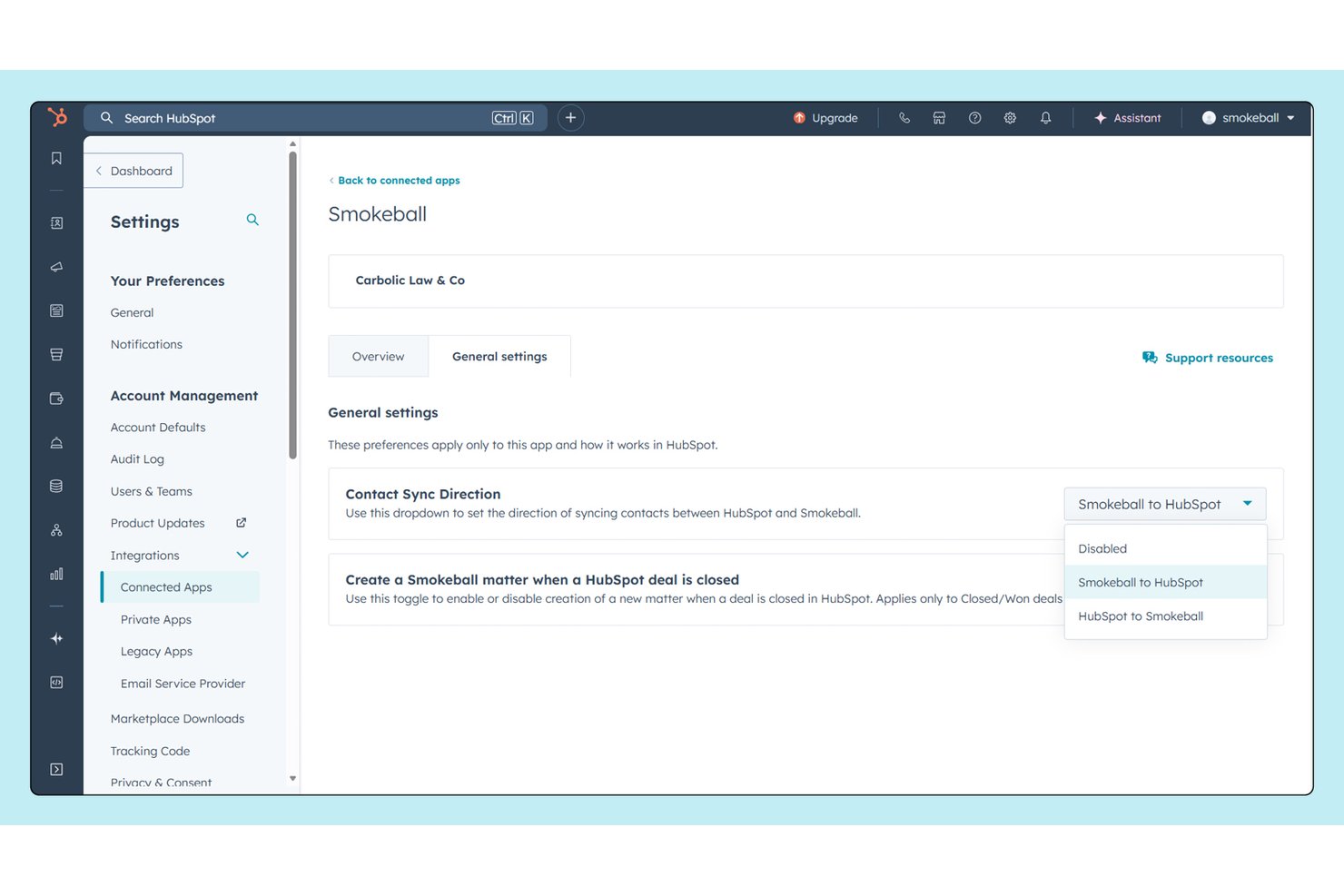
Smokeball is a legal practice management platform for small and mid-sized law firms that combines client intake, matter management, document automation, automatic time tracking, and billing in one connected system.
Who Is Smokeball Best For?
Smokeball is a strong fit for small and mid-sized law firms that want client intake, matter management, and billing handled in a single connected platform rather than across multiple tools.
Why I Picked Smokeball
I picked Smokeball as one of the best because its lead management feature tracks a prospect from first contact all the way to an open matter, so nothing slips between intake and case setup. Once a matter opens, automated task workflows kick in and guide your team through the next steps without manual handoffs. I also like that AutoTime logs billable activity in the background throughout, so time captured during intake conversations isn't lost when the matter goes live.
Smokeball Key Features
- TemplateLab: Access 20,000+ automated document and form templates that pull in matter details to pre-populate fields.
- Client portal: Gives clients a dedicated space to view matter information and communicate directly with your firm.
- Email management: Automatically files client emails and attachments to the correct matter without manual sorting.
- Archie AI: An AI assistant embedded in matters that reads files, drafts documents, and surfaces next steps inside Microsoft Word and Outlook.
Smokeball Integrations
Smokeball offers 60+ native integrations through its Marketplace, including QuickBooks Online, Microsoft Outlook, Microsoft Word, Zoom, RingCentral, Smith.ai, Thomson Reuters CoCounsel, InfoTrack, EvenUp, and CiteLaw, and it connects with Zapier. A partner API is also available for custom integrations.
Pros and Cons
Pros:
- Auto-files client emails to correct matter
- Tracks billable time during intake process
- Turns intake into active matter automatically
Cons:
- No mobile intake form experience
- Intake forms require Smokeball support edits

MyCase
Best for all-in-one intake within your case files
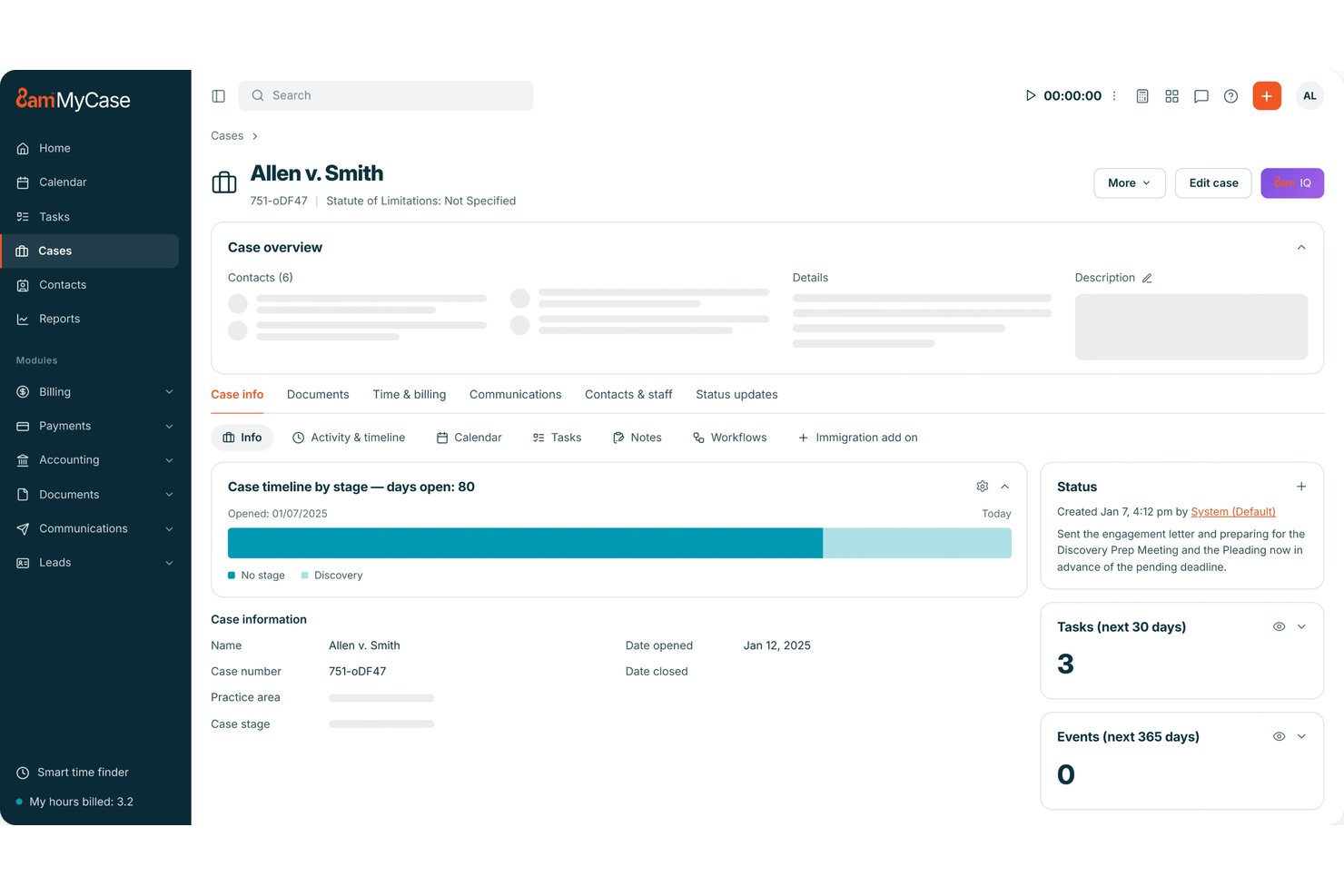
MyCase is a legal practice management platform that combines customizable client intake forms, built-in CRM, case management, billing, and payment collection in one system.
Who Is MyCase Best For?
MyCase is a strong fit for small to mid-sized law firms that want intake forms, CRM, case management, billing, and payments all connected in one platform rather than spread across separate tools.
Why I Picked MyCase
I picked MyCase as one of the best because intake data flows directly into the client's case file the moment a form is submitted, which means no re-entering information across separate systems. I love that the forms use conditional logic, showing or hiding questions based on prior answers, so clients only see what's relevant to their matter. You can also collect consultation and retainer fees during intake, which keeps onboarding and payment in one step rather than two separate conversations.
MyCase Key Features
- Website embed for intake forms: Place intake forms directly on your firm's website so prospective clients can submit their information without any back-and-forth.
- eSignature: Clients can sign engagement letters and agreements from any device, with eSignature built into the platform at no extra cost.
- Built-in text messaging: Send and receive messages with clients and leads through integrated text messaging, with every conversation saved automatically to their case record.
- Workflow automation: Automatically trigger the creation of tasks, events, and documents when a new intake form is submitted, so your team's next steps are ready without manual setup.
MyCase Integrations
MyCase offers 60+ native integrations relevant to legal intake and case management, including Lawmatics, DecisionVault, Intaker, LawPay, QuickBooks, Gmail, Microsoft Outlook, Google Calendar, Dropbox, and NetDocuments. An API is available for custom integrations.
Pros and Cons
Pros:
- Collects consultation and retainer fees upfront
- Conditional logic tailors every intake form
- Intake data flows directly into case files
Cons:
- Lacks extensive granular intake reporting tools
- Limited intake form design customization options

Best for CRM-grade intake and marketing ROI tracking
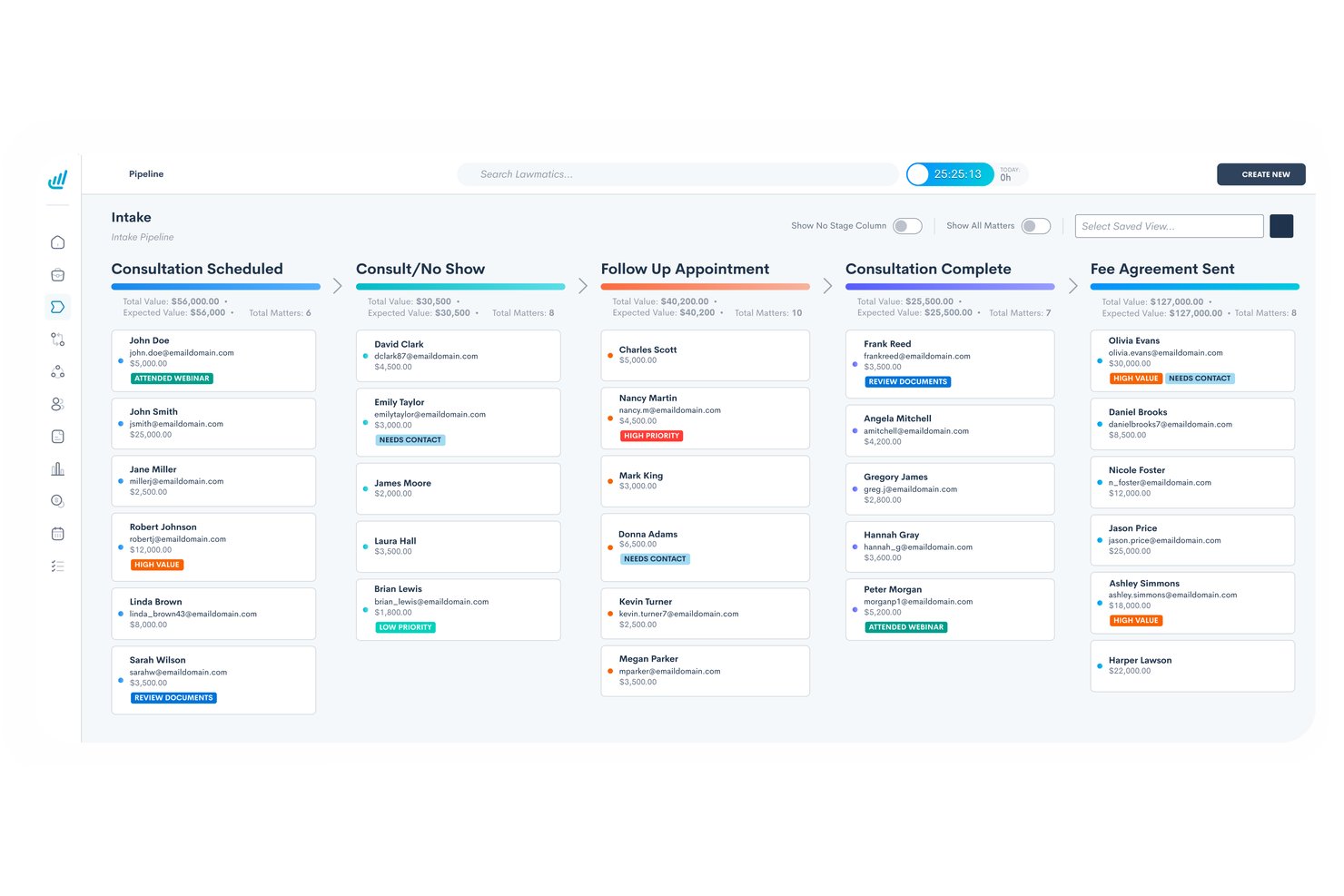
Lawmatics is a legal CRM and client intake platform that combines intake forms, automated follow-ups, e-signatures, conflict checking, and marketing analytics into a single system for law firms.
Who Is Lawmatics Best For?
Lawmatics is a strong fit for growth-focused law firms that want to track where clients come from and measure the return on their marketing spend alongside managing intake.
Why I Picked Lawmatics
I've included Lawmatics in my top picks because it treats intake as the front end of a full CRM pipeline, not just a form-capture tool. What sets it apart is the built-in marketing attribution tracking, which shows you exactly which campaigns, referral sources, or ad channels are generating signed clients. Pair that with automated follow-up sequences and conflict checking, and you get a system that closes the loop between marketing spend and intake conversion.
Lawmatics Key Features
- Custom intake form builder: Build intake forms tailored to specific practice areas and case types using customizable templates.
- Client self-scheduling: Let prospective clients book consultation appointments directly through calendar-synced availability links.
- Electronic signatures: Send, receive, and manage legally binding e-signatures on retainer agreements and intake documents without leaving the platform.
- Audience segmentation: Group contacts dynamically by matter type, lead status, or location to deliver targeted follow-up communications.
Lawmatics Integrations
Lawmatics offers native integrations with Clio, MyCase, PracticePanther, Rocket Matter, Smokeball, LawPay, QuickBooks, Google Ads, Microsoft Outlook, and Zoom, along with an integration marketplace covering case management, billing, reception, and communication tools. An API is available for custom integrations through the LawLink.ai universal connector.
Pros and Cons
Pros:
- Offers conflict checks within intake flow
- Automates personalized follow-up sequences
- Tracks marketing ROI linked to intake conversion
Cons:
- E-signature customization options feel limited
- Intake analytics require CRM pipeline setup

Litify
Best for mid-size firm intake and conflict checks
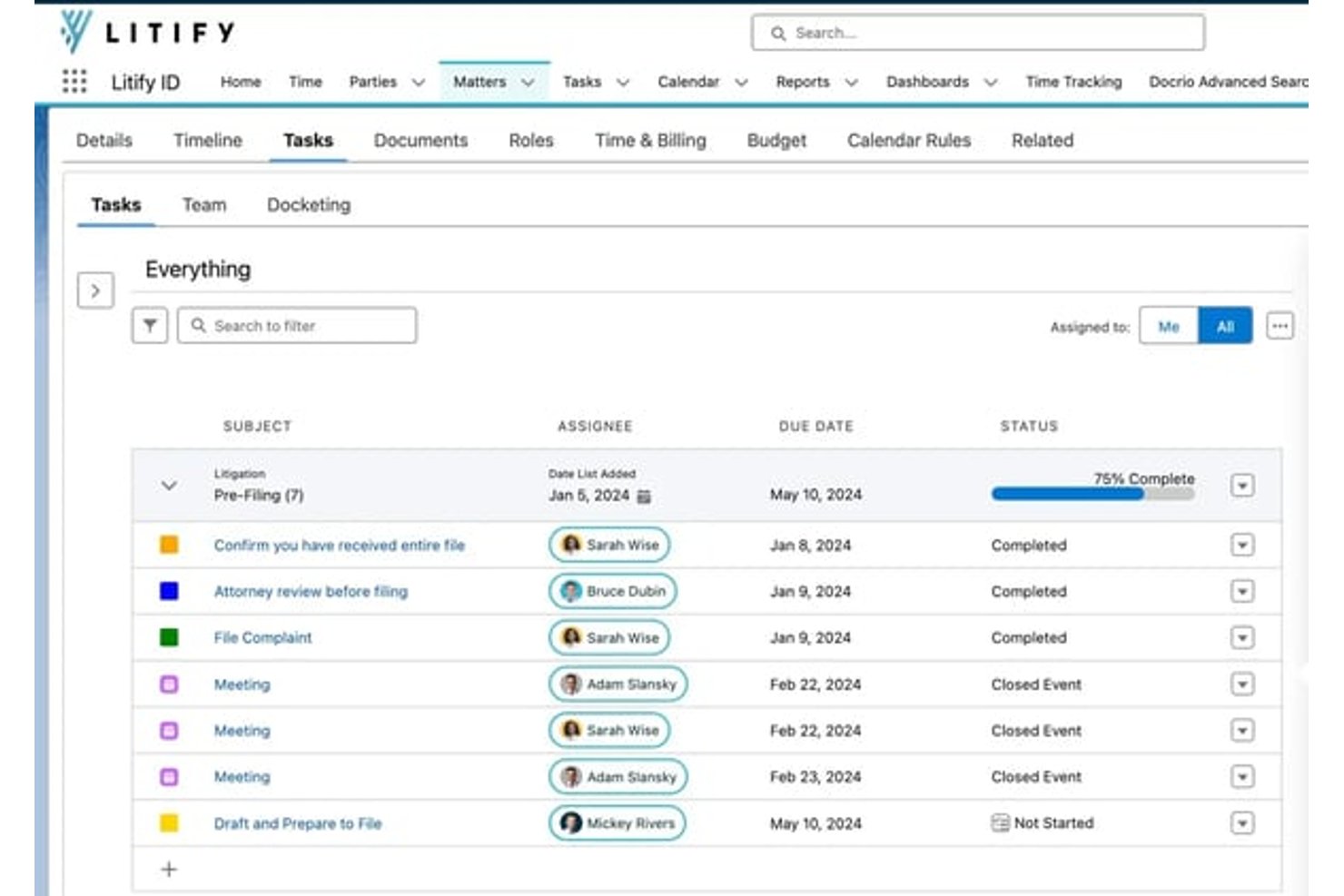
Litify is a Salesforce-based legal operations platform that covers client intake, matter management, document generation, time and billing, and AI-driven workflow automation across practice areas.
Who Is Litify Best For?
Litify works well for mid-size law firms that need to manage high intake volumes alongside conflict checks within a single Salesforce-native platform.
Why I Picked Litify
I picked Litify as one of the best because its Conflict Check Agent stands out for mid-size firms processing high intake volumes. It uses fuzzy matching to catch conflicts even when names or data are incomplete or inconsistent, which is exactly where manual checks tend to fail. Pair that with dynamic intake questionnaires that branch based on client responses, and your team can qualify matters faster without sacrificing accuracy.
Litify Key Features
- Matter plans: Automatically generate configurable task lists by practice area and case type when a new matter opens.
- Legal service request routing: Triage incoming requests and route contract, IP, or HR matters to the right specialist automatically.
- AI time capture: Track and recommend billing entries for activities like emails and coordination without manual input.
- No-code workflow configuration: Build and edit intake workflows, reports, and views without writing any code, directly within the Salesforce-native environment.
Litify Integrations
Litify is built natively on Salesforce and offers integrations with DocuSign, iManage, Microsoft Outlook, QuickBooks, Google Calendar, Epiq, Confido Legal, Workday, and SAP. An API is available for custom integrations, and Zapier support is not clearly documented.
Pros and Cons
Pros:
- No-code workflow tools reduce IT reliance
- Dynamic intake forms adapt to client responses
- Fuzzy matching for more accurate conflict checks
Cons:
- Customization can require advanced setup skills
- Heavy reliance on Salesforce environment

Law Ruler
Best for e-signature via SMS at intake
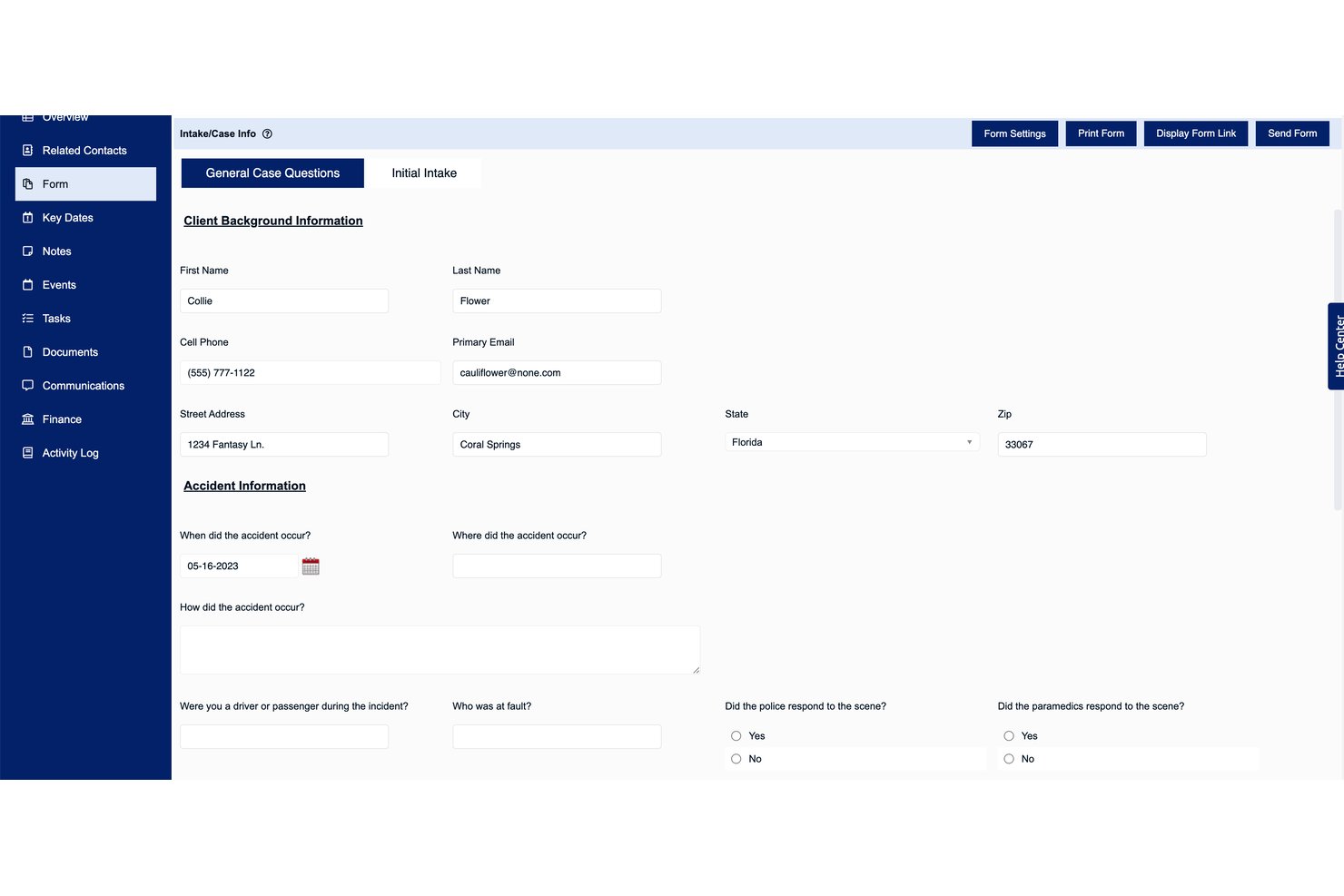
Law Ruler is a legal client intake platform for law firms that combines smart intake forms, lead management, automated document assembly, and e-signature collection via email or SMS.
Who Is Law Ruler Best For?
Law Ruler is a strong fit for plaintiff-side and high-volume law firms that need to capture e-signatures from prospective clients at the moment of first contact, before they walk away.
Why I Picked Law Ruler
I picked Law Ruler as one of the best because it's the only legal intake tool I've seen that lets firms send e-signature requests directly via SMS at the moment of first contact. That matters in high-volume plaintiff-side practices where a prospective client who doesn't sign right away often doesn't sign at all. Law Ruler pairs this with Smart Forms that adapt questions based on each lead's answers, so by the time the signature request lands in their text messages, the retainer is already pre-populated with their information.
Law Ruler Key Features
- Pipeline inbox: A visual dashboard that tracks each lead's status and movement through your intake-to-client conversion workflow.
- Automated appointment scheduling: Law Ruler sends email and text follow-ups to schedule consultations without manual coordination from your team.
- Lead qualification and pre-screening: The platform automatically flags and filters leads based on intake responses, so your team focuses only on cases that fit your practice.
- Automated document assembly: Client data from intake forms populates legal document templates, reducing the time spent preparing retainer agreements and other paperwork.
Law Ruler Integrations
Law Ruler offers native integrations with practice management and legal tools including TimeSolv, CosmoLex, Rocket Matter, HelloSign, Smith.AI, ApexChat, Twilio, Thomson Reuters, and Microsoft 365, and it connects with Zapier. An API is available for custom integrations at no additional fee.
Pros and Cons
Pros:
- Visual dashboard tracks lead status
- Smart intake forms adapt to client answers
- Sends e-signature requests instantly via SMS
Cons:
- Advanced automation setup can feel complex
- Intake customization requires platform support
Other Legal Client Intake Software
Here are some additional legal client intake software options that didn’t make it onto my shortlist, but are still worth checking out:
- Lead Docket
For marketing ROI in high-volume PI intake
- Actionstep
For conflict checks built into your intake flow
- CasePeer
For personal injury firm intake pipelines
- Rocket Matter
For intake within a practice management suite
- PracticePanther
For solo firms taking intake through to billing
- Neos
For PI firms scaling their intake pipeline
- Docketwise
For immigration law intake workflows
- RunSensible
For all-in-one intake and matter management
- Intaker
For AI-driven lead capture across channels


How I Evaluate Legal Client Intake Software
I split my evaluation into baseline criteria every tool must meet and differentiating factors that separate good from great—from conflict check depth to how well intake data flows into matter management.
Core Functionality (Table Stakes For This List)
When I'm selecting tools for my list, I rank each one on a scale from 0 (does not offer the functionality) to 5 (excels in this area) for each core functionality listed below. I then calculate the tool's total score into a percentage, using 65% as a benchmark to help assess its overall fit for the list.
- Customizable Intake Forms: I check whether forms support conditional logic and practice-area templates, since a family law questionnaire needs very different fields than a PI intake.
- Lead & Contact Management: Pipeline stages, automated follow-ups, and activity history all factor in—I look for tools that move leads from inquiry to signed engagement without manual babysitting.
- Conflict Check Tools: I evaluate how deeply a tool searches across parties, aliases, and related matters, and whether it logs results with an audit trail your compliance team can reference later.
- E-Signature & Engagement Letters: The ability to send retainer agreements with merge fields and collect signatures natively matters here—tools like Lawmatics and Law Ruler handle this differently, so I compare workflow and delivery options.
- Practice Management Integration: I look at whether intake data syncs into your matter management system in real time, since re-keying client details from intake into platforms like Clio or Filevine defeats the purpose.
- Intake Analytics & Reporting: Tracking lead sources, conversion rates, and referral performance helps justify marketing spend, so I evaluate dashboard depth and whether reports can be filtered by campaign or practice area.
Once I have a list of tools that meet the criteria, I consider what sets each platform apart.
Differentiating Factors (What Sets Vendors Apart)
Here's how I compare and contrast different vendors:
Standout Features
I look for referral source and UTM tracking that ties marketing spend directly to signed matter revenue—not just lead counts. Tools like Lawmatics and Lead Docket handle attribution differently, so I check whether you can filter ROI by practice area or campaign. Payment collection at intake is another separator; I evaluate whether a platform supports IOLTA-compliant trust deposits at the point of signing, since collecting retainers during onboarding cuts days off your accounts receivable cycle. I also consider how well each tool handles automated client communication, from drip emails to SMS re-engagement of stalled leads.
Beyond Features
I evaluate how well each platform fits a firm's existing practice management stack. Bidirectional syncing with tools like Clio or Filevine should cover contacts, custom fields, and documents—not just names and emails. I also check onboarding support, since migrating a conflict database or building conditional intake templates without a dedicated success manager can stall adoption for weeks, especially at firms without in-house IT.
How to Choose a Legal Client Intake Software
When you’re picking legal client intake software, ask yourself: which parts of client onboarding and hand-off still create friction in your firm, and what’s non-negotiable for compliance or marketing ROI?
| If your priority is… | Look for… |
| Streamlining intake to matter management | Direct integration with your practice/matter platform |
| Preventing conflicts and compliance risks | Searchable, logged conflict check functions |
| Tracking marketing ROI and lead sources | Campaign source attribution and intake analytics |
| Capturing signatures and approvals instantly | E-signature and SMS-enabled intake workflows |
| Automating follow-up for new leads | Built-in drip/SMS/email reminders in the intake flow |
How to Vet Your Shortlist
- Test integration flow: Set up a trial client and confirm all intake data syncs to your current case management system within 48 hours.
- Run a real conflict check search: Input names/parties from a closed matter and request the searchable audit trail as a pdf before day three.
- Verify attribution and reporting: Import 20 test leads with varied “How did you hear about us?” inputs, then export a breakdown of sources/campaigns.
- Request engagement letter workflow: Ask the vendor to send you a sample e-signature request via both email and SMS, and sign using your own device.
- Tradeoff—customization vs. out-of-the-box setup: Decide whether you need highly tailored workflows (requiring longer implementation) or instant usability with default templates.
What Is Legal Client Intake Software?
Legal client intake software is a digital tool law firms use to capture, qualify, and onboard new client inquiries. It automates intake forms, communication, conflict checks, and engagement letter processes so you can move clients from initial contact to active matter without manual data entry or missed steps. Using this software helps ensure compliance, reduces onboarding errors, and connects intake data directly to your practice or case management systems.
Features of Legal Client Intake Software
When selecting legal client intake software, keep an eye out for the following key features:
- Customizable intake forms: Build forms that adapt to different practice areas and use conditional logic, so you can collect the right information for every new client without duplicating effort.
- Lead and contact management: Track inquiries from first contact to signed engagement with tools that automatically log communications, manage pipeline stages, and support follow-ups so you don’t lose track of leads.
- Conflict check tools: Search your firm’s database for potential conflicts of interest by scanning parties, related contacts, and matters, and generate an audit trail for compliance.
- E-signature and engagement letters: Create, send, and collect signatures on retainer agreements directly within the intake workflow. Some tools allow delivery by both email and SMS.
- Practice management integration: Sync all intake data—including documents, contacts, and custom fields—directly with your case or matter management system to avoid manual data entry.
- Intake analytics and reporting: Monitor key performance measures like conversion rates, referral sources, and campaign effectiveness through dashboards and customizable reports.
- Automated client communication: Send drip email campaigns, SMS reminders, and assignment confirmations to keep prospects engaged and reduce missed opportunities.
- Payment collection at intake: Accept initial retainers, trust deposits, or other fees securely during the onboarding process so you can start on paid matters immediately.
- Document management: Organize, store, and retrieve intake documents, identification, and supporting files so everything you need moves seamlessly with the client through onboarding.
- Task and workflow automation: Trigger specific actions—like assigning tasks or sending notifications—when an intake reaches certain steps, so nothing slips through the cracks during onboarding.
Benefits of Legal Client Intake Software
Implementing legal client intake software provides several benefits for your team and your business. Here are a few you can look forward to:
- Faster client onboarding: Automatically capture and qualify leads using customizable intake forms, e-signatures, and conflict check tools to move clients quickly from inquiry to signed engagement.
- Fewer compliance gaps: Use searchable, logged conflict checks and audit trails to support safe onboarding and protect against conflicts of interest.
- Improved lead and contact management: Centralize all communication, documents, and activity history so you never lose track of a lead or miss a follow-up.
- Connected practice management workflows: Sync intake data—including custom fields and documents—directly with your practice or case management system to prevent manual data entry and reduce errors.
- Data-driven decision making: Access intake analytics and campaign attribution reports to measure marketing ROI, track conversion rates, and optimize your intake pipeline.
- Streamlined payment collection: Accept engagement fees and retainers securely during onboarding to reduce delays between intake and paid work.
- Automated client communications: Schedule drip emails and SMS reminders to keep prospects engaged throughout the intake process without extra manual effort.
Costs and Pricing of Legal Client Intake Software
Selecting legal client intake software requires an understanding of the various pricing models and plans available. Costs vary based on features, team size, add-ons, and more. The table below summarizes common plans, their average prices, and typical features included in legal client intake software solutions:
Plan Comparison Table for Legal Client Intake Software
| Plan Type | Average Price | Common Features |
| Free Plan | $0 | Basic customizable intake forms, limited lead and contact management, basic conflict check, and email support. |
| Personal Plan | $30–$50/user/month | Customizable intake forms, lead management, basic e-signature tools, conflict check, and limited practice management integration. |
| Business Plan | $60–$90/user/month | Advanced intake forms, expanded contact management, e-signature and template workflows, deeper conflict check, analytics and reporting, and integrations with practice management systems. |
| Enterprise Plan | $100–$150/user/month | All business features plus advanced analytics, priority support, workflow automation, onboarding assistance, enhanced security, and custom integrations. |
Legal Client Intake Software FAQs
Here are some answers to common questions about legal client intake software:
How do I know if legal client intake software will fit my existing practice management system?
Most legal client intake software integrates with popular practice management platforms like Clio, Filevine, or MyCase. Before choosing a tool, test a trial integration with your current system. Be sure that all relevant intake data—like contacts, custom fields, and documents—syncs fully and automatically, not just names or emails. Ask the vendor for a demo using your own sample data to see exactly how the integration works.
Is e-signature functionality standard or do I need to pay extra?
E-signature tools are included in many mid-tier and business plans but may be limited on lower-priced options. If collecting engagement letters or retainer agreements during intake is essential, confirm whether the plan you’re considering supports native e-signature and whether it delivers documents by both email and SMS. Some vendors offer advanced signature tools only as paid add-ons.
Can legal client intake software help with conflict checks and compliance?
Yes, most leading intake platforms include built-in conflict check tools. These let you search contacts, parties, and related matters for potential conflicts and log the results as an audit trail for compliance. Evaluate how deeply the search scans your database and whether you can export a proof-of-search report for your compliance team.
How does intake software help track marketing ROI?
Legal client intake tools often offer lead source attribution, campaign tracking, and intake analytics. You can capture how prospects found your firm, assign UTM codes, and run reports to see which marketing channels generate high-converting leads. This data helps you make smarter decisions about advertising spend and referral partnerships.
What happens if I need to customize intake forms for different practice areas?
Most legal client intake software lets you build custom forms for each practice area, often with conditional logic. This means you can tailor questions based on client responses—such as showing specific fields for family law versus personal injury. Always check if template libraries are available and whether you can launch new forms without coding.
How secure is client data in legal client intake software?
Security is a top priority in this category. Most reputable legal intake platforms offer features like data encryption, two-factor authentication, audit logging, and permission controls. Always confirm that the software meets applicable legal industry standards and ask your vendor about options for custom security settings or regional data hosting if needed.
Can I automate follow-ups and reminders for new leads?
Yes, automated follow-ups are commonly built-in. Many intake tools let you set up drip emails, SMS reminders, or task assignments based on status or milestones in the intake process. This helps you avoid manual tracking and ensures no prospective client slips through the cracks. Look for platforms that offer template workflows or easy customization for your typical client journeys.