

Smokeball Review: Pros, Cons, Features and Pricing
Smokeball brings legal practice management into one platform, from case management and document automation to billing, time tracking, and law firm workflow automation.

We review tools independently, and commissions help fund our testing. See our transparency policy, our methodology, or suggest a tool.
Smokeball is a legal practice management software built for small law firms that handle high volumes of documents and billable work. It tracks time automatically in the background as you work—no manual entry needed. I'd consider it over other tools, like Clio, if your firm prioritizes hands-off time capture and tightly integrated document generation.
Smokeball Evaluation Summary
4.8/5
- Pricing upon request
- Free demo available
Why Trust Our Software Recommendations
6,700+
Reviews
20
Industry experts
16+
Evaluation factors
14
Years
Our team has been testing and reviewing software since 2012. As legal practice leaders ourselves, we know how difficult—and important—it is to choose the right software.
For this guide, we evaluated tools using hands-on testing and independent research, scoring tools using our selection criteria.
Our reviews reflect our human editorial judgment, not a sales pitch.
Smokeball Overview
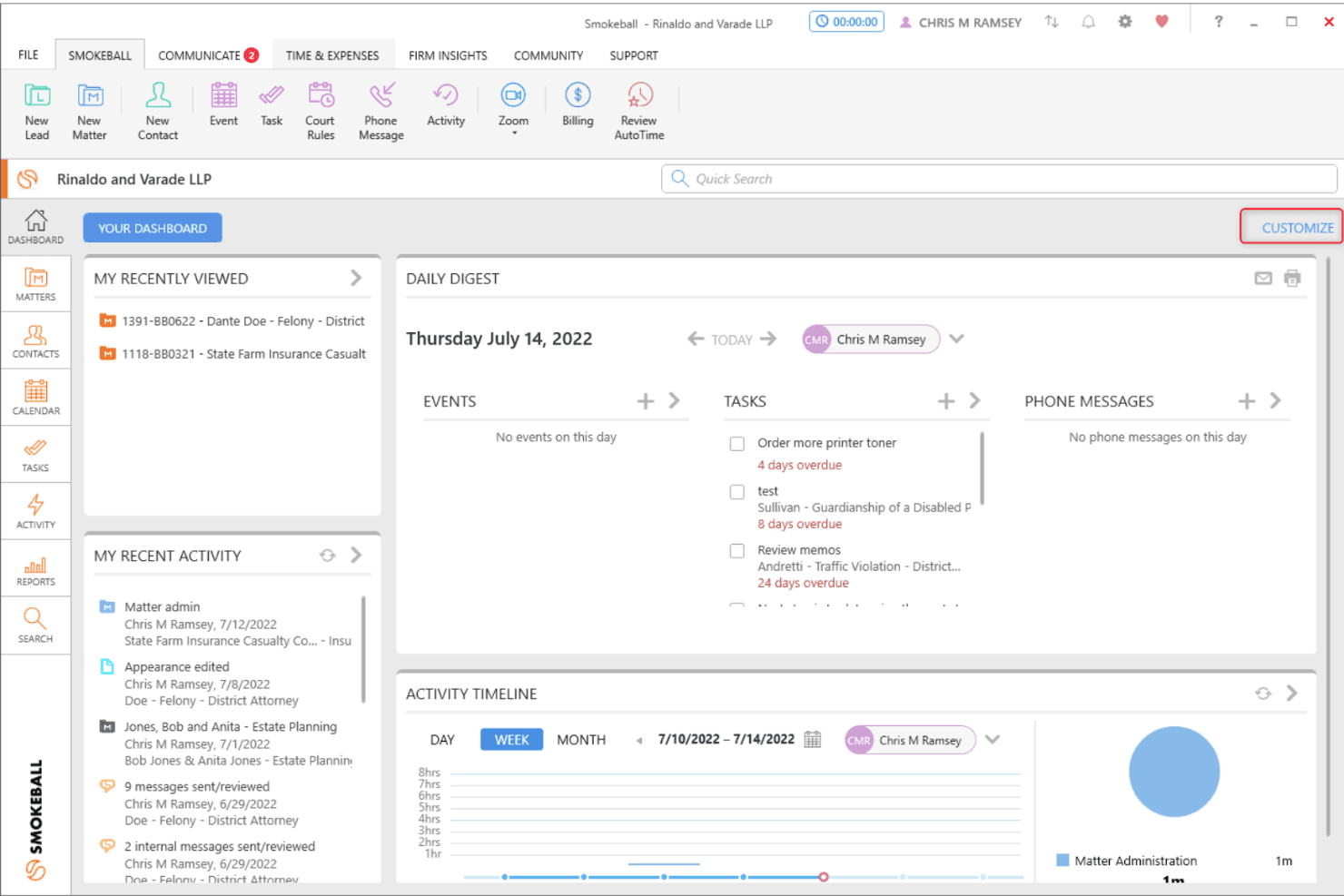
When I compare Smokeball to other legal practice management software, its document automation and built-in email tracking really set it apart. The interface is intuitive, onboarding is straightforward, and support is responsive. Pricing is higher than some, but you get strong reporting and workflow tools. Integrations are solid, though not the most extensive.
I think Smokeball is best for small to midsize firms that want automation without sacrificing usability. For example, firms handling high volumes of document-heavy matters will notice real time savings, but those needing deep third-party integrations might find limits.
Pros
- Built-in legal forms library covers many practice areas
- Automatic time tracking captures billable hours without manual entry
- Document automation saves significant time on repetitive tasks
Cons
- Scheduling across different time zones can be inconsistent
- Limited integrations with third-party document storage providers
- Pricing is higher than many comparable platforms
Is Smokeball Right For Your Needs?
Who Would be a Good Fit for Smokeball?
Smokeball is a strong choice for law firms and legal professionals who need robust document automation, integrated time tracking, and a library of legal forms. I think it’s especially well-suited for small to midsize firms, practice groups handling high volumes of paperwork, and teams that value built-in compliance tools. If your work depends on efficient document workflows and accurate billing, Smokeball’s features can help you stay organized and productive.
- Litigation TeamsCentralized matter management and time tracking help manage complex, multi-party cases.
- Solo PractitionersIntegrated email, billing, and document management reduce the need for multiple tools.
- Estate Planning AttorneysPre-built templates and compliance tracking simplify trust and will preparation.
- Family Law DepartmentsAutomated document creation and matter management support high-volume, detail-heavy cases.
- Real Estate PracticesThe built-in forms library and document assembly streamline property transaction workflows.
- Small Law FirmsSmokeball’s automation and case management tools are tailored for firms with limited IT resources.
Who Would be a Bad Fit for Smokeball?
Smokeball isn’t ideal for every legal environment. Larger firms with highly customized workflows, organizations needing deep integration with external systems, and teams outside traditional legal practice may find its feature set limiting. If your work relies on advanced reporting, broad third-party integrations, or non-legal workflows, you’ll likely want to look elsewhere.
- High-Volume PI FirmsCase intake and lead management tools are less advanced than some competitors.
- Non-Legal BusinessesFeatures are tailored to legal workflows, not general business operations.
- International PracticesScheduling and compliance tools are focused on US and Australian markets.
- Tech StartupsLimited API access and integration options restrict workflow automation.
- In-House Legal DepartmentsThe platform is designed for client-facing law firms, not corporate legal teams.
- Large Enterprise FirmsSmokeball’s customization and scalability may not meet enterprise-level demands.
How We Test & Score Tools
We’ve spent years building, refining, and improving our software testing and scoring system. The rubric is designed to capture the nuances of software selection and what makes a tool effective, focusing on critical aspects of the decision-making process.
Below, you can see exactly how our testing and scoring works across seven criteria. It allows us to provide an unbiased evaluation of the software based on core functionality, standout features, ease of use, onboarding, customer support, integrations, customer reviews, and value for money.
Core Functionality (25% of final scoring)
The starting point of our evaluation is always the core functionality of the tool. Does it have the basic features and functions that a user would expect to see? Are any of those core features locked to higher-tiered pricing plans? At its core, we expect a tool to stand up against the baseline capabilities of its competitors.
Standout Features (25% of final scoring)
Next, we evaluate uncommon standout features that go above and beyond the core functionality typically found in tools of its kind. A high score reflects specialized or unique features that make the product faster, more efficient, or offer additional value to the user.
We also evaluate how easy it is to integrate with other tools typically found in the tech stack to expand the functionality and utility of the software. Tools offering plentiful native integrations, 3rd party connections, and API access to build custom integrations score best.
Ease of Use (10% of final scoring)
We consider how quick and easy it is to execute the tasks defined in the core functionality using the tool. High scoring software is well designed, intuitive to use, offers mobile apps, provides templates, and makes relatively complex tasks seem simple.
Onboarding (10% of final scoring)
We know how important rapid team adoption is for a new platform, so we evaluate how easy it is to learn and use a tool with minimal training. We evaluate how quickly a team member can get set up and start using the tool with no experience. High scoring solutions indicate little or no support is required.
Customer Support (10% of final scoring)
We review how quick and easy it is to get unstuck and find help by phone, live chat, or knowledge base. Tools and companies that provide real-time support score best, while chatbots score worst.
Customer Reviews (10% of final scoring)
Beyond our own testing and evaluation, we consider the net promoter score from current and past customers. We review their likelihood, given the option, to choose the tool again for the core functionality. A high scoring software reflects a high net promoter score from current or past customers.
Value for Money (10% of final scoring)
Lastly, in consideration of all the other criteria, we review the average price of entry level plans against the core features and consider the value of the other evaluation criteria. Software that delivers more, for less, will score higher.
Core Features
Document Automation
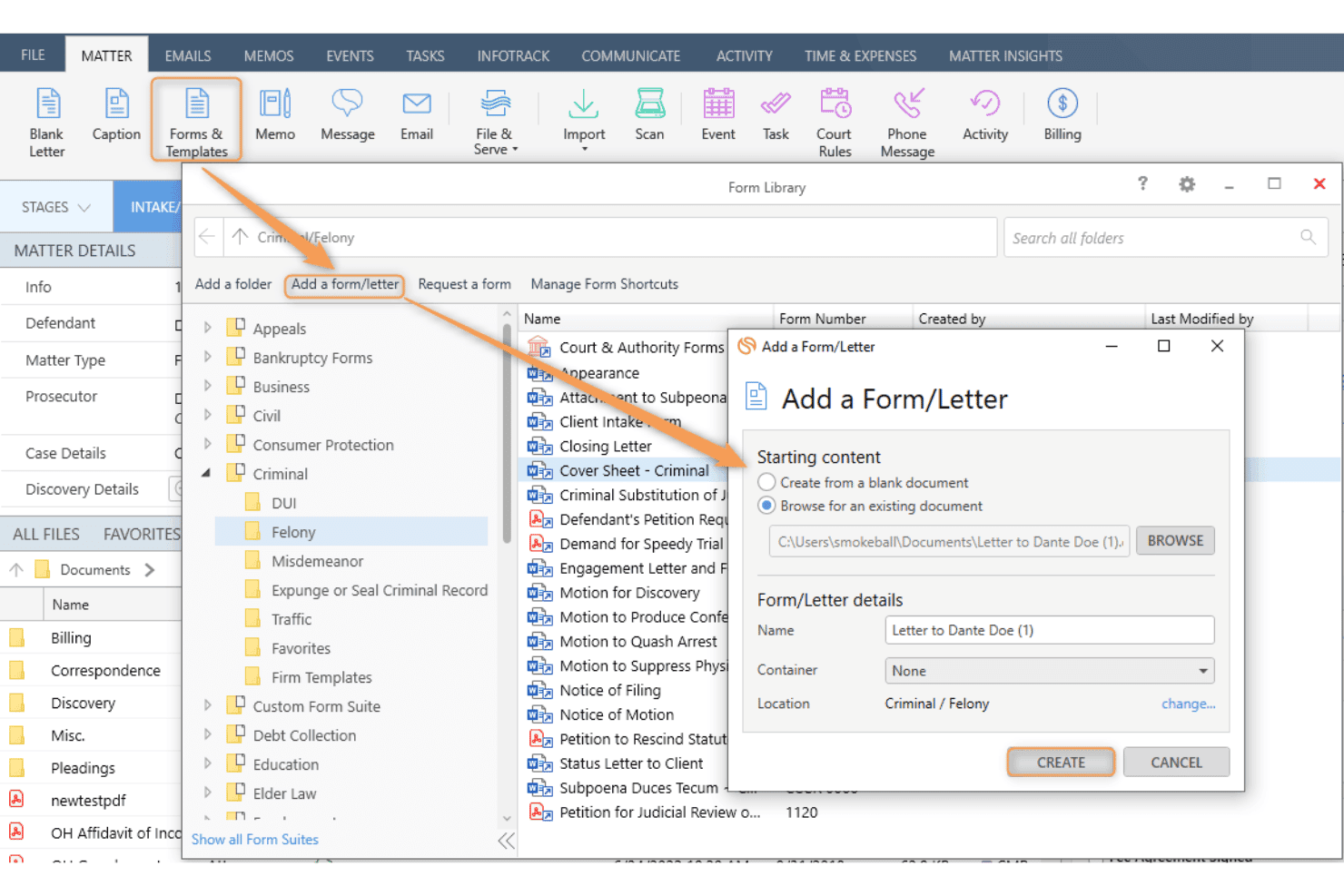
Automatically generate legal documents using templates and client data. This saves time and reduces errors in repetitive paperwork.
Time Tracking
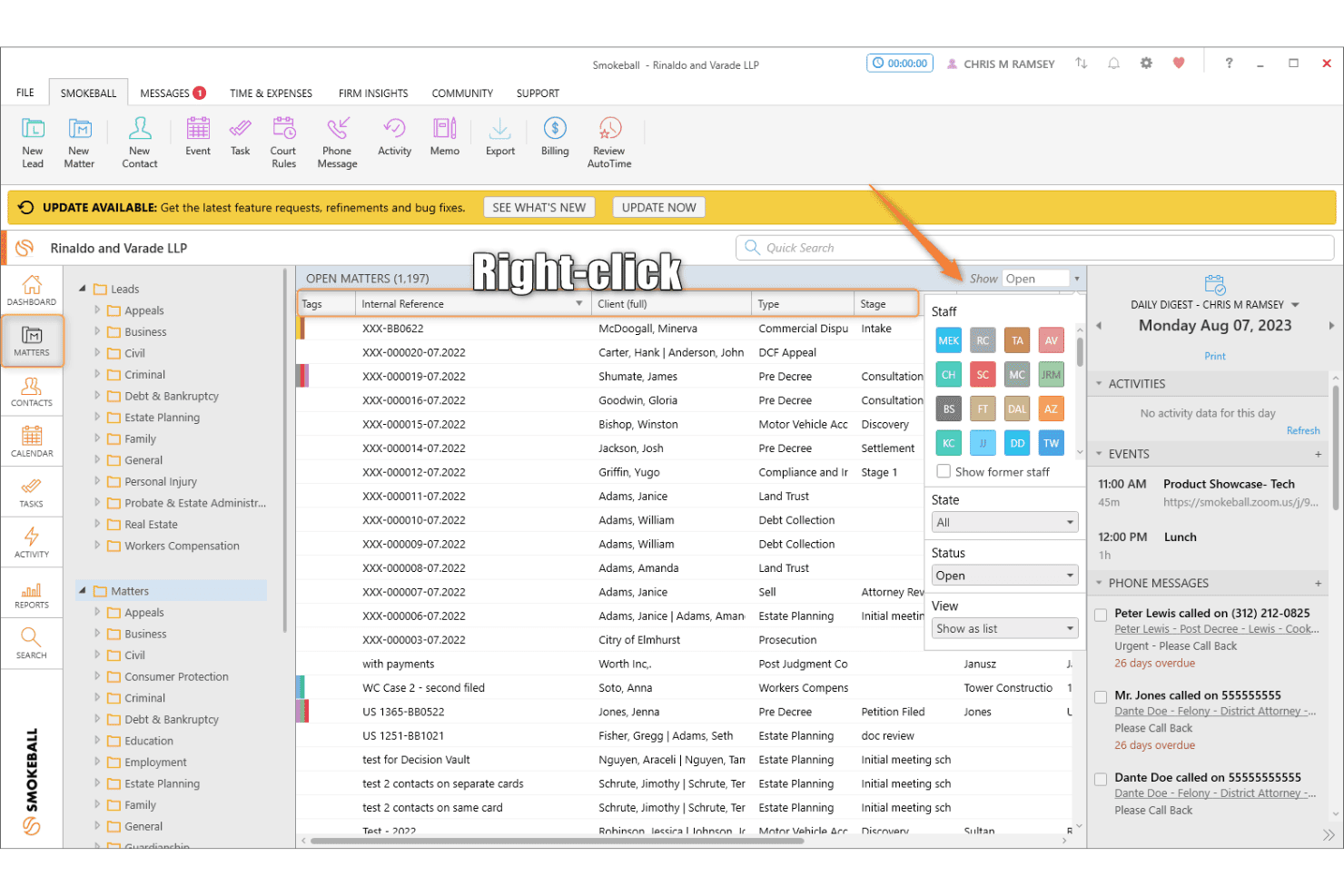
Track billable hours automatically as you work within matters. You don’t need to start or stop timers manually.
Matter Management
Organize all case details, documents, emails, and notes in one place. This centralizes information for easy access and collaboration.
Legal Forms Library
Access a wide range of pre-built legal forms for multiple practice areas. Forms are regularly updated to stay compliant with local regulations.
Billing and Invoicing
Create, send, and manage invoices directly from each matter. Built-in trust accounting helps you stay compliant with legal billing rules.
Email Integration
Sync emails directly to matters for a complete communication record. This keeps all client correspondence organized and searchable.
Ease of Use
Smokeball stands out for its clean interface and logical navigation, making it easy for new users to get started. Most features, like document automation and time tracking, are accessible with just a few clicks. Users often mention that onboarding is smooth and support is responsive when questions come up. I think the built-in help resources and guided setup make Smokeball especially approachable for small firms or solo practitioners who want to avoid a steep learning curve.
Integrations
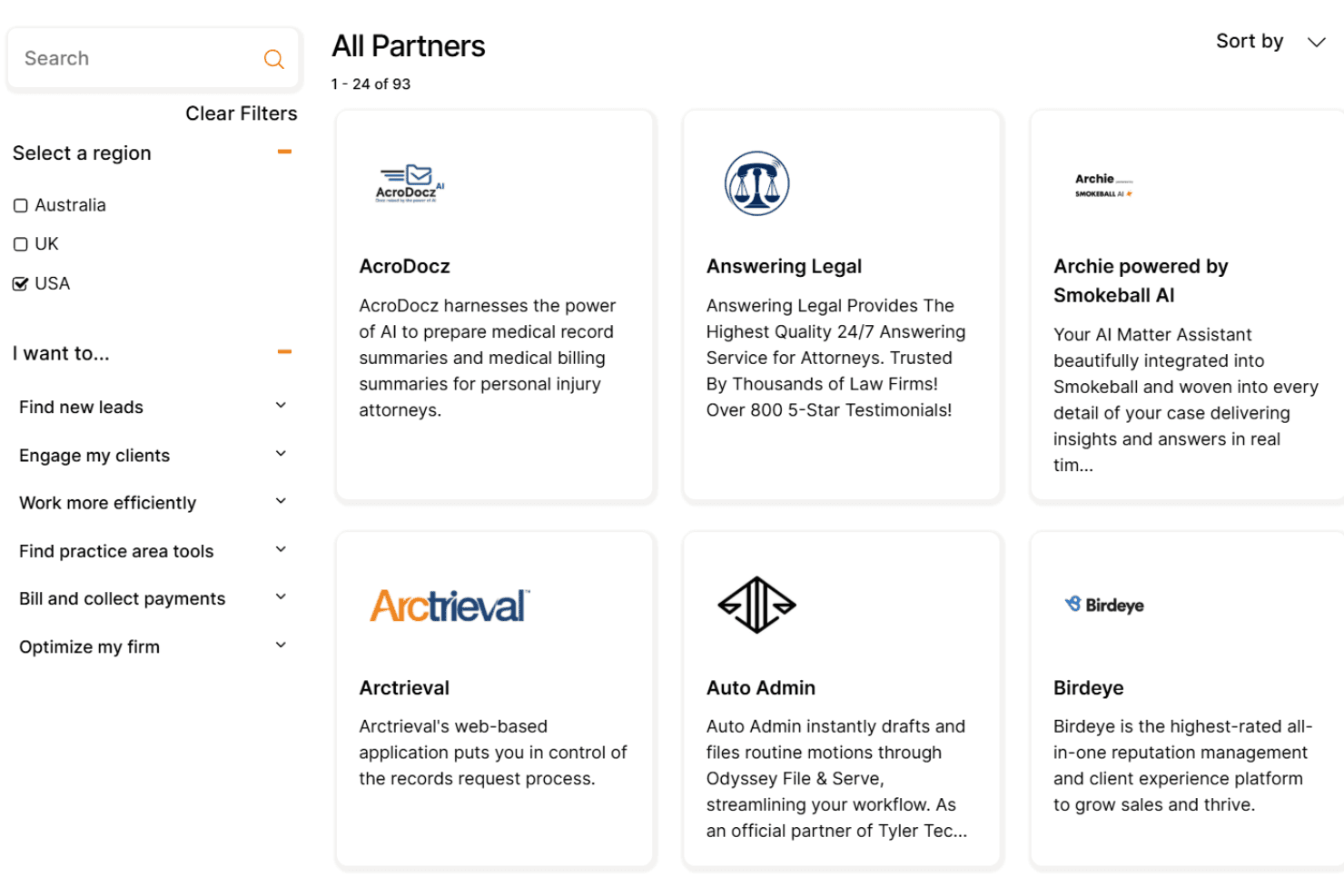
Smokeball integrates with Archie powered by Smokeball AI, Birdeye, VXT Calling & SMS, CollBox, Aatrox Communications, Accounting Logic, AcroDocz, Activa Communications - Xelion, Advisent, and AEK Media, among others.
Smokeball does not offer a public API but connects with a wide range of third-party tools through its marketplace.
Smokeball Specs
- 2-Factor Authentication: Yes
- API: Yes
- Approval Workflows: Yes
- Audit Trail: Yes
- Calendar Management: Yes
- Compliance Tracking: Yes
- Contract Management: No
- Custom Reports: Yes
- Customer Management: No
- Data Export: Yes
- Data Import: Yes
- Document Management: Yes
- External Integrations: Yes
- Multi-User: Yes
- NDA Management: No
- Notifications: Yes
- Policy Management: No
- Scheduling: Yes
- Workflow Management: Yes


