

Employer of record services act as a third-party organization that hires employees on your behalf—handling payroll, compliance, and HR administration so you can quickly enter new markets without setting up a local entity. If you’re looking for the best employer of record services, you probably need a trusted partner who understands local laws, minimizes risk, and makes global growth possible. In this list, you’ll find insider picks and head-to-head comparisons to help you choose the right platform, avoid costly mistakes, and confidently support your expanding team.
Why Trust Our Software Recommendations
6,700+
Reviews
20
Industry experts
16+
Evaluation factors
14
Years
Our team has been testing and reviewing software since 2012. As legal practice leaders ourselves, we know how difficult—and important—it is to choose the right software.
For this guide, we evaluated tools using hands-on testing and independent research, scoring tools using our selection criteria.
Our reviews reflect our human editorial judgment, not a sales pitch.
Employer of Record Services Comparison Table
This comparison table summarizes pricing details for my top Employer of Record services selections.
| Tool | Best For | Trial Info | Price | ||
|---|---|---|---|---|---|
| 1 | Best for misclassification indemnity cover | Free demo available | From $199/employee/month | Website | |
| 2 | Best for automated contract generation | Free demo available | From $599/employee/month | Website | |
| 3 | Best for automated onboarding with AI | Free demo available | From $579/user/month | Website | |
| 4 | Best for rapid local hiring support | Free demo available | From $459/employee/month (billed annually) | Website | |
| 5 | Best for dedicated onboarding guidance | Free demo available | From $399/employee/month | Website | |
| 6 | Best for one system spanning HR, payroll, and EOR | Free demo available | From $8/user/month | Website | |
| 7 | Best for in-country compliance management | Free demo available | From $599/employee/month | Website | |
| 8 | Best for direct local entity infrastructure | No free trial; demo available | From $599/employee/month | Website | |
| 9 | Best for workforce data analytics tools | Free demo available | Pricing upon request | Website | |
| 10 | Best for international workforce expansion | Free demo available | From $599/employee/month | Website |


Best Employer of Record Services Reviews
Below are my detailed summaries of the best employer of record services that made it onto my shortlist. My reviews offer a detailed look at the features, compliance capabilities, and pricing of each platform to help you find the best one for you.
 Best for misclassification indemnity cover
- Free demo available
- From $199/employee/month
Visit WebsiteCustomer Rating:4.7/5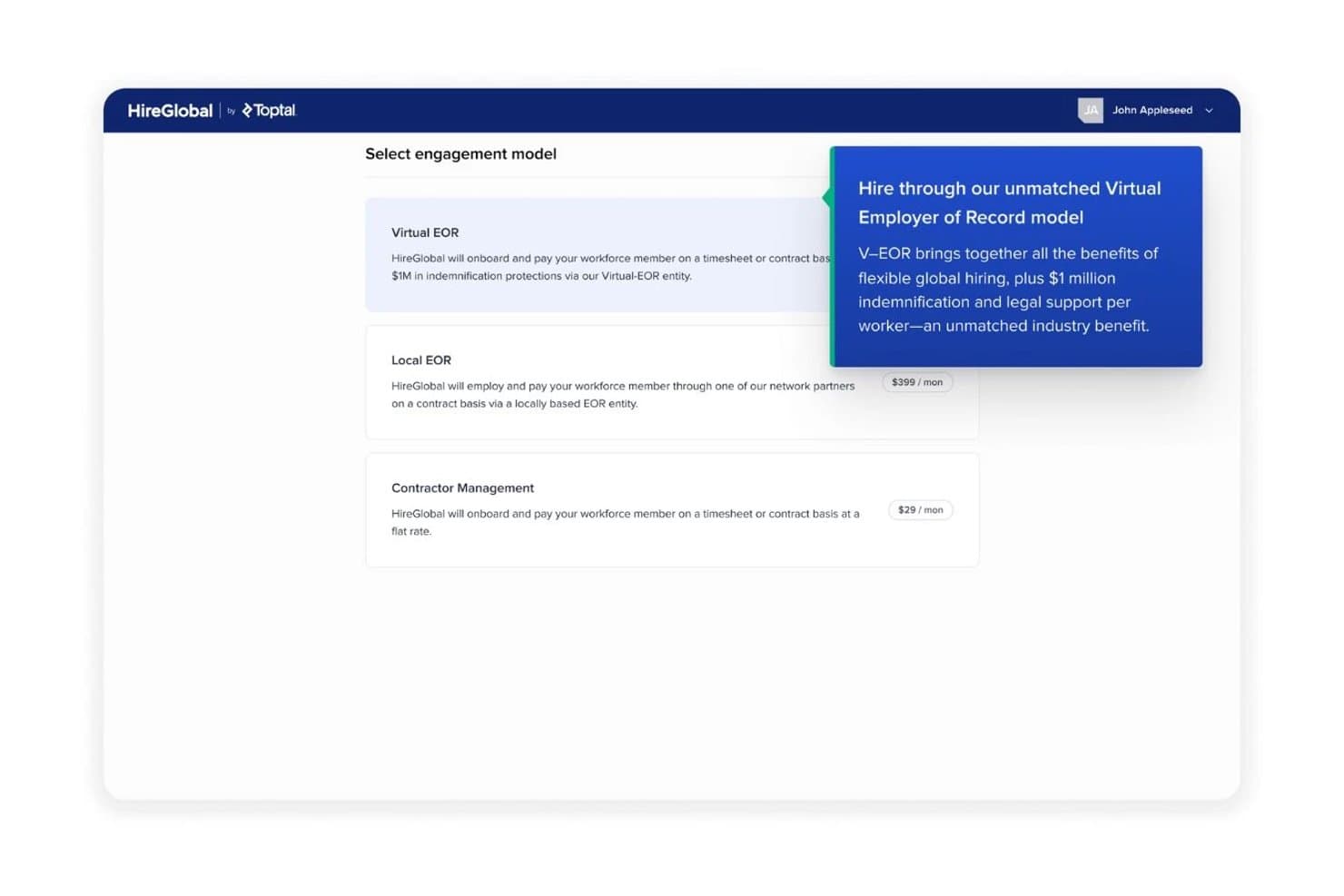
HireGlobal lets users choose between Virtual EOR, Local EOR, or Contractor Management. HireGlobal is an employer of record platform built on Toptal's global infrastructure that covers contractor management, agent of record, and full EOR employment across 180+ countries, with tiered plans that include misclassification indemnification and compliant payroll in 50+ currencies.
Who Is HireGlobal Best For?
HireGlobal is a strong fit for in-house legal teams and general counsel who need to engage global contractors or employees while keeping misclassification risk tightly controlled.
Why I Picked HireGlobal
I picked HireGlobal as one of the best because its Virtual EOR plan offers something I haven't seen matched elsewhere: $1M per-worker misclassification indemnification with legal defense included. If a contractor relationship is challenged in a foreign jurisdiction, that coverage activates automatically. Backed by 40+ in-house lawyers who proactively update contracts when local laws change, it's a genuinely strong fit for general counsel managing cross-border contingent workforces.
HireGlobal Key Features
- Tiered worker engagement models: Four distinct hiring tiers—contractor management, AOR, Virtual EOR, and full EOR—let you match each worker to the right compliance structure per jurisdiction.
- Proactive contract updates: HireGlobal's legal team monitors regulatory changes across 180+ countries and updates employment contracts automatically when local laws shift.
- Consolidated invoicing: A single invoice covers your entire global workforce, with HireGlobal distributing individual payments to workers in 50+ currencies.
- Centralized HRIS dashboard: One platform manages contracts, payroll, time and attendance, reimbursements, and compliance documentation across all worker types.
HireGlobal Integrations
HireGlobal has a documented integration with TopTracker.
Pros and Cons
Pros:
- Onboarding for employees in under five minutes
- Dedicated legal team monitors global law changes
- $1M per-worker misclassification indemnity included
Cons:
- Relies on partner network for some country coverage
- No published native integrations with HRIS systems
Learn more about HireGlobal: Best for automated contract generation
- Free demo available
- From $599/employee/month
Visit WebsiteCustomer Rating:4.9/5
Deel Hire offers a workforce dashboard with payroll, payments, and hiring tracking. Deel Hire is a global employer of record platform that handles employment contracts, payroll, tax filings, benefits administration, and compliance across 110+ countries.
Who Is Deel Hire Best For?
I'd say Deel Hire is a strong fit for fast-scaling companies hiring across multiple countries who need contract generation and compliance handled without building local legal infrastructure.
Why I Picked Deel Hire
Deel Hire is one of my top picks because I love how it handles localized employment contract generation automatically, pulling in country-specific clauses, IP protections, and statutory requirements without requiring your legal team to start from scratch for every new hire. When onboarding an employee in a new country, Deel generates a compliant contract and gets it signed in as little as one day. I also find its built-in IP protection clauses particularly valuable, since all intellectual property passes directly to the employer, which is a detail many EOR contracts leave ambiguous.
Deel Hire Key Services
- Global payroll processing: Run payroll in 150+ currencies with automatic tax calculations and local payment disbursements.
- Benefits administration: Manage country-specific statutory benefits, including health insurance, pension contributions, and mandatory leave entitlements.
- Compliance monitoring: Receive automatic updates when local labor laws change, keeping employment arrangements aligned with current regulations.
- Expense management: Employees submit expenses directly in the platform, with reimbursements processed through the same payroll cycle.
Deel Hire Integrations
Deel offers integrations with QuickBooks, Xero, BambooHR, Expensify, NetSuite, Sage Intacct, Greenhouse, Workday, SAP, and ADP. An API is also available for connecting Deel to your existing HRIS, finance, and ERP systems.
Pros and Cons
Pros:
- Supports 15+ employee payment methods
- Localized contracts auto-update with law changes
- Owns 250+ entities across 100+ countries
Cons:
- Fee itemization can lack transparency
- Support response slows during high-volume periods
Learn more about Deel Hire: Best for automated onboarding with AI
- Free demo available
- From $579/user/month
Visit WebsiteCustomer Rating:4.9/5
Borderless AI offers a global hiring dashboard with onboarding and employee tracking. Borderless AI is an AI-native employer of record platform that handles international hiring, contract generation, payroll, benefits administration, and compliance across 170+ countries, without requiring a foreign entity setup.
Who Is Borderless AI Best For?
Borderless AI is a strong fit for fast-growing tech companies that need to hire international employees quickly without building out a global legal entity structure.
Why I Picked Borderless AI
I picked Borderless AI as one of the best because of how far it pushes AI into the actual hiring workflow. The AI-powered Contract Generator produces locally compliant employment contracts in under five minutes, without waiting on legal review or local counsel. On top of that, HRGPT lets HR teams get instant answers to country-specific employment questions directly in the platform. For teams onboarding across multiple countries at once, that combination cuts days of back-and-forth out of the process.
Borderless AI Key Services
- Compensation Checker: Monitor market salary trends and benchmark compensation by role and country directly in the platform
- Flexible payroll workflows: Configure approval flows, payment schedules, and pay policies without custom development or manual workarounds
- Multi-currency payroll: Run payroll in local currencies across 170+ countries, with built-in statutory deductions and country-specific tax compliance
- Dedicated in-house support: Every client gets a named point of contact based in Canada, available around the clock with no tiered support queues
Borderless AI Integrations
Borderless AI is live on the ADP Workforce Now Marketplace in both the U.S. and Canada, with BambooHR and Greenhouse also referenced as active integrations. An open API is available for custom connections.
Pros and Cons
Pros:
- Dedicated named support contact assigned
- No upfront payroll deposits required
- AI-generated contracts speed up onboarding
Cons:
- Fewer third-party integrations than competitors
- Reporting and analytics are basic
Learn more about Borderless AI: Best for rapid local hiring support
- Free demo available
- From $459/employee/month (billed annually)
Visit WebsiteCustomer Rating:4.7/5
Multiplier offers an onboarding dashboard for hiring EOR employees and contractors. Multiplier is an employer of record platform that lets you hire, onboard, and pay employees across 150+ countries, with locally compliant contracts, multi-currency payroll, and benefits administration built into a single platform.
Who Is Multiplier Best For?
Multiplier is a strong fit for HR and people ops teams at growth-stage companies that are hiring across multiple countries at the same time.
Why I Picked Multiplier
I picked Multiplier as one of the best because its end-to-end hiring workflow is built for speed. I like that you can generate a locally compliant offer letter, trigger onboarding tasks, and auto-enroll a new hire in statutory benefits without leaving the platform. Multiplier also assigns a dedicated in-country specialist to each hire, so local compliance questions get answered before they slow things down.
Multiplier Key Services
- Contractor management: Classify, onboard, and pay independent contractors in 150+ countries, with built-in misclassification risk checks to flag potential compliance issues.
- Country hiring guides: Access jurisdiction-specific hiring guides that outline local labor laws, notice periods, and mandatory entitlements before you hire.
- Equity and stock option management: Set up and manage stock option plans for international employees, with local tax treatment factored in by country.
- Document repository: Store and retrieve employment contracts, addenda, and policy acknowledgments for every employee in a centralized, searchable records system.
Multiplier Integrations
Multiplier offers native integrations with BambooHR, Greenhouse, and Workday, which covers the core HRIS and ATS connections. An API is also available for custom integrations.
Pros and Cons
Pros:
- No setup or offboarding fees charged
- Strong Asia-Pacific regional hiring support
- Same-day onboarding in 150+ countries
Cons:
- Offboarding disputes resolve slowly via partners
- Self-serve reporting lacks data depth
Learn more about Multiplier: 5Best for dedicated onboarding guidance
Pebl
- Free demo available
- From $399/employee/month
Visit WebsiteCustomer Rating:4.6/5
Pebl offers a global payroll dashboard with payroll items and approval tracking. Pebl is an employer of record platform that handles compliant hiring, employment contract generation, payroll, benefits administration, and employee onboarding across 180+ countries without requiring local entity setup.
Who Is Pebl Best For?
Pebl works well for HR and legal operations teams at companies that need to hire across multiple new markets without the administrative burden of establishing local legal entities.
Why I Picked Pebl
I've included Pebl in my top picks because its dedicated onboarding guidance is genuinely structured, not just a checklist. The G-P EOR Prime package includes a dedicated customer success manager, quarterly account reviews, and direct access to G-P's HR and legal teams during onboarding. I also like that the AI-guided onboarding flow auto-generates locally compliant contracts in seconds, so new hires in markets like Japan or Brazil don't get stuck waiting on manual legal review.
Pebl Key Services
- Multi-currency payroll processing: Run payroll in 150+ currencies with built-in tax calculations and local statutory deductions handled automatically.
- G-P Assist: Get real-time answers to HR, payroll, and employment law questions across 180+ countries directly inside the platform.
- Benefits benchmarking: Compare your compensation packages against local market standards before finalizing offers in a new country.
- Workforce analytics dashboard: Track headcount, payroll spend, and HR activity across all active countries from a single view.
Pebl Integrations
Pebl offers native integrations with ADP Workforce Now, BambooHR, HiBob, and UKG Pro, with additional native integrations for Workday. It also provides an API for custom integrations.
Pros and Cons
Pros:
- AI assistant answers queries in 50+ languages
- Visa and work permit processing included
- Dedicated account managers with in-country expertise
Cons:
- Occasional dashboard bugs affect data entry
- Onboarding delays in complex hiring scenarios
Learn more about Pebl: Best for one system spanning HR, payroll, and EOR
- Free demo available
- From $8/user/month
Visit WebsiteCustomer Rating:4.9/5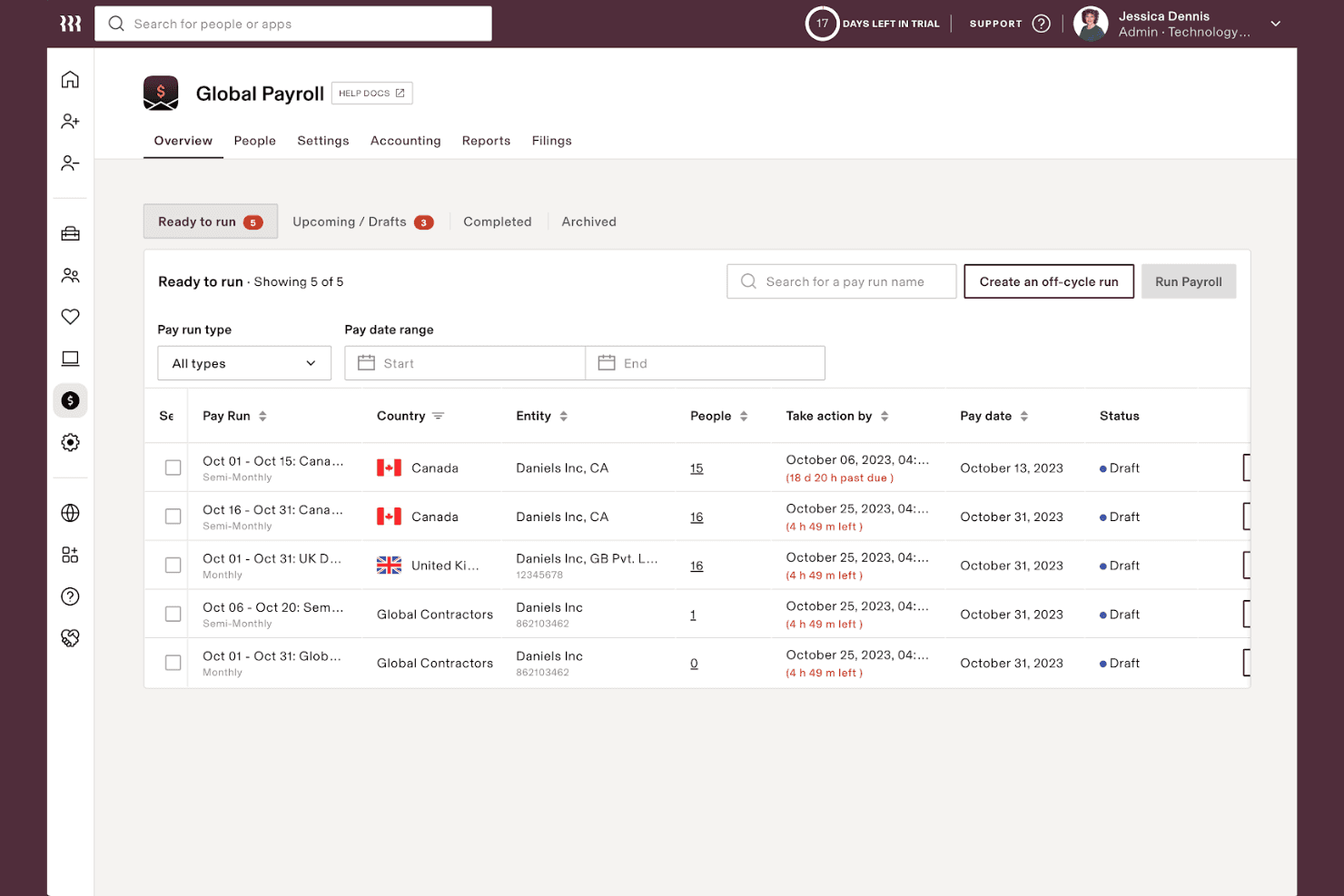
Rippling lets users manage global payroll runs across multiple countries and entities. Rippling is an employer of record platform that combines global hiring, multi-country payroll, contractor management, and HR administration in a single unified system.
Who Is Rippling Best For?
Rippling suits legal operations directors and HR managers who need to hire, pay, and manage a mix of employees and contract attorneys across multiple countries from a single platform.
Why I Picked Rippling
Rippling earns its spot on my shortlist because it's the only platform where EOR, payroll, and HR genuinely live in one system rather than being bolted together. I particularly like the Misclassification Risk Analyzer, which flags whether contract attorneys or paralegals should be reclassified before it becomes a legal problem. When a contractor converts to an employee, their full history carries over automatically, and payroll runs in-house with lead times as short as five days.
Rippling Key Features
- Misclassification Risk Analyzer: Flags whether global workers are correctly classified as employees or contractors before it creates a legal liability.
- Automated tax filing: Calculates and files taxes across countries automatically, with payroll data syncing directly to your general ledger.
- Localized employment contracts: Generates country-specific agreements reviewed by in-country legal and HR experts with 10+ years of local experience.
- Contractor of Record (COR): A dedicated product for engaging contractors in a way that reduces misclassification exposure across jurisdictions.
Rippling Integrations
Rippling integrates payroll and expenses with the general ledger and connects with Sequoia for benefits. Custom apps and workflow automation are available, while specific accounting connectors and API details aren’t publicly confirmed.
Pros and Cons
Pros:
- Automated classification checks reduce legal exposure
- Contractor conversion preserves worker history
- Payroll users report smooth global runs
Cons:
- Supplemental benefits vary by country
- EOR country coverage remains unclear
Learn more about Rippling: Best for in-country compliance management
- Free demo available
- From $599/employee/month
Visit WebsiteCustomer Rating:4.6/5
Remote offers an HR dashboard with headcount, payroll tasks, and team insights. Remote is an employer of record platform that owns 100% of its legal entities across 90+ countries, covering global payroll, localized contract generation, benefits administration, compliance monitoring, and full employee lifecycle management in a single platform.
Who Is Remote Best For?
Remote is a strong fit for mid-size companies hiring across multiple jurisdictions who need a single EOR with fully owned local entities and no third-party intermediaries.
Why I Picked Remote
Remote earns its spot on my shortlist because of Compliance Watchtower, a feature I find genuinely impressive. It monitors labor law changes across 90+ countries in real time, surfaces actionable updates directly in the platform, and is managed by Remote's in-house legal team. I also like that Remote offers unlimited indemnity coverage with no caps, which is rare in this space and meaningful when hiring across multiple jurisdictions where compliance exposure can be unpredictable.
Remote Key Services
- Global payroll processing: Run payroll in local currencies across 90+ countries, with tax calculations and payments handled directly by Remote's owned entities.
- IP Guard: Protects your company's intellectual property when hiring internationally by ensuring ownership stays with your business, not the employee.
- Benefits administration: Configure country-specific benefits packages, including statutory minimums and supplemental options like health insurance and pension.
- Contractor management: Onboard, pay, and manage contractors alongside full-time employees within the same platform.
Remote Integrations
Remote offers native integrations with BambooHR, Greenhouse, HiBob, Personio, Workday, QuickBooks, NetSuite, Xero, Gusto, and Slack. It also connects with tools via Zapier and provides an API for building custom integrations to sync employee and contractor data between Remote and your HR tools of choice.
Pros and Cons
Pros:
- In-house legal team handles terminations directly
- IP protection addendum in every contract
- Equity and stock option administration included
Cons:
- Limited flexibility for custom pay structures
- Country coverage narrower than top competitors
Learn more about Remote: Best for direct local entity infrastructure
- No free trial; demo available
- From $599/employee/month
Visit WebsiteCustomer Rating:4.6/5
Atlas HXM offers a global payroll dashboard with payroll and invoice tracking. Atlas HXM is an employer of record platform that hires, onboards, and pays workers in 160+ countries through its own direct legal entities, covering contracts, payroll, and compliance without third-party partners.
Who Is Atlas HXM Best For?
Atlas HXM suits legal and HR teams at mid-size to enterprise companies managing employment compliance across a high volume of international jurisdictions.
Why I Picked Atlas HXM
Atlas HXM earns its spot on my shortlist because I rate its owned-entity model above any other EOR I've reviewed. My team can issue country-specific employment contracts and run payroll in local currency without a third-party intermediary in the chain. I also like that Atlas HXM's in-country compliance teams handle statutory updates directly, so there's no lag between a regulatory change and our actual employment practices.
Atlas HXM Key Services
- Immigration and work permit support: Manages visa applications, work permit renewals, and country-specific immigration requirements for international hires.
- Contractor-to-employee conversion: Converts existing contractor relationships into compliant employment arrangements without starting the hiring process from scratch.
- IP and confidentiality agreement management: Generates locally enforceable intellectual property and non-disclosure agreements as part of the employment contract package.
- Employee self-service portal: Gives employees direct access to their contracts, payslips, and personal HR records in one place.
Atlas HXM Integrations
Native integrations are not currently listed.
Pros and Cons
Pros:
- Onboards international employees within days
- Visa sponsorship in 100 countries available
- Owns entities in 160+ countries directly
Cons:
- Contractor management tools feel underdeveloped
- Premium pricing versus budget EOR providers
Learn more about Atlas HXM: Best for workforce data analytics tools
- Free demo available
- Pricing upon request
Visit WebsiteCustomer Rating:4.3/5
Safeguard Global offers a compensation dashboard with salary and pay details. Safeguard Global is an employer of record platform covering hiring, onboarding, payroll, and compliance across 187 countries, with a built-in analytics layer that surfaces real-time workforce spend and labor cost data.
Who Is Safeguard Global Best For?
Safeguard Global is a strong fit for enterprise organizations managing large, distributed international workforces where payroll spend visibility and labor cost reporting are core priorities.
Why I Picked Safeguard Global
I picked Safeguard Global as one of the best because its analytics layer goes deeper than most EOR platforms I've used. The spend analytics dashboard breaks down labor costs, payroll tax amounts, and turnover rate by country, currency, and contract type in real time. I also like the Global Workforce Analytics tool, which lets you compare salaries by role, level, and country before you even make a hire, which is useful for planning headcount budgets across multiple markets.
Safeguard Global Key Services
- Multi-currency payroll processing: Run payroll in local currencies across 187 countries from a single platform, with automatic currency conversion.
- Compliance monitoring: Tracks in-country labor law changes and flags contract or payroll updates required to stay compliant.
- Benefits administration: Manages statutory and supplemental employee benefits by country, including health insurance and pension enrollment.
- Employee self-service portal: Gives workers direct access to pay stubs, tax documents, and employment records without routing requests through HR.
Safeguard Global Integrations
Safeguard Global currently integrates with Workday, through its Global Payroll Connect suite of five API-driven payroll integrations. An API is also available for custom integrations as part of their partner program.
Pros and Cons
Pros:
- Covers 187 countries from one platform
- Combines EOR and managed payroll services
- Real-time spend analytics by country and currency
Cons:
- Support response times can be inconsistent
- Frequent invoicing errors reported by users
Learn more about Safeguard Global: 10Best for international workforce expansion
G-P
- Free demo available
- From $599/employee/month
Visit WebsiteCustomer Rating:4.5/5
G-P offers a global workforce dashboard with payroll, invoices, and team insights. G-P is an EOR platform covering 180+ countries, with a proprietary Global Compliance Engine that automates employment contracts, payroll, onboarding, and offboarding across local labor laws.
Who Is G-P Best For?
G-P is a strong fit for enterprise HR and legal teams managing rapid headcount growth across multiple new countries simultaneously.
Why I Picked G-P
I've included G-P in my top picks because no EOR on the market handles multi-country expansion with this level of built-in legal infrastructure. I'm particularly impressed by the proprietary Global Compliance Engine, which digitizes local labor laws across 180+ countries and automatically validates contracts, payroll, and onboarding at every step. I also like the AI-guided onboarding flow, which takes you from offer letter to compliant hire in minutes rather than days. The contractor conversion feature is another standout, letting you reclassify contractors to full-time employees across countries without separate legal coordination.
G-P Key Services
- Local benefits benchmarking: Browse and apply country-specific benefits packages that align with local market standards and statutory requirements.
- Multi-currency payroll processing: Run accurate payroll across 150+ currencies without manual calculations or currency conversion overhead.
- G-P Assist: An AI tool that answers HR, employment, and payroll questions in real time across 180+ countries inside the platform.
- Custom reporting and analytics: Build and export custom reports on workforce and HR data, with real-time operational insights across your global headcount.
G-P Integrations
G-P offers native integrations with ADP TotalSource, ADP Workforce Now, Paylocity, BambooHR, HiBob, Personio, SAP SuccessFactors, SAP BTP, TriNet, UKG Pro, UKG Ready, and Workday. It also integrates with Google Workspace, Microsoft Entra ID, and Okta/Auth0 for identity management and SSO, and provides an API for custom integrations.
Pros and Cons
Pros:
- AI-powered HR compliance advisor (G-P Gia)
- Deep in-country legal and compliance expertise
- Wholly owned legal entities in 180+ countries
Cons:
- Onboarding slower than newer EOR platforms
- Premium pricing above most EOR competitors
Learn more about G-P:
Other Employer of Record Services
Here are some additional employer of record services options that didn’t make it onto my shortlist, but are still worth checking out:
- 11Papaya GlobalBest for managing multi-currency payroll
- 12Oyster HRBest for equity tracking across global hires
- 13RemoFirstBest for flat-rate global coverage
- 14RivermateBest for customizable agreement templates
- 15FoxHireBest for staffing agency partnership support
- 16PlaneBest for onboarding global teams quickly
- 17Payoneer Workforce ManagementBest for contractor management tools
- 18WorkMotionBest for automated global hiring compliance
- 19Remote PeopleBest for integrated recruiting support
- 20Global ExpansionBest for region-specific payroll expertise
How I Evaluate Employer of Record Services
For legal teams hiring across borders, I evaluate EOR platforms in two layers: core compliance and payroll requirements, and the differentiators that separate one vendor from another.
Core Functionality (Table Stakes For This List)
When I'm selecting tools for my list, I rank each one on a scale from 0 (does not offer the functionality) to 5 (excels in this area) for each core functionality listed below. Then, I calculate the tool's total score into a percentage. Each tool needs to achieve a minimum total score of 65% to be considered for inclusion.
- Global employment coverage: I check whether the provider can hire through its own entities or partners in enough countries to match a firm's expansion plans.
- Compliance management: Each vendor should localize contracts and track regulatory changes, like updates to termination rules or statutory notice periods.
- Multi-country payroll: I evaluate whether payroll runs in local currencies with accurate tax withholdings and statutory contributions for each hire's jurisdiction.
- Benefits administration: Packages should go beyond statutory minimums, covering health insurance, pensions, and supplemental options relevant to each country.
- Onboarding and contracts: The platform should generate jurisdiction-specific agreements, handle e-signatures, and store documents in one place for easy retrieval.
- Worker classification support: I look for tools that assess whether a hire qualifies as a contractor or employee and support conversion when the relationship shifts.
Once I have a list of tools that meet this criteria, I consider what sets each platform apart.
Differentiating Factors (What Sets Vendors Apart)
Here's how I compare and contrast different vendors:
Standout Features
Contractor conversion workflows matter when your firm regularly engages contract attorneys who may need to shift to full-time roles as misclassification risk grows. I also evaluate whether a provider operates through its own legal entities or relies on third-party partners, since owned entities typically mean faster onboarding and more direct compliance oversight. Immigration and visa support is another differentiator—providers with in-house mobility teams can handle work permits and sponsorship without requiring you to coordinate separately.
Beyond Features
Compliance and risk liability is where I spend the most time. I check whether the provider assumes legal liability for employment disputes, termination procedures, and IP assignment—details that matter when your firm has attorneys working on sensitive client matters across borders. Pricing transparency is another factor I evaluate closely, since some providers bundle FX markups or severance accruals into costs that aren't obvious upfront. Integration fit also counts; a provider with native HRIS and accounting connectors saves your ops team from manual data reconciliation each pay cycle.
How to Choose Employer of Record Services
It’s easy to get bogged down in long feature lists and complex pricing structures. To help you stay focused as you work through your unique software selection process, here’s a checklist of factors to keep in mind:
| Factor | What to Consider |
|---|---|
| FactorScalability | What to ConsiderWill the service support your firm’s headcount and geographic expansion targets, or require changing providers later? |
| FactorIntegrations | What to ConsiderDoes the EOR connect with your HRIS, payroll, or accounting platforms, or will your team need to manage data manually? |
| FactorEase of use | What to ConsiderCan HR or operations managers onboard, approve, and support remote staff with minimal training and few administrative steps? |
| FactorImplementation and onboarding | What to ConsiderHow long does it take from sign-up to first employee onboarded, and who’s responsible for onboarding steps—your firm or the provider? |
| FactorCost | What to ConsiderAre there hidden fees for onboarding, FX, or offboarding? Is pricing transparent enough to compare across competitors? |
| FactorSecurity safeguards | What to ConsiderDoes the vendor provide clear data protection standards and compliance certifications for handling sensitive legal or payroll data? |
| FactorCompliance requirements | What to ConsiderCan the EOR keep all employee records, payroll, and benefits in line with every region’s legal requirements? |
| FactorSupport availability | What to ConsiderIs help available in relevant time zones and languages? How quickly can issues be escalated and resolved for urgent payroll or legal needs? |
What Are Employer of Record Services?
Employer of record services are third-party providers that act as the legal employer for workers on your behalf, handling employment contracts, payroll, taxes, and compliance in each jurisdiction. These services let you hire and manage staff in new countries without creating your own legal entity, while reducing risk around misclassification and local labor law violations.
Employer of Record vs Setting Up a Legal Entity
One of the first decisions you’ll make when hiring internationally is whether to use an employer of record (EOR) or establish your own legal entity. Both approaches let you hire employees abroad, but they involve very different legal responsibilities, costs, and long-term commitments. Organizations that opt to establish entities in multiple countries often adopt the best legal entity management software to help manage corporate records, governance, and ongoing compliance. Here are the key differences between using an Employer of Record and setting up a legal entity:
| Features | Employer of Record (EOR) | Legal Entity Setup |
|---|---|---|
| Features Setup time | Employer of Record (EOR)Hiring can begin in a few days once onboarding is complete. | Legal Entity SetupEntity setup can take several weeks, including registration and bank account setup. |
| FeaturesUpfront Cost | Employer of Record (EOR)No entity setup costs; pricing is typically per employee. | Legal Entity SetupHigher initial costs for registration, legal support, and administration. |
| FeaturesOngoing Costs | Employer of Record (EOR)Predictable monthly fee per employee. | Legal Entity SetupLower per-employee cost at scale, but ongoing admin and compliance expenses. |
| FeaturesCompliance & liability | Employer of Record (EOR)EOR manages payroll, taxes, and employment compliance. | Legal Entity SetupFull responsibility for compliance, tax filings, and legal risk. |
| FeaturesPayroll & tax management | Employer of Record (EOR)Fully managed, including filings and statutory contributions. | Legal Entity SetupRequires internal resources or local providers to manage payroll. |
| FeaturesFlexibility | Employer of Record (EOR)Easier to enter or exit the market. | Legal Entity SetupEntity closure can be time-consuming and costly. |
| FeaturesControl & customization | Employer of Record (EOR)Limited control over contracts and benefits structures. | Legal Entity SetupFull control over employment terms, policies, and benefits. |
| FeaturesBest use case | Employer of Record (EOR)Short-term hiring, market testing, or small teams. | Legal Entity SetupLong-term expansion with a larger, established presence. |
What Legal Teams Should Consider Before Choosing an EOR
An employer of record becomes part of your employment and compliance framework, so it’s worth looking beyond pricing and country coverage. Before selecting a provider, I’d review how it manages legal responsibilities, employment obligations, and compliance across every market where you plan to hire.
- Entity Ownership: Confirm whether the provider owns legal entities in the countries where you plan to hire or relies on in-country partners. This affects visibility, consistency, and how employment issues are managed.
- Employment Contracts: Review how employment agreements are prepared and maintained. Contracts should reflect local labor laws while protecting your business’s confidential information and intellectual property.
- Compliance Support: Ask how the provider keeps employment contracts, payroll, statutory benefits, and local employment practices aligned with changing regulations.
- Data Protection: Employees’ personal and payroll data often moves across borders. Make sure the provider has clear processes for handling sensitive information and meeting applicable data protection requirements.
- Termination Process: Understand how the provider manages employee terminations, including notice requirements, final payments, and country-specific employment obligations.
- Country Coverage: Verify that the provider supports the countries where you plan to hire today and has the infrastructure to support future expansion.
Questions to Ask an EOR Provider Before You Sign
Before you sign an agreement, make sure you’ve covered the questions below. The answers will help you understand how the provider manages legal responsibilities, compliance, and ongoing support.
| ✓ | Question | Why It Matters |
|---|---|---|
| ✓✓ | QuestionDo you own legal entities in every country where we plan to hire? | Why It MattersSome providers operate through local partners, which can affect consistency and issue resolution. |
| ✓✓ | QuestionWho is responsible for employment contracts and terminations? | Why It MattersClarifies how employment obligations are divided between your business and the EOR. |
| ✓✓ | QuestionHow do you keep contracts and payroll compliant with local employment laws? | Why It MattersHelps you understand how regulatory changes are monitored and implemented. |
| ✓✓ | QuestionHow do you protect employee and payroll data? | Why It MattersPayroll data often crosses borders, making data governance an important consideration. |
| ✓✓ | QuestionHow do you handle employment disputes or compliance issues? | Why It MattersSets expectations for the provider’s role if legal or employee matters arise. |
| ✓✓ | QuestionWhat happens if we expand into additional countries? | Why It MattersConfirms whether the provider can support your future hiring plans without changing platforms. |
| ✓✓ | QuestionAre there additional fees for onboarding, country expansion, or offboarding? | Why It MattersGives you a clearer picture of the total cost beyond the base subscription. |
Understanding EOR Liability
Using an employer of record doesn’t transfer every legal responsibility to the provider. The EOR becomes the legal employer for local employment purposes, but your business continues to direct the employee’s day-to-day work and remains responsible for business decisions that affect the role.
When evaluating an EOR, it’s worth understanding how responsibilities are typically shared:
- The EOR manages employment administration, including locally compliant employment contracts, payroll, statutory contributions, and mandatory benefits.
- Your business manages the working relationship, including hiring decisions, day-to-day supervision, performance management, and setting business objectives.
- Employment decisions are often collaborative. While your business decides when to hire or terminate an employee, the EOR helps ensure those actions comply with local employment laws.
- The service agreement matters. Responsibility for compliance, dispute management, and other legal obligations can vary between providers, so review the contract carefully before signing.
The goal isn’t to shift every legal obligation to the EOR. It’s to clearly define who is responsible for what, so your business can expand internationally with fewer compliance surprises.
Features of Employer of Record Services
When selecting employer of record services, keep an eye out for the following key features:
- Global employment coverage: Legally employs workers in multiple countries without the need for your own entity, offering flexibility for cross-border hiring.
- Localized compliance management: Keeps employment contracts, payroll, and benefits compliant with local laws, reducing risk for your firm.
- Multi-country payroll processing: Runs payroll in local currencies, manages tax withholdings, and ensures employees are paid accurately and on time.
- Benefits administration: Provides access to country-appropriate health insurance, pensions, and statutory leave to attract and retain talent.
- Onboarding and contract generation: Creates compliant employment agreements and digitizes onboarding workflows for remote hires.
- Worker classification support: Assesses and helps manage the risk of contractor misclassification to maintain legal compliance.
- Expense and time tracking: Enables employees to log expenses and working hours within the platform for streamlined approval and reimbursement.
- Self-serve employee portal: Allows team members to access pay slips, update personal records, and manage benefits from anywhere.
- Data security controls: Protects sensitive HR and payroll data through robust encryption, user permissions, and privacy safeguards.
Benefits of Employer of Record Services
Implementing employer of record services provides several benefits for your team and your business. Here are a few you can look forward to:
- Simplified global hiring: Quickly employ staff in new countries without setting up foreign legal entities.
- Reduced compliance risk: Stay updated with local labor laws, payroll, and tax regulations through expert-driven platform compliance features.
- Faster onboarding: Digitized contract generation and onboarding workflows speed up the process for legal and support staff across borders.
- Accessible benefits management: Offer competitive, locally compliant benefits without navigating unfamiliar insurance or pension providers.
- Accurate multi-country payroll: Ensure timely, compliant payments to employees in multiple currencies with proper tax withholdings.
- Misclassification protection: Receive worker classification support to help mitigate the risks associated with contractor misclassification.
- Centralized employee data: Store contracts, payroll, and onboarding documents securely in one platform, supporting efficient operations and audit-readiness.
Costs and Pricing of Employer of Record Services
Selecting employer of record services requires an understanding of the various pricing models and plans available. Costs vary based on features, team size, add-ons, and more. The table below summarizes common plans, their average prices, and typical features included in employer of record services solutions:
Plan Comparison Table for Employer of Record Services
| Plan Type | Average Price | Common Features |
|---|---|---|
| Plan TypeFree Plan | Average Price$0 | Common FeaturesProvides limited access for trials, includes contract templates, sample workflows, and basic compliance resources. |
| Plan TypePersonal Plan | Average Price$250-$500/employee/month | Common FeaturesOffers global employment in select countries, payroll processing, contract management, and basic support. |
| Plan TypeBusiness Plan | Average Price$500-$700/employee/month | Common FeaturesCovers multi-country hiring, full compliance services, local benefits management, employee onboarding, and integrations. |
| Plan TypeEnterprise Plan | Average Price$700+/employee/month | Common FeaturesIncludes advanced compliance, custom integrations, dedicated account management, immigration support, and tailored reporting. |
Employer of Record Services FAQs
Here are some answers to common questions about employer of record services:
How does an employer of record help with compliance?
An employer of record assumes responsibility for employment contracts, payroll, tax withholdings, and statutory benefits. They stay updated on changing local laws to minimize risk and prevent compliance lapses that could expose your firm to legal or financial penalties.
Can I use an employer of record to hire in any country?
No, coverage depends on the provider’s network of owned entities and partners. Always confirm which countries are supported directly and which rely on third-party aggregators, as this can affect onboarding speed, costs, and compliance oversight.
How quickly can employees be onboarded through an EOR?
Onboarding timelines vary by provider and country, but typically range from one to three weeks. Document verification, background checks, and specific country regulations may influence timelines, so it’s important to set realistic expectations with your team and new hires.
Who handles employment disputes or terminations?
Most EOR providers manage termination processes and employment disputes in line with local laws. They draft compliant agreements, guide severance, and help ensure all legal obligations are met, shielding your business from direct legal exposure in foreign jurisdictions.
Are employee benefits included with EOR services?
Yes, most EORs administer locally compliant benefits such as health insurance, pensions, and paid leave. Always ask what benefit options are available by country, as offerings often vary and may require your involvement in plan selection or funding.
How does an EOR handle IP transfer upon termination?
EOR platforms include IP assignment clauses in employment contracts so any software, code, or related work created by the employee is owned by your company. When the employee leaves, the platform helps ensure all code, access, and assets are securely transferred and compliant with local laws.